
You Have No Idea How Far Behind Tesla Is
The leapfrog moment has just happened.

Tesla had the biggest head start in the EV market. The Model S launched in 2012, and it took six years for legacy automakers to offer anything that could even try to compete with it. Even then, Tesla’s charging network was light-years ahead of what anyone else was offering. Likewise, when the Model 3 launched in 2017, it had no genuine competition for over three years. At the turn of the decade, it looked like Tesla would extend this lead with new models and the ‘revolutionary’ 4680 battery. But that simply hasn’t happened, and now Tesla’s sales are crashing as every single one of their competitors now offers comparable or slightly better EV options. But the leapfrog moment has just happened. BYD have just annouced their 1,500 kW-capable Blade Battery 2.0 and the stupidly affordable EV it is going into. Now it is Tesla who is playing catch-up. So, what about this puts Tesla on the back foot? And why did Musk fumble the bag?
Let’s start with this new EV from BYD, and what makes it so damn special. In China, it is called the Seal 07 and will be equipped with BYD’s second-generation LFP Blade Battery, specifically the “short blade” variant. This new battery retains the same stupidly high safety standards and long lifespan of the previous version, but it charges WAY faster! The 69 kWh pack in the Seal 07 has a peak charging rate of 1,500 kW, enabling it to charge from 10% to 70% in just 5 minutes, and from 10% to 97% in just 10 minutes.
In other words, this car can do a normal rapid charge in the same time it takes to fill the tank on a combustion vehicle. This is the kind of tech we thought would be more than a decade away just a few years ago.
But BYD hasn’t put this in some silly, expensive flagship halo car. No, the Seal 07 is a mass-market Model 3 competitor. I have compared the two in the table below:
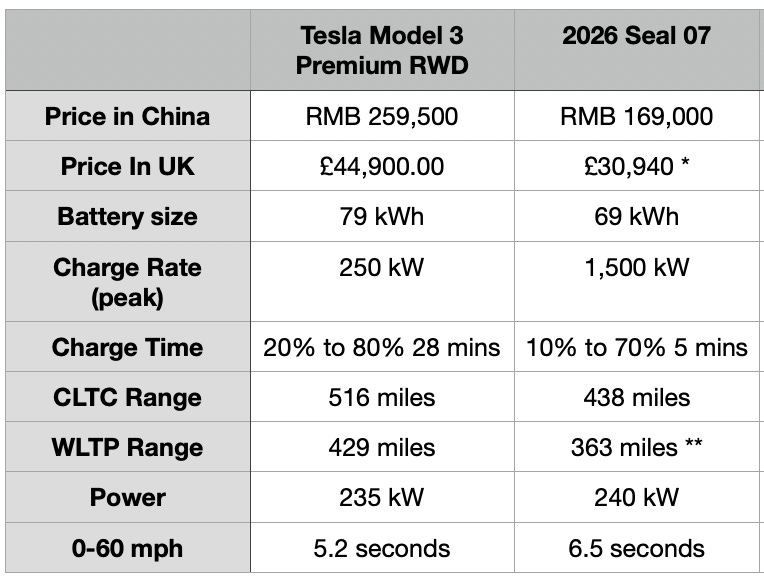
*Estimated from the price difference between the current BYD seal in China and the UK
**Estimate based on the ratio of the Model 3 CLTC to WLTP
So, the BYD Seal 07 is RMB 90,500 (£9,700 / $13,000) cheaper than the equivalent Model 3 in China, whilst charging more than five times faster! Yes, the Model 3 has a slightly longer range and accelerates slightly faster, but is that enough to justify being 54% more expensive?! It’s not like this version of the Model 3 is better spec’d either, as the Seal 07 will have BYD’s “God’s Eye” system, which has been touted as more advanced and safer than Tesla’s FSD.
There is some important context here. The Chinese EV market is in a price war, and BYD has had to slash prices to stay competitive; even then, its sales have fallen sharply in recent months. So, you might think the price of the Seal 07 isn’t directly comparable to the Tesla.
But, don’t be so sure. For one, Tesla has also had to drop its prices as its sales have collapsed across the globe. But the main driver of BYD’s falling sales and discounts was that other Chinese EV makers, like Xiaomi, offered better-equipped, more capable EVs at lower prices than BYD. However, with the launch of the Blade Battery 2.0, that seems set to rapidly change, as it puts BYD back at the forefront of the industry. Plus, BYD could sell this car in Europe for £10,000 more (or equivalent) and still be competitive with Tesla’s offering. So, the prices are more comparable than you might think, as they strongly suggest BYD has a gargantuan cost-of-manufacturing advantage that could easily become a profit-margin advantage (if it isn’t already).
There is a really important part of the Seal 07 that I haven’t talked about yet. You see, it is all well and good having an EV that can charge at 1,500 kW, but unless there are thousands of chargers capable of delivering that power. Luckily, this is exactly what BYD are doing. They developed their new 1,500 kW “Flash Chargers” to work with their second-generation Blade Battery and unlock these charge times, and they have been proven to deliver BYD’s claimed charge rates in the real world. On top of that, they have already deployed 4,200 Flash Charger stations in China and plan to build 20,000 more by the end of this year. But this rollout isn’t limited to China, as BYD are planning to build thousands of them in Europe, the Middle East, and across Asia.
In other words, if you are in a region where you can buy the new Seal 07, there will already be a ton of 1,500 kW-capable chargers available, and if not, there will be very soon.
So, why? Why has BYD been able to take such a catastrophically huge leap forward that it makes Tesla’s technology and pricing look outdated?
In a word, hubris. Basically, Musk fumbled the bag by taking Tesla down a dead-end.
Like BYD, Tesla recognised the cost and technological advantages of developing and building their batteries in-house. But they went down very different routes. While BYD optimised proven, cost-effective technology, Musk bet on unproven, risky technology.
BYD chose to optimise the proven, cost-effective LFP cell chemistry and prismatic cell formats to create the Blade Battery. Musk opted to bet it all on unproven dry-coating technology.
Now, making big bets isn’t the end of the world if you understand what you are dealing with, but Musk simply doesn’t understand batteries. That isn’t my opinion, but the CEO of the largest battery maker in the world, CATL, who back in 2024 said to Musk’s face that Tesla’s 4680 battery “is going to fail and never be successful” because “He doesn’t know how to make a battery. It’s about electrochemistry.”
But Musk thought he knew better than the experts and wasted precious years and billions of dollars in R&D to make a battery that is already obselete, currently only powers the Cybertruck, and, in fact, it looks like the 4680 as we know it might soon end production.
Meanwhile, BYD invested in genuine research with leaders in the field for six years and now has a battery with charging speeds, safety standards, and, almost certainly, cost advantages that no one else has. They took ego, hubris and dogma out of the equation, did the hard graft, and have ended up leapfrogging the entire industry in one fell swoop.
Tesla could have done the same. But Musk’s ego got in the way. They wasted their lead, and now they are in catch-up.
Especially as BYD is not some standalone distant player. They have deep strategic partnerships with many big players. Toyota has created a 50/50 joint venture with BYD to use their technology in their EVs, so the Seal 07 could easily become the next Camry. Ford is in the final stages of securing a battery supply deal with BYD. Stellantis (which owns the likes of Jeep, Ram, Citroen and Alfa Romeo) is also seemingly moving to use BYD’s battery technology. Basically, all the big players in the automotive world have some close connection to BYD to use their technology.
In other words, it isn’t just BYD that is leapfrogging Tesla, as almost every major player in the EV market will soon use BYD’s technology in some way.
Tesla could do this, too. After all, they have a longstanding relationship with BYD to use their first-generation Blade Battery in their European Model Y (kind of proving that BYD’s battery technology has always been better than Tesla’s 4680). But unlike all the other automakers, Tesla’s value in based on the idea that their in-house tech would be the leader. So, adopting BYD’s tech would likely damage the value of the company.
BYD is a beautiful reminder of what Tesla could have been if it had kept grounded. If it ensured its direction was set by reason, reality, and science, not by a greedy billionaire oligarch snake-oil salesman. They show just how much Musk has slept on his laurels. As such, the next few years in the EV market are going to be interesting to say the least, as we could be about to watch Goliath get slain.
Thanks for reading! Everything expressed in this article is my opinion, and should not be taken as financial advice or accusations. Don’t forget to check out my YouTubechannel for more from me, or Subscribe. Oh, and don’t forget to hit the share button below to get the word out!
BYD makes some beautiful cars, but their SUVs are like upgraded Suburbans or Tahoes at half the price. I heard Canada has made a deal with China to import some.
A quote attributed to Albert Einstein. When asked why he didn't retire and rest on his laurels, he replied, "Anybody who rests on his laurels is wearing them in the wrong place."
Musk wasn't resting on his laurels. His illusion that he's a genius engineer/designerCEO keeps him from doing what his companies need - along with the point you made recently, that he doesn't get paid by the performance of his companies, but by their stock price. He has no interest in Tesla being a successful car company, or he wouldn't have nixed the cheaper Model 2, bet the farm on an an untried technology, and pulled Tesla engineers to work for SpaceX. Instead ,he keeps spieling new ridiculous fantasies to "reinvent" the company's goals - and keep the stock price up.