
Was Starship Launch 13 A Success?
It's complicated. Or is it?

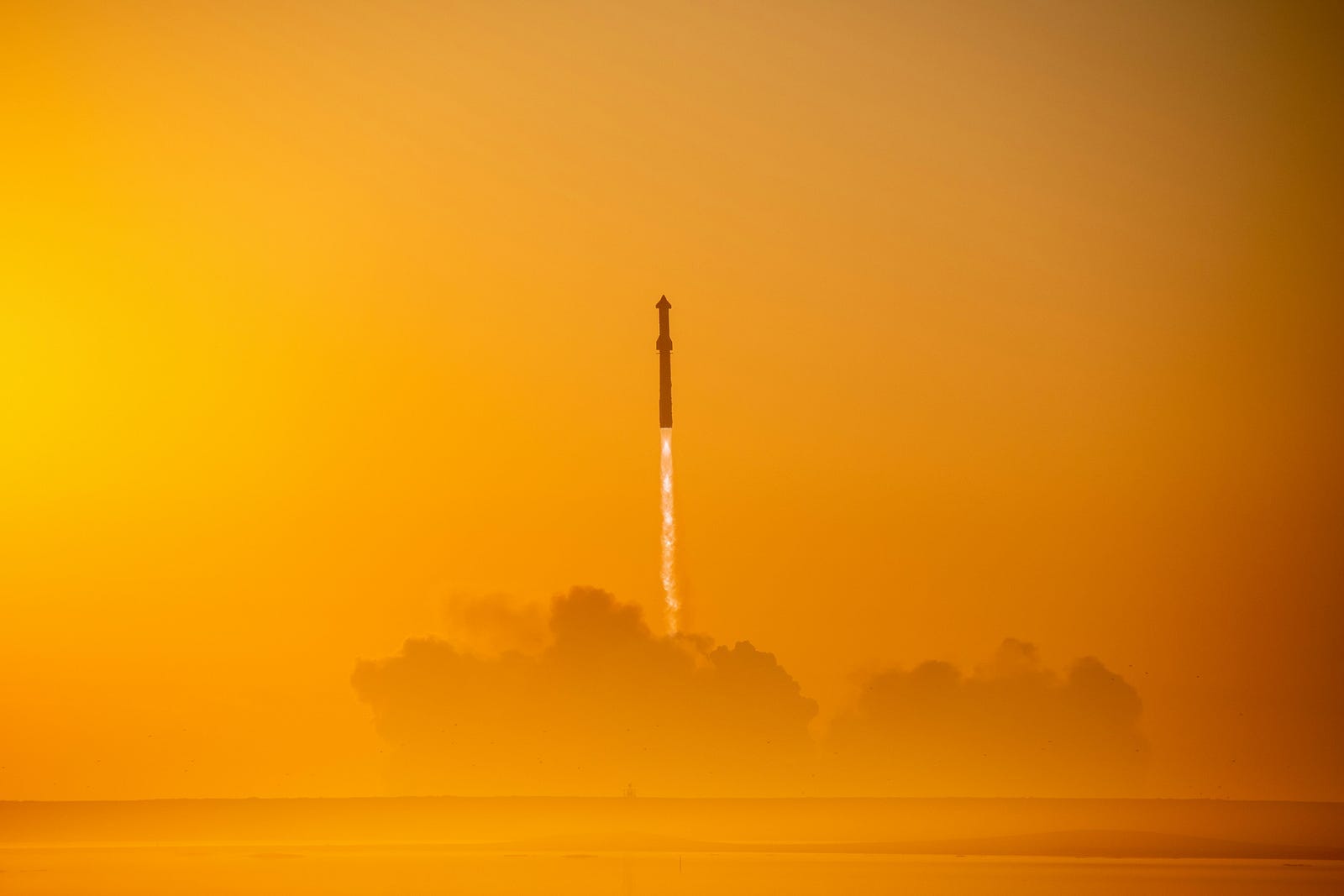
It has been over a decade since Elon announced Starship and three years since its first test launch, but this colossal rocket has yet to show any evidence that it can actually work as a space launch vehicle, let alone revolutionise this tiny niche industry. So, was 13 SpaceX’s lucky number? Did their 13th test flight actually move the needle forward on this quagmire of a project? From one very narrow perspective, yes, it did. But in real terms, this flight hasn’t got SpaceX any closer to the mythical fully reusable, cheap-to-launch, 100-ton-to-LEO (Low Earth Orbit) rocket Musk promised us a decade ago. It’s almost like this guy has proven himself to be a narcissistic pathological liar, and we should know better than to trust anything that falls out of his gaping maw.
The Good
However, I want to separate the authoritarian oligarch from the work, because the actual engineers at SpaceX, the ones tasked with making Musk’s idiotic ideas a reality, pulled off a miracle here, and they deserve praise. So, what went well?
Well, this flight successfully deployed 20 functional Starlink V3 satellites, which marks the first time its payload wasn’t just a dummy mass. That factor matters because V3 is critical to Starlink’s future, and Starlink is by far SpaceX’s biggest breadwinner. The V3 satellites have far greater capacity than the current V2 varieties but are so physically large that only Starship can accommodate them. In SpaceX’s IPO, they stated that a “single Starship launch will be capable of deploying up to 60 Starlink V3 satellites to LEO, representing a potential twenty-fold increase in Starlink downlink capacity deployed relative to a Falcon 9 launch”, and let’s not forget that SpaceX is trying to make Starship launches cheaper than the current Falcon 9 launch. In other words, for Starlink to become massively profitable, cheap enough to compete industry-wide, and have enough local capacity to adequately service densely populated areas (where most internet users are), it needs Starship to be able to successfully deploy Starlink V3 satellites.
So, even though they only deployed a third of Starship’s supposed capacity, this is a major step forward for SpaceX actually having a use case for this rocket. But there are still some serious issues here, which we will get onto in a minute.
This was also the first time Starship’s upper stage performed a soft splashdown in the Indian Ocean without exploding. This is a huge positive in multiple ways. For Starship’s upper stage to be reusable, it needs to land back on Earth. The upper stage faces a far more risky landing procedure than the booster/lower stage because it re-enters the atmosphere at near-orbital speeds during landing. As such, it needs to prove it can consistently land safely over the ocean (as part of a soft splashdown) before they attempt a terrestrial landing. This marks a reasonable step towards reaching that critical reusability goal, and it shows how well SpaceX engineers have optimised Starship’s design and incredibly risky landing procedure.
Also, because Starship didn’t explode and simply floated in the water, SpaceX was able to source data about its heat shield. A heat shield is critical for any spacecraft hoping to re-enter Earth’s atmosphere, as it prevents the spacecraft from burning up. Not only is Starship’s heat shield the largest ever made (and built from thousands of tiles, making it way more susceptible to failure), but for Starship to be economically viable as a reusable launch vehicle, it needs to be capable of working reliably over multiple landings. Building such a component is a material science miracle, so the more data they can collect about the current shield’s performance, the better.
Indeed, the drone footage of the heat shield after landing also looked promising. It appeared intact, with only minor discolouration and only a few possible broken tiles. However, again, there are some issues here that we will discuss in a moment.
This brings me to the final good point, if you can even call it good. This test flight “looked good”. It is something for SpaceX bagholders — I mean, investors — to point towards. From a purely marketing and PR standpoint, deploying satellites and looking good on landing is enough to signal progress to those clinging onto the Musk bandwagon. While it by no means boosted SpaceX’s stock price, it has seemingly slowed the rate at which it has been losing value at the very least.
But that is where the positives end.
The Bad — Booster
Okay, are you ready? There is a lot to go through, and I will try to be as concise as possible.
The booster failed to land. It completed its jobs of initial launch and separation from the upper stage, but as it came back down to Earth, three of its engines failed to reignite, and at the point of splashdown, only five of its 13 landing engines appeared to be working. It hit the water at such velocity that it basically exploded on impact, also known as a “hard splashdown”.
But, hang on, hadn’t SpaceX already figured out how to land the booster? They have landed one on land and reflown it already. Well, that was the older version of the booster. Test Flights 12 and 13 were the first use of the V3 Starship and booster, and SpaceX seems to understand they have taken a step backwards. Rather than try to properly land either of these boosters, SpaceX sent both of them to do a “soft splashdown” in the Gulf of Mexico, almost as if they knew they would fail. The first failed spectacularly, with the engines completely failing to reignite after separation, causing it to crash into the water at 900 mph! And now the second one has failed in a similar fashion. Reusing the booster was supposed to be the easy part, which means this repeated failure really doesn’t bode well for Starship’s reusability. Remember this part for later — it is important context.
The Bad — Payload
The biggest issue for Starship isn’t actually its reusability but its payload. Musk promised 100 tons to LEO but has only ever taken a tiny fraction of that on a suborbital launch. There is no point having a fully reusable rocket if it can’t take a decent payload to orbit. So, you’d think that SpaceX would be fully transparent with how much payload these test flights carried, particularly now that they are a publicly traded company. Indeed, they were transparent with Launches 1 to 11 but not with Launches 12 and 13 of this V3 Starship. Instead, SpaceX quoted it in terms of the number of Starlink V3 satellites (or dummy satellites) it was carrying. But we don’t know how much these satellites weigh. The closest estimate we have had for a long time is an announcement a year ago that said V3 Starlink satellites would have a mass of up to two metric tons. But SpaceX’s IPO filing stated that Starship will be able to take 60 satellites to LEO, which, based on a 100-ton payload capacity, puts each satellite at less than 1.6 tons.
This has muddied the waters and potentially hidden a truly damaging implication. For example, I based my previous analysis of Flight 12 on the two-ton figure, leading me to estimate its payload at 44 tons. That made it look like V3 had a significant payload capacity increase over V2 (even if the V3 booster failed when the V2 didn’t, with more on that in a minute). However, the IPO filing suggests that this figure was actually 37.5 tons or less, and based on the IPO filing figures, Flight 13 had a payload of 34.1 tons or less. As you will have noticed, this is less, not more. The payload capacity is going in the wrong direction.
Now, Starship V2 only ever carried 16 tons on a successful transatmospheric flight, but SpaceX rated Starship V2 at 35 tons to LEO. And now, V3’s booster is failing at around the same figure, which implies that V3 doesn’t have that much more payload capacity than V2. SpaceX’s attempts to hide the actual payload mass only strengthen that damning implication. That is objectively awful news for Starship.
The Bad — Not Orbit
But hang on again, did you catch that? Flight 13, like every other Starship launch, wasn’t an orbital flight; it was a transatmospheric suborbital flight. That dramatically changes the maths on every front.
For one, it means the 20 V3 Starlink satellites didn’t enter orbit. They were able to connect to the Starlink network briefly to test out their new systems, but they burned up in the atmosphere about 20 minutes later. So, as it stands, Starship can’t deliver satellites to orbit, meaning this Starlink deployment isn’t actually a milestone at all. Instead, it’s hollow and meaningless, because Starship still isn’t a usable launch vehicle.
According to SpaceX’s livestream of Flight 13, the upper stage reached a maximum altitude of 198 km, and at that peak it had a velocity of 26,292 km.
I conducted this kind of analysis in my Flight 12 article, but that isn’t fast enough to enter orbit and suggests that Starship’s functional payload to orbit is far lower than it seems. You can enter orbit at 198 km, but it creates major atmospheric resistance and isn’t stable, so it is known as VLEO (very low Earth orbit), and very few satellites use it. For some context, Starlink satellites are some of the lowest operational satellites, and they have an altitude of 550 km, or more than double what Flight 13 reached.
Orbital velocity at 198 km is 28,042 km/h; that is 1,749 km/h (1,086.778 mph) faster than Flight 13. So, could Starship 13 have turned on its engines, gained that speed and entered orbit?
