
Was Starship Launch 12 A Success?
Not really, no.

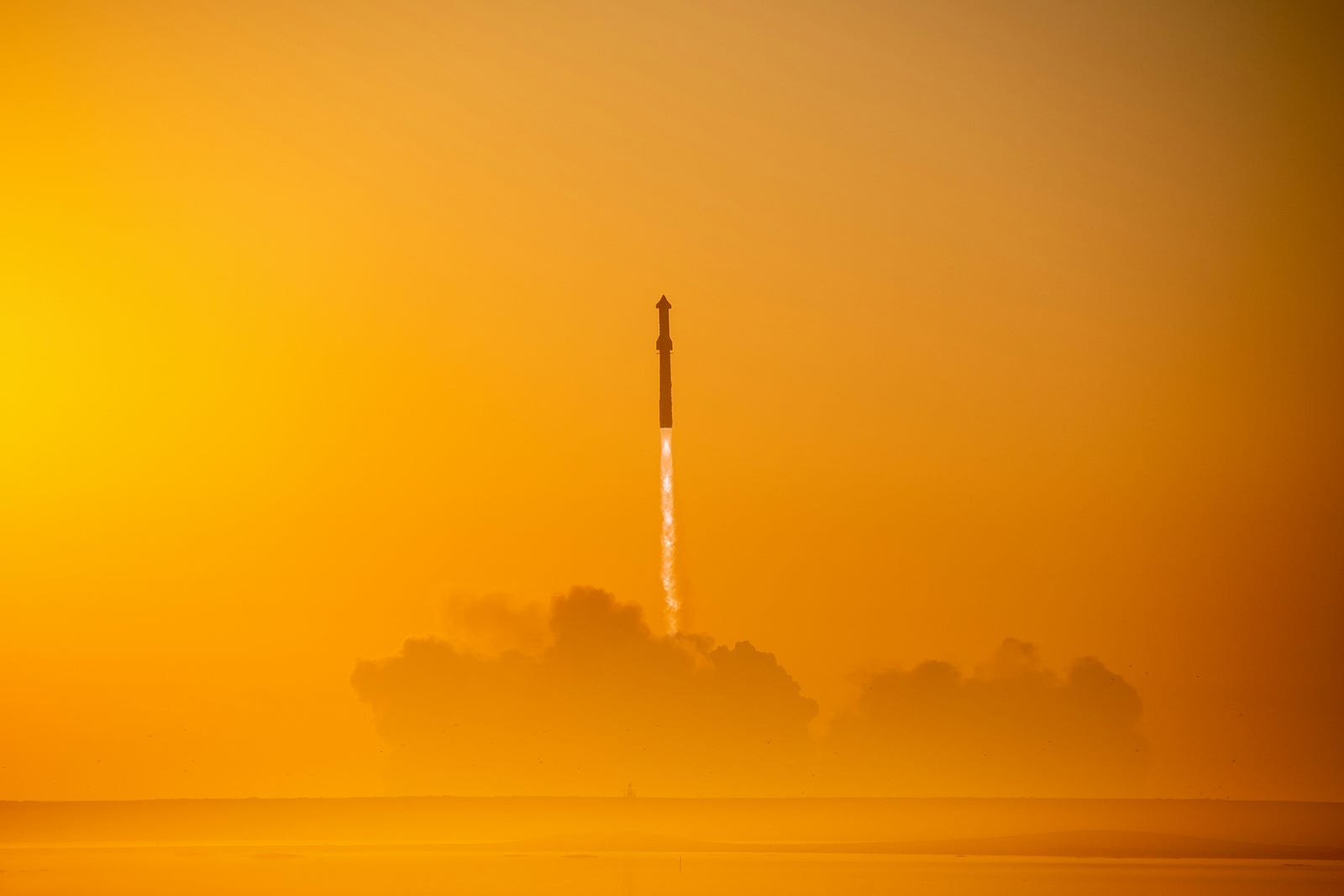
The media buzz around Starship has officially died. I was expecting this “highly anticipated” launch to be painted across the headlines, but it seems people simply don’t care that another one of Musk’s giant phalluses exploded in the Indian Ocean. By all accounts, the polish on this turd has tarnished as people have grown tired of waiting for this “revolutionary” tech to actually materialise instead of being an expensive trash fire. This is one of Musk’s seriously bad patterns. He has overpromised himself into multiple corners, from self-driving cars to Mars-bound rockets and even pathetic C-3PO wannabes, and now people want him to put up or shut up. The trouble is, as we have seen with DOGE and the Cybertruck, Musk can’t deliver, but he likes to ‘look like’ he has — and this launch was yet another example. If you buy SpaceX’s line, they have made a serious step forward. But if you actually look at the launch with even a slightly critical lens, that narrative totally falls apart.
The Launch
This was the first launch of the Starship V3. For this article, all you need to know is that this is a major redesign from V2. It’s bigger, carries more fuel, has upgraded Raptor 3 engines (which burn fuel faster and therefore produce more thrust), and the booster has more engines. Primarily, V3’s goal is to dramatically increase the payload of Starship. V2 was pathetic, with Musk claiming it could take just 35 tonnes to LEO, or more than a 65% shortfall in promised payload, but in reality, it only ever took 16 tonnes on a suborbital flight. V3 is aiming to reach the promised 100 tonnes to LEO (Low Earth Orbit) mark, which is critical to meeting all of Starship’s planned use cases. In other words, if they can’t achieve a payload of 100 tonnes to LEO, the project is a failure.
So, how did the launch go? Well, despite some glowing reports, not great.
The rocket launched, and the stages separated fine. But the Booster lost an engine during launch, and then the engines failed to reignite after separation, causing it to crash into the Gulf of Mexico at 900 mph! Not exactly conducive to being reusable. The upper stage carried on its suborbital trajectory without a hitch. It reached a maximum altitude of 194 km (121 miles) at a speed of just over 26,300 km/h (16,300 mph), where it deployed its payload of 44 tonnes worth of dummy satellites. It then conducted a controlled splashdown in the Indian Ocean, with the heat shield looking extremely charred but intact.
That sounds like a relative success, right? Sure, the Booster failed spectacularly, but SpaceX has seemingly more than doubled the payload! That is a serious step forward towards their goal, right?
Well, sorry to burst your bubble, but no.
The Sleight Of Hand
It is very important to mention that this isn’t 44 tonnes to orbit. This is 44 tonnes on a suborbital flight that reached a maximum altitude of just 194 km (121 miles) and only 26,300 km/h (16,300 mph). For some context, a Starlink satellite orbits at an altitude of 550 km (340 miles), which is nearly three times as high as this Starship reached. These Starlink satellites also travel at 27,320 km/h (16,976 mph), or a thousand kilometres an hour faster than this Starship!
I don’t think people realise what a colossal difference this small detail makes. The media is seemingly parroting SpaceX’s narrative that this means Starship now has a usable payload of 44 tonnes. But it doesn’t! Instead, the only thing this does is heavily imply that Starship still has a major payload deficit. Not just a small underperformance, but an underlying critical flaw which makes it totally unusable. But, by running with the 44-tonne figure and not the 194 km figure, that isn’t what people notice.
So, let me explain what all of this implies.
The Payload Problem №1: Set Up
Based on what we know, let’s figure out roughly how much payload V3 could actually take to orbit.
In order to do this, I will have to make some assumptions.
My first assumption is that this Starship was pushing its payload limits, which is supported by the failed engine, as with Flights 7 to 11, which experienced engine failure with a high payload and had no failures with a lower payload. It also makes sense for SpaceX to try to reach the highest payload figure possible, as it will help their upcoming IPO.
I also have to make some assumptions about its mass. We know the payload was 44 tonnes, but we don’t know the dry mass of the upper stage, or the mass of the reserve propellant it was carrying when it reached its maximum altitude. I will be exceedingly generous and assume a 150-tonne dry mass, which is on the lower end of estimates, and a reserve fuel mass of 30 tonnes, which is on the higher end of other estimates. These dry mass and propellant capacity estimates are realistic because they are more than enough to enable landing, given that this propellant, plus aerodynamic drag, is theoretically enough to reduce speed to zero during landing.
This gives our Starship a total mass of 224 tonnes (150 tonne dry mass, 30 tonne reserve propellant and 44 tonnes of payload) as it reached its maximum altitude of 194 km at a velocity of 26,300 km/h.
Okay, so what would this Starship have to do to travel from here to orbit?
The Payload Problem №2: Into VLEO
Technically speaking, 194 km is just about high enough for a stable orbit. At that altitude, you are slightly above the edge of the atmosphere, so there is functionally no aerodynamic drag, and if you travel fast enough, you could technically enter orbit. However, events like small geomagnetic storms can easily create atmospheric drag at this altitude, rendering the orbit unstable. This is why orbits below 400 km are called VLEO (Very Low Earth Orbit) and are rarely used, as they are too risky for typical satellite operations.
So, even though 194 km is far too low for Starlink satellites, could this Starship have entered orbit at this altitude?
Orbital velocity at an altitude of 194 km is 28,051 km/h. So, at its maximum altitude, this Starship would need to gain an additional 1,700 km/h (1,056 mph) in velocity to enter orbit.
However, let’s say that at this max altitude, this Starship turned on its engines until it gained this extra velocity. How much fuel would it burn through? The answer is about 21 tonnes, or two-thirds of the reserve fuel it requires to land (using the rocket equation and a vacuum exhaust velocity of 3,700 m/s). The nine tonnes of reserve fuel left is not enough to complete the landing. It can only scrub off 604 km/h (375 mph) of velocity during landing, and, as the Booster from this launch demonstrated, far more speed needs to be scrubbed off for a safe landing.
In other words, this Starship could transport 44 tonnes into the lowest possible orbit, but it wouldn’t have enough fuel to land the upper stage. Also, don’t forget, I was generous with Starship’s dry mass and its reserve propellant here; there is always a chance these figures are worse.
This is one of the lowest energy orbits possible. But higher orbits will require much higher total orbit energy (the sum of an orbital object’s kinetic and gravitational potential energy). This energy comes from a rocket’s propellant and engines. Therefore, Starship can’t reach much higher orbits with this payload without also expending the upper stage.
The Payload Problem №3: Into LEO
But VLEO is utterly useless for most satellites. How much more fuel would be needed to expand this orbit out to 550 km so that Starship can actually deliver a Starlink satellite? You know, the simplest and easiest to achieve of all Starships’ designed use cases.
Using a Hohmann Transfer Calculator, we can calculate that it would require another 13.5 tonnes of propellant to transfer into this higher orbit (based on a specific impulse of 355 m/s, a commonly cited value spec for the Raptor 3 vacuum engine).
But wow! Hang on, our Starship only has nine tonnes left! So, four tonnes of our payload have to be sacrificed to gain four extra tonnes of propellant.
In other words, this Starship could deliver 40 tonnes of payload to a usable LEO in a ‘partially reusable’ configuration, where only the Booster was recovered. But the Booster wasn’t recovered! So, as far as we can tell, this hypothetical 40 tonnes to LEO would expend both the Booster and upper stage, which together cost some $500 million to build, putting the launch cost at roughly $550 million for 40 tonnes to LEO. For some context, Falcon Heavy can launch 63,800 kg to LEO when fully expended at a cost of just $150 million. That makes Starship V3 5.8 times more expensive per kg to LEO than a rocket that has been in operation for nearly a decade.
Just to remind you, even having to expend the upper stage of Starship totally ruins the premise of this launch vehicle, as even if the booster is recovered, Falcon Heavy will still be cheaper and more reliable.
If it isn’t obvious, this all proves that Starship could, in theory, reach LEO and still land the upper stage — it would just have functionally zero payload capacity (the payload to LEO when the upper stage is expended is roughly the same as the fuel needed to land from a 550 km orbit), which kind of defeats the point of this moronic rocket.
Summary
Now, I may be off with my assumptions. Maybe this Starship had far more reserve fuel in the tanks, though I can’t think of a single reason why it would. Maybe it wasn’t being pushed to its payload limit, even though the engine failures made it seem that way, and even though the IPO pressure will be motivating SpaceX to make it look like the payload capacity is improving. But it could very easily swing the other way, too. I assumed the Booster failed to land because of engine failure. Maybe it was actually because it used all its landing fuel during the launch to give the upper stage an extra push, leaving it no option but to tumble back to Earth and artificially increase the payload? Musk has done significantly shadier stuff in the past, after all.
Either way, I hope this has shown you why deploying a 44-tonne payload on a suborbital flight that maxed out at an altitude of 194 km is not a step forward for Starship, despite what many in the media are spouting. Yes, it is better than the V2’s performance, but it hasn’t really got closer to its target. It’s still a functionally useless rocket.
So, no, this test flight was not a success. It hasn’t really moved the needle forward. What’s worse is that it strongly implies the fatal flaw here is not in the minutiae. The brilliant miracleworker engineers at SpaceX can’t solve this problem because the fatal flaw lies in the underlying concept of Starship as a fully reusable two-stage rocket that Musk insists on pushing. It is even more evidence that the fuel required to land the upper stage is roughly the same weight as the payload to orbit, making this vehicle fundamentally useless and an unsalvageable dead end.
In time, we will see if my assumptions and analysis are correct. But as it stands, SpaceX hasn’t actually demonstrated any meaningful progress. As such, this launch just looks like a pathetic attempt to polish a giant festering turd. Sadly, the media seems to have lost all critical thinking abilities and is eating up SpaceX’s faecal polish hook, line and sinker.
Thanks for reading! Everything expressed in this article is my opinion, and should not be taken as financial advice or accusations. Don’t forget to check out my YouTubechannel for more from me, or Subscribe. Oh, and don’t forget to hit the share button below to get the word out!
The ketamine NAZI believes that the Starship can be involved in the proposed Artemis 3 moon landing! With the Trump administration that is a death sentence for the Artemis 3 astronauts! Please remember that the DOGE version of the Ketamine NAZI has all of our social security data!!!
The Bezos rocket explosion is good news for Musk in one sense, but bad news for the whole idea of a moon base. Apollo could absorb failures, since it only needed to make a handful of quick visits. A moon base will, if it ever happens, require reliable transport on a regular schedule.