

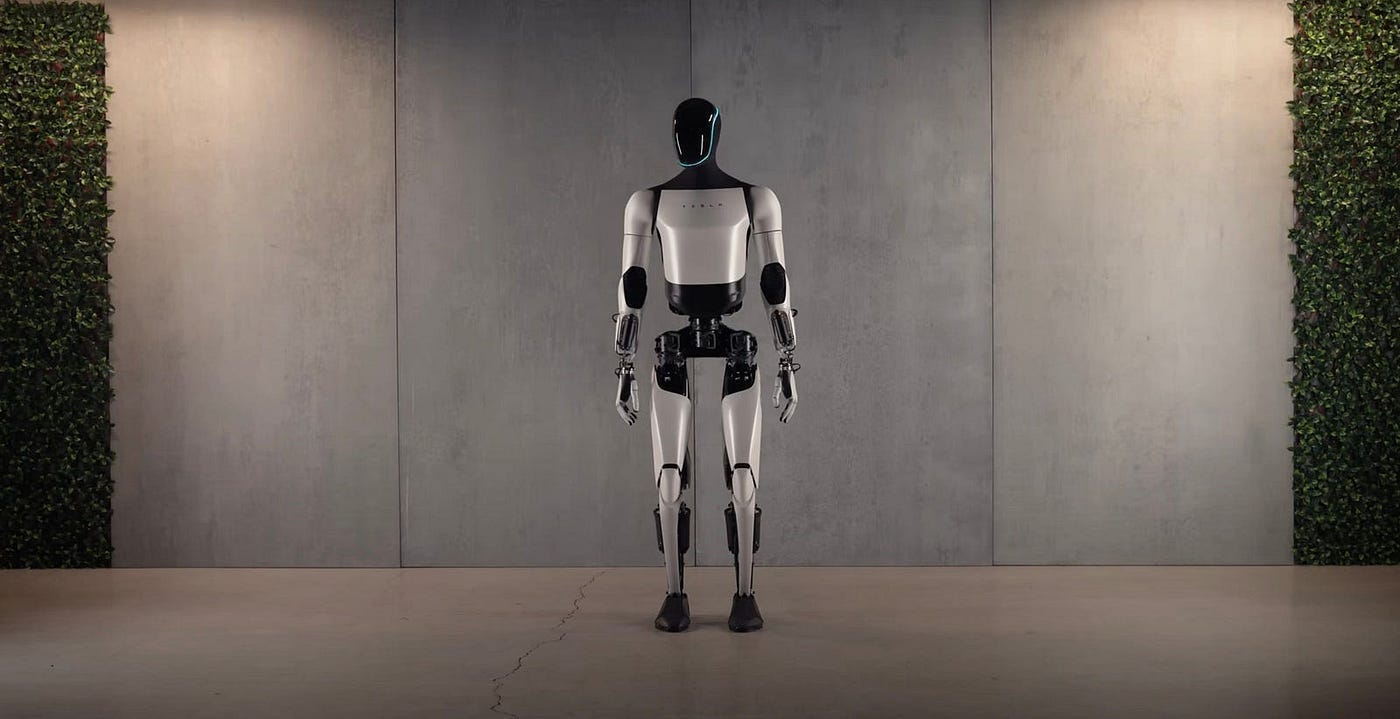
The variety of claims Elon Musk has spouted about Tesla’s Optimus robot are nothing short of insane. He has said that Optimus will generate $10 trillion in long-term revenue for Tesla, that it will eventually account for 80% of Tesla’s value, and that it will increase Tesla’s value to a whopping $25 trillion. It’s a good thing Musk has a solid track record of delivering on his promises; otherwise, I would think this was the delusional rambling of a madman… Mind you, he also said Tesla would start a pilot production line of the finished Optimus and produce 5,000 units by the end of 2025, and that never happened. In fact, Tesla recently announced that it will unveil a new “production-ready” third version of Optimus (which implies the version slated for production in 2025 was never production-ready) and that by late 2027, production will start at Tesla’s Fremont factory, which was where the Model S and X were produced. With all of this as context, maybe we should take these far-out proclamations with a pinch of salt? In fact, if you were paying attention during Tesla’s recent earnings calls, Musk let slip something that not only demonstrates just how wide the gap between reality and Musk’s yammerings really is but also how little Musk actually understands the technology he is trying to flog.
The Revelation
For months, Tesla has claimed they had two Optimus robots working in their factories. This was the only scrap of evidence we had that Optimus might be capable of doing even the most basic tasks autonomously. I cannot stress this enough — the entire Optimus narrative hinges on selling this idea and convincing investors that this Johnny 5 impostor is more than just a teleoperated Disney animatronic from 2003.
But it seems Tesla might have massaged the truth here. During the recent earnings call, it was revealed that no Optimus units are currently performing productive work in any of Tesla’s plants. Musk stated that Optimus’ presence in the factory was “more so that the robot can learn” and was not assisting in production at all.
So, let me get this straight: The robot Musk wanted to start producing last year isn’t even capable of helping out at Tesla’s own factories. Like, not even in a gimmicky way? It couldn’t, say, pick up a box of bolts here and drop them over there — that kind of thing? More importantly, why are your robots being “trained” in the factory in the first place? I’ll discuss this further in a minute.
We Shouldn’t Be Surprised
If you are shocked at this revelation, you should have been paying closer attention. Tesla has been desperate to sell this illusion of Optimus autonomy but has failed repeatedly. What about that hilarious failure at a Miami “Autonomous” event, where Tesla was trying to insinuate that the Optimus robots handing out water bottles were doing so autonomously, only for one of the robots to take off a non-existent headset and fall base over apex (watch the video here)? This effectively shattered any illusion and made it painfully clear the robot was being teleoperated. While Tesla hasn’t outright admitted that this bot was being teleoperated, it has admitted that the demo video of Optimus folding clothes with the VR puppeteer in the frame and the bots at the We Are Robot event, which were obviously puppeteered by interns, were both being teleoperated.
So far, Optimus has failed as a tech demonstrator, which means we should not be at all surprised that Tesla can’t get it to help out at its factories.
But the implications of this revelation go much deeper than you might think.
Tesla Is Behind
Inconveniently for Tesla, there are already humanoid robots working in EV factories. As I recently covered (read more here), BYD is currently trialling UBTech’s Walker S1 in its factories, where it performs tasks such as basic quality control, transporting components across the factory, and even part installation.
This shouldn’t be that surprising, as UBTech has demonstrated the Walker S1 doing remarkably complex tasks, such as playing tennis, and successfully interacting with production line machinery. It appears capable of attempting such a trial.
Though, admittedly, it is not doing these tasks well. As the Financial Times reported, UBTech’s chief brand officer, Michael Tam, stated that the Walker S1 is “30 to 50 per cent as productive as humans and only in certain tasks such as stacking boxes and quality control.” As such, it is almost certainly still stuck in a “gimmicky tech demonstration” stage, and Chinese factory workers likely don’t have anything to worry about just yet.
The Walker S1 is clearly far more capable than Optimus, but even it cannot yet make a business case anywhere close to Musk’s preposterous Optimus claims. It also shows that Tesla really isn’t the market leader and has functionally no advantage over its competition. So even if humanoid robots are a multi-trillion-dollar opportunity, companies like UBTech, not Tesla, are the ones set to profit.
But humanoid robots likely aren’t even a viable technology, let alone an economy-shifting business opportunity.
The Wrong Direction
In truth, we have known for a long time now that humanoid robots only make sense in fiction or to those who fetishise dominating the workforce. In reality, there are vanishingly few cases in which a humanoid robot makes more sense than a specialised one.
Take the Walker S1. Simple, cheap, specialised robots can — and already do — install parts, transport components across factories, and perform basic quality checks far more quickly, accurately, and cost-effectively than a humanoid robot ever could. On top of that, they are cheaper and quicker to integrate into the production line in the vast majority of cases.
Indeed, the robotics industry has known that humanoid robots are the wrong direction to go for quite a while now.
Take Chris Walti, who actually headed Tesla’s Optimus development. He has publicly stated that the humanoid form factor isn’t “a useful form factor” and that “we weren’t designed to do repetitive tasks over and over again. So why would you take a hyper-suboptimal system that really isn’t designed to do repetitive tasks and have it do repetitive tasks?” Or Brad Porter, former VP of Robotics at Amazon, who said that “humanoids are the wrong solution for most tasks” and that far simpler solutions, such as wheels rather than bipedal legs, are almost always cheaper and more reliable. Then there is Gartner, which points out that humanoid robots are unusable due to their high cost, integration challenges, unreliability, and lack of capability. Given the availability of better options, such as specialised robots or human workers, this will remain the case for a long time to come.
When you think about it, this insistence on imitating a human makes little sense. If humans had evolved for millennia to work in a car factory, they wouldn’t look like us. Likewise, why go to the expense and effort of getting a humanoid robot to vacuum when you can just get a Roomba to do a far better job?
Insisting that robots look and function like humans is like designing a car to resemble and work like a horse. It is arse-about-face. Sure, we like the idea of humanoid robots because we can anthropomorphise them, but actually using them, even if they are capable of doing the task at hand, makes zero sense.
Musk Doesn’t Understand AI
Remember that bit I told you to remember? The fact that Optimus is “training” in the factory? Yeah, that is a bit of a smoking gun as to why Optimus is so shit.
Tesla uses two main methods to “train” the AI behind Optimus: video-based imitation learning and teleoperation training. This is because Optimus is based on the same AI and AI computers as Tesla’s FSD, which is how they train the FSD AI. And we all know how well that is going, don’t we?
But, as pointed out by the brilliant Australian roboticist Rodney Brooks, these training methods have some serious and obvious flaws.
Let’s start with video-based imitation learning. This is the process of “teaching” the AI how to accomplish the tasks you want the robot to perform by feeding the AI videos of humans doing such tasks. This is an approach which Brooks calls “pure fantasy thinking”.
Why? Because we humans use far more than just visual data to complete these tasks. Our sense of touch is insanely powerful. Our hands have 17,000 specialised, highly sensitive touch receptors capable of detecting changes as small as 40 μm at a rate of approximately one billion bits per second. In other words, a single human hand feeds our brain over two gigabytes of incredibly detailed data every second! We rely on this significantly more than visual data to perform even the most basic of tasks. Think of it this way: you can fold a shirt blindfolded quite easily, but you would really struggle to fold one using tongs instead of your hands.
Brooks points out that video-based imitation learning trains the AI on incomplete data, leaving it with a gaping blind spot, meaning it can’t effectively replicate the human in the training data.
Musk’s solution to this data alignment issue seems to be teleoperating training. This is where you use VR to puppeteer the robot to perform the task and use that as training data for the AI. This way, the data collected theoretically aligns more closely with what the AI has access to, enabling better training. But Brooks points out some major flaws with this approach, too.
The AI can only ever perform as well as these teleoperators (or more realistically, not as well as the teleoperators), and these teleoperators really struggle to complete even basic tasks when controlling the robot.
The VR suits these teleoperators use have very limited finger control and even less force feedback, severely limiting the teleoperator’s sense of touch. The robot’s dimensions can differ from the teleoperator’s, throwing off their immersion. The teleoperator’s depth perception may be inaccurate due to the two cameras that are used to see the world with depth perception and to provide a VR video image having differing pupillary distances. The teleoperator’s sense of balance and proprioception (the sense of where your limbs are in space) is constantly different from the robot’s. All of this means these teleoperators have a really hard time teleoperating humanoid robots, as the data being fed to them is often confusing, and their senses are severely numbed.
This issue is obvious due to Optimus’ constant failures while being teleoperated. And here’s the thing: if these teleoperators struggle to complete even basic tasks via Optimus, then so will the AI, as it can only ever hope to badly copy them.
The fact that Elon seems to have completely ignored these fundamentals of AI training and believes that video imitation and teleoperator training will be enough to enable Optimus to take over millions of jobs is deeply worrying.
This lack of understanding of the core technology behind Optimus might also explain why Tesla is training a few Optimus robots in its factory, rather than trialling them like the Walker S2.
Tesla is almost certainly trying to conduct video-imitation and teleoperation training of basic production line tasks alongside the production line. That way, they can access the humans and tasks they want to train the AI on and still say, “There is an Optimus in the factory.”
But Tesla has been training Optimus robots for at least three, if not four, years by now. The fact that Tesla hasn’t conducted a trial of Optimus integrating into Tesla production lines, even for shockingly basic tasks, after all this time, is damning. Trials like these are a critical part of development and proof of concept for investors. The fact that Tesla hasn’t even reached this fundamental step yet strongly suggests that its approach to humanoid-robot AI training is fundamentally wrong and severely limiting development, just as Brooks said it would.
Summary
I can’t describe Optimus as anything other than a fanciful fiasco. Not only are Musk’s claims about the business side of humanoid robotics totally untrue, but they are undermined by the fact that their competitors are way ahead of Tesla. Additionally, it is painfully obvious that Musk doesn’t understand AI or robotics at all, as the gap between reality and whatever he thinks is possible is so large you could fit his colossal ego in there. I very much look forward to sitting back and watching this delusional car crash play out over the coming years and munching popcorn as Elon is proven to be a grifting moron yet again.
Thanks for reading! Everything expressed in this article is my opinion, and should not be taken as financial advice or accusations. Don’t forget to check out my YouTubechannel for more from me, or Subscribe. Oh, and don’t forget to hit the share button below to get the word out!
Really appreciate your analysis of teleoperation training of Optimus. Makes sense to me. You’re good at boiling things down and explaining things.
If Noel Smuk gives up on Mars, I mean if the ELON gives up on Mars, then the Hive Mind is Doomed. Or is it Domed? Or just Dumbed.
A million Thank You’s again to Mr. Locket & all his talents.
I actually bought von Braun’s novel, and have tried to ramp up interest in reading it just to see what a Nazi sci fi writer can come up with. Leon Skum is named after the “emperor” of Mars colony, called the ELON. Nelo Kums' father apparently worshipped at von B’s smelly feet.
My own dad never declared it, but he hinted that he encountered von Braun when he was stationed in or around El Paso/White Sands (IIRC) in 46 or 47 right after the war ended and the Nazi rocket scientists were all held there while being scrubbed for US citizenship/jobs. Dad always smiled slyly while watching newsfilms of von B. on TV in the 50’s, and once when I asked him why we would let him become an American and lead the rocket program, Dad said, “Sometimes you just have to put a clothespin on your nose.” Or words to that effect. I.e. for the sake of the USA, hold your nose to block out the stink. That was my father’s view. That we literally conned von B. into joining us.
Forgive me if I’ve shared this story before. It has little to do with Lone Sukm.
Tesla is a very long con, perpetrated by one delusional drug addict and a lot of munchkins. The only valid stories about them I’ve found, consistently, have been right here.