
Starship Is Going Nowhere
A devastating revelation.

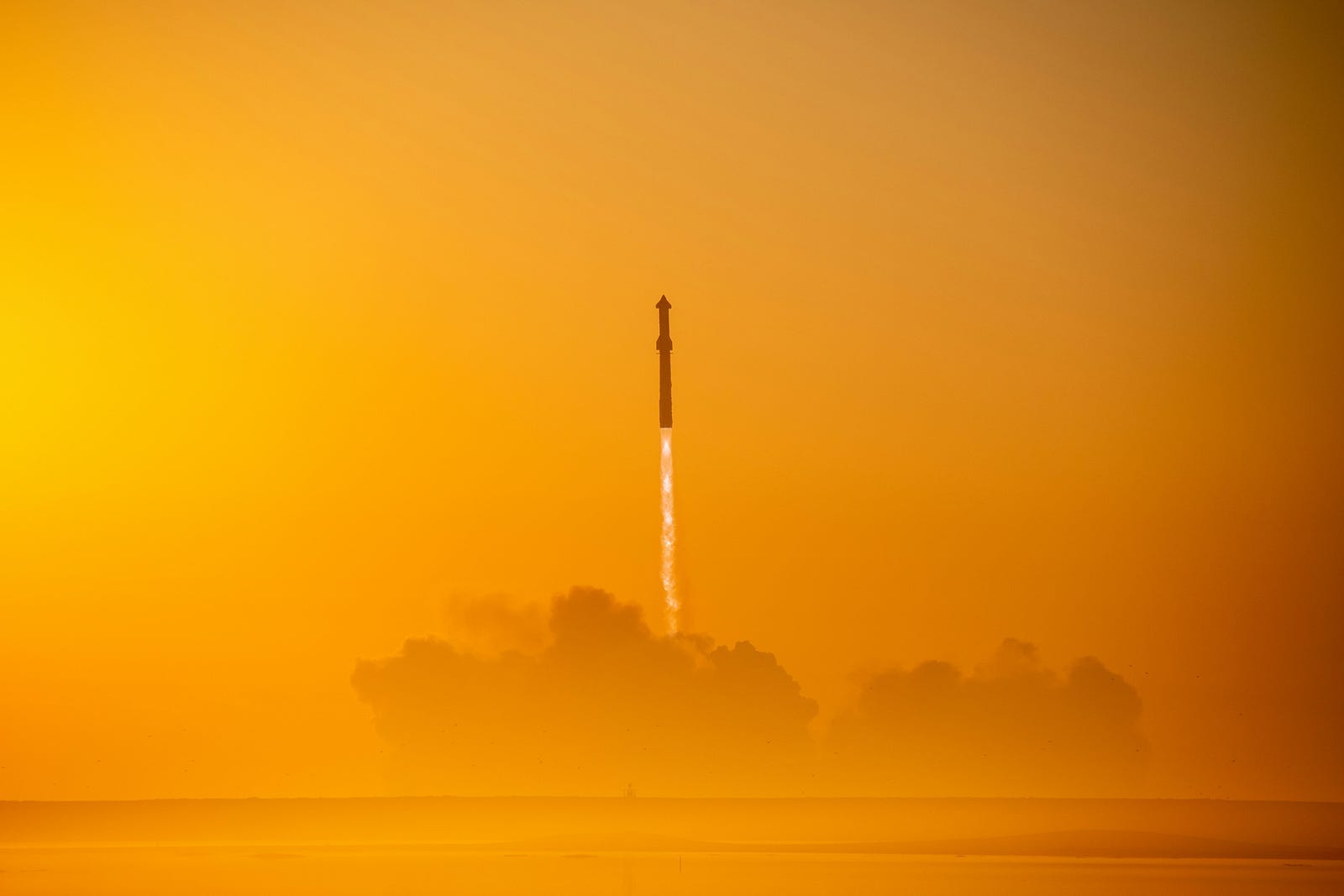
One of the few upsides to SpaceX’s rapidly approaching IPO is that we finally get to glimpse the murky world of its obscure finances. They are legally obligated to show us how cash moves through this beast, and the picture painted by the recent filings is not pretty. You see, from orbital data centres to Starlink, NASA missions, and even Musk’s fabled anarcho-capitalist feudal settlement on Mars, Starship is critical to unlocking SpaceX’s future. Yet, these IPO filings only highlight that it is a biblically expensive mess going nowhere fast. But I don’t think people realise just how damning this revelation is, because it proves that Starship is nothing more than a hopeless money pit.
The Gap
Let’s start with this revelation. Reuters reported that, according to SpaceX’s IPO filings, the company has spent more than $15 billion on Starship so far. That validates my previous estimate that Starship “costs are close to $10 billion, if not significantly more”. Now, in our current crazy times, that might not sound especially expensive, but it is. For some context, Falcon 9 cost just $400 million to develop, and the initial budget for Starship was $5 billion. So, Musk has already blown the budget more than two times over.
Yet, Starship isn’t even close to finished, let alone being a viable, functional launch vehicle.
The only real targets it has achieved so far are completing a suborbital flight, reaching orbital velocity (but not orbit), landing and relaunching the booster (which is much easier than the upper stage), and conducting a splashdown landing of the upper stage. For spending three times the initial budget, that is pathetic progress.
So, how far does Starship have to go?
Well, Starship has two main use cases.
The easiest and simplest is launching Starlink satellites into LEO (Low Earth Orbit). For Starship to be a viable and profitable way to launch Starlink satellites, it needs to reach LEO with its promised 100-ton payload, land both stages, and ensure both stages are rapidly reusable with virtually no maintenance costs. That way, it will be able to launch around 40 Starlink V3 satellites per launch for a nominal cost of $70 million per launch. This would reduce the cost of launching Starlink satellites by roughly over 50%, enabling Starlink to firmly operate at a profit, not just a positive EBITDA.
The much more difficult use case is for out-of-orbit flights like NASA’s Artemis missions and Musk’s Mars missions. This is because Starship can’t travel directly to these planets; it needs to use other Starships to refuel in LEO. This creates quite a complex and highly risky mission profile. First, a ‘depot’ variant of Starship is sent into orbit, then multiple ‘tanker’ variants of Starship shuttle fuel to the depot, 100 tons at a time, until the depot is full. After this, the Mars/Moon-bound Starship launches to LEO, rendezvous with the depot, fully refuels itself from the depot, and then fires off to its destination. Each Starship variant will have complex, unique systems, and each fuel transfer will carry a risk of a mission-ending catastrophic explosion. As such, this mission profile is significantly more complex than a simple Starlink launch.
So, what targets does Starship need to meet to be able to conduct Starlink launches, and how many more do they need to meet to pull off Moon/Mars missions?
In truth, there are loads of targets, and they are much harder to achieve than what SpaceX has accomplished so far.
So, let’s go through them, shall we?
Targets Until Starship Reaches Usability
Reach Orbit
Let’s start with the main one: Starship needs to actually reach orbit. So far, the most it has achieved is take 16 tons on a transatmospheric flight at orbital velocity. ‘Transatmospheric’ means it just skimmed the upper atmosphere, so it reaches a lower altitude than ‘suborbital’, which in itself is (typically) lower than required to reach proper orbit. Transatmospheric and suborbital flights, even at orbital velocities, can’t deploy satellites into orbit. But this isn’t as simple as it might sound, given that rockets have to expend kinetic energy (speed) in order to gain altitude. So, even though Starship has reached orbital velocity, it needs to expend a lot more energy to reach orbit, which requires burning more fuel — and, crucially, Starship might not have this fuel available. The extra fuel required to take Starship from its current transatmospheric path up to LEO is roughly 20 tonnes (as calculated by Thunderf00t), which suggests that Starship can currently reach only the lowest possible orbit if it carries no payload! So as it stands, just reaching orbit is a potentially difficult target to meet.
2. Increase Payload
Getting to orbit alone isn’t enough to make Starship viable; it has to actually carry stuff there, and for the economics to work out, it needs to meet its target payload-to-LEO of 100 tons. So, Starship needs to transition from a max payload of 16 tons on a non-orbital flight to 100 tons, or sixfold its current payload, on an orbital flight.
That would be a monumental leap for SpaceX. Is there any evidence in SpaceX’s past that suggests they can increase payloads to this degree? Well, not really. The first-ever Falcon 9 rocket (V1.1) had just a 13.5-ton payload to LEO, but the completely redesigned Falcon 9 V1.2 wasn’t just SpaceX’s first partially reusable rocket; it upped this payload to 22.8 tons to LEO. That looks like a 73% increase. But in reality, it isn’t. For one, V1.1 wasn’t reusable, and V1.2 could only reach 22.8 tons when fully expended; its reusable payload to LEO is much lower at 17.5 tons. As such, V1.1 and V1.2 are almost totally different rockets. V1.1 was basically a scale test bed for developing the booster landing technology, and SpaceX needed to redesign and scale the entire thing from the ground up to both introduce reusability and increase payload. But crucially, since the introduction of V1.2 (also known as Block 4) in 2015, Falcon 9’s payload to LEO has not increased.
In other words, there is very little precedent for SpaceX, let alone the entire rocket industry, to dramatically increase the payload of a rocket without a total redesign, let alone increase it by over sixfold. I cannot overstate the size of this challenge, especially when making Starship bigger alone won’t solve it.
3. Deploy Payload To Orbit
Starship has already tested its payload bay doors by ejecting Starlink dummy satellites during one of its transatmospheric flights. But, as Blue Origin recently demonstrated, it is one thing to carry a payload to orbit and eject it, and another to deploy it in the correct orbit. Starship is a large,, unregulated vehicle that is still suffering from engine failures during ascent. These issues can cause rockets to deliver satellites to the wrong orbit, which is simply not acceptable. So, not only does SpaceX need to get Starship into orbit and then somehow increase its payload to a colossal 100 tons, it also has to solve these reliability and accuracy issues so that it can actually be useful for delivering payloads, not just taking them on a scenic flight.
4. Land And Catch Upper Stage
To reduce weight by removing the landing legs and increase landing precision, SpaceX has opted for both of Starship’s stages to land using ‘chopsticks’. Essentially, the rocket has to come to a hovering stop just above the landing pad, and two giant arms will catch it in mid-air. It is an impressive technical feat, as you have to be pinpoint precise, and SpaceX has proven they can handle it with the Super Heavy Booster. But, if they want Starship to be a fully reusable rocket (which the economics of the rocket entirely depend upon), then they need to catch the upper stage, too.
You might think landing the booster and the upper stage are similarly difficult tasks, but that isn’t the case. The upper stage will land at three times the velocity, meaning the amount of kinetic energy that has to be scrubbed off compared to landing the booster is enormous. On top of that, it has to re-enter the upper atmosphere, which adds incredibly complex fluid dynamics to the equation. The forces involved are immense, and even a slight error could shift the landing spot by tens of metres. Despite these challenges, it seems SpaceX has nearly got this down to a tee, with recent upper-stage splashdowns being just 3m from the target landing spot. That is impressive, but potentially too inaccurate to catch the upper stage.
Plus, there is the issue of safety. Musk has stated that “SpaceX will only try to catch the ship [upper stage] with the tower after two perfect soft landings in the ocean. The risk of ship breakup over land needs to be very low.” When you consider that Starship is still losing critical heat shield tiles during landing, that Musk has admitted this could cause horrific failure and that explosive engine failures have been commonplace for the past year, the chances of meeting this safety threshold in the near future are not looking likely.
5. Reuse Upper Stage
It’s one thing to land a rocket and another thing to send it back up into the heavens. To do that, the rocket needs to be, at the very least, salvageable. The main structure should not be exposed to too much heat during re-entry, given that it could be too malformed or brittle to be reused. Likewise, the engines, fuel tanks, and heat shield need to be in good enough nick so that they only require light maintenance. Otherwise, it could very easily be cheaper, quicker and easier to just scrap the one you landed and build a new one from scratch. But that would defeat the purpose of landing it.
It’s like trying to restore a crashed car. Sometimes the car can outwardly not look too bad. But once you get into the nitty-gritty, they aren’t always salvageable. Ask me how I know…
