
Blue Origin Is Eating SpaceX's Lunch
But we shouldn't cheer for them.

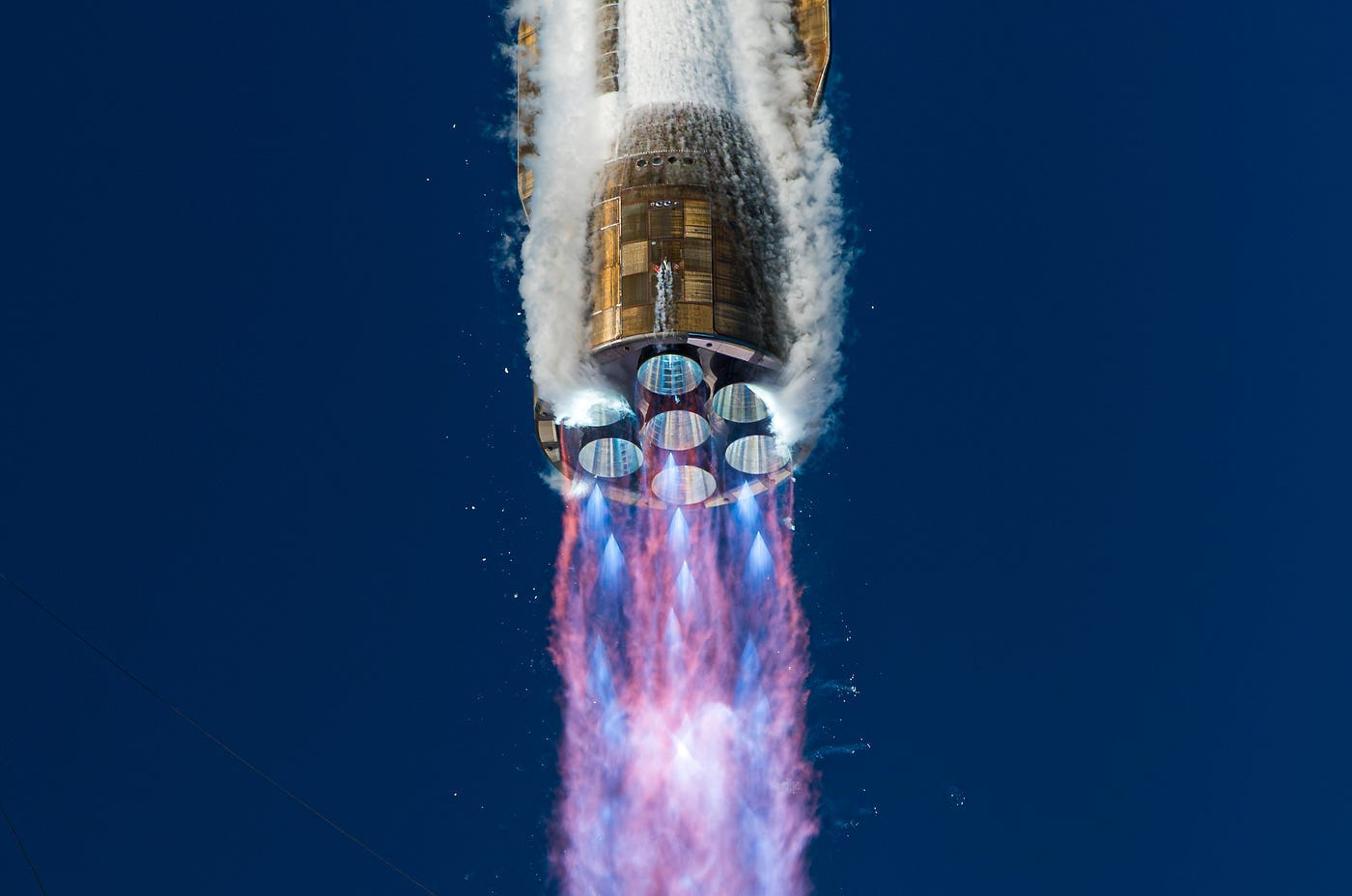
The first Space Race was an intercontinental ideological battle that eventually culminated in one of the most complex acts of cross-border cooperation: the ISS. By comparison, the new ‘space race’ is just a billionaire dick-measuring contest, and, like most men who peaked twenty years ago, some are struggling to even get it up (i.e., Starship). Now, Blue Origin is beginning to overtake SpaceX, much like the tortoise to the hare. However, unlike Starship, their New Glenn rocket (which is Starship’s direct competitor) is actually walking the walk. Last Sunday, Blue Origin launched its New Glenn rocket for the third time, and while it experienced some rather major hiccups, it once again proved that it is miles ahead of Starship. But should we celebrate Musk taking an L here?
NG-3
Let’s start with this launch, which was called NG-3, because despite it being called a test launch, it wasn’t really a ‘test launch’. NG-3 carried a paying customer’s payload, a gigantic AST SpaceMobile cellular internet satellite called BlueBird 7, which New Glenn was tasked with taking to Low Earth Orbit (LEO).
However, NG-3 did have other objectives; namely, this was the first time they reflew a booster. From a conceptual standpoint, New Glenn is essentially a larger, more powerful and more efficient version of SpaceX’s Falcon 9 because it is partially reusable, with the upper stage/fairing being a consumable part and the booster using retro-rockets to safely return to Earth for future use. Blue Origin failed to land the booster from the first launch but successfully landed it on the second. NG-3 used that landed booster, making it the first time a New Glenn booster had been reflown. Proving reusability was a key target for this mission, which is exactly what they did.
For the most part, NG-3 went well. It left the launch pad, the stages separated successfully, the booster flew back and landed safely, the upper stage reached orbit, and the payload was successfully delivered to orbit. It was a nearly perfect mission, except for one giant caveat.
The payload was delivered to the wrong orbit!
As TechCrunch reported, just two hours after launch, Blue Origin announced that it had placed the $30 million, 6.1-metric-ton, 233-square-metre satellite in an “off-nominal orbit”. Then, AST SpaceMobile released a statement that New Glenn had placed the BlueBird 7 satellite into an orbit that was “lower than planned”, that this orbit was too low “to sustain operations”, and that the giant BlueBird 7 satellite would need to be deorbited as soon as possible.
That is… less than ideal and does mean that Blue Origin failed its primary mission.
Since then, the FAA has grounded New Glenn and launched an investigation. That might sound alarming, but it’s just standard procedure. Plus, Blue Origin has already admitted to its mistakes. Blue Origin’s chief executive, Dave Limp, claimed that this error occurred because of a lack of “sufficient thrust” in a single engine — which is, most likely, a fixable issue, given that these engines have worked well enough before.
In Context
Delivering a satellite to the wrong orbit might sound like a biggie, and I’m sure it is to AST SpaceMobile, but in the grand scheme of things, NG-3 was still a sizeable leap forward for Blue Origin.
Let’s not forget that this is just its third launch. New Glenn’s first launch, NG-1, was partially successful, as it placed a dummy satellite in Medium Earth Orbit (MEO) but failed to land its booster. Its second launch, NG-2, was a complete success, launching two NASA missions to Mars and safely landing the booster (read more here). So, the fact that NG-3 was only a partial success is still a significant step in the right direction, as they have demonstrated their booster can be relaunched.
Let’s also not forget the name of New Glenn’s biggest competitor. New Glenn is a reusable heavy-lift vehicle designed to lower the cost of launching satellite constellations and crewed missions to the lunar surface. It has exactly the same mission brief as Starship; it just goes about its role in a very different way.
Additionally, by Starship’s third test flight, it had failed to land a booster (let alone relaunch it), launch with a payload, launch without significant engine issues and make it to orbit. In terms of progress per launch or progress per development spend, New Glenn is still miles ahead of Starship. In fact, NG-3 proves it has leapfrogged Starship, as even after 11 test flights, Starship has yet to reach orbit or deliver a payload to orbit. In fact, the updated second-generation Starship has explosively failed during three out of five launches. This means that not only is New Glenn demonstrably more capable now, but it is also statistically more reliable, even after the failure of the NC-3 launch.
So, yes, NG-3 was technically a failure, but not to the same extent as the Starship launches.
The Moon
This is really important, because it looks like Blue Origin is on track to take Starship’s Artemis III contract!
Thanks to Starship’s glacially slow development pace, NASA has opened up its contract to launch Artemis III to others, mainly Blue Origin, as they are the only other company with a launch vehicle and a lunar lander in the works.
Blue Origin is making rapid progress developing its MK1 Blue Moon lunar lander, which is designed to carry three tons of cargo to the lunar surface. Blue Origin’s Blue Moon MK1 is set to complete a lunar landing demonstrator mission later this year and will be launched by New Glenn.
But Blue Origin is also making rapid progress on their MK2 Blue Moon lander, which can carry either 20 tons or two astronauts to the lunar surface. This lander does require the upgraded super-heavy variant of New Glenn, the 9x4 (read more here); however, with New Glenn’s fast progress, they seem to be on target to launch this variant by early 2027. This is ideal, as Blue Moon MK2 was selected as the lander for NASA’s 2030 Artemis V lunar mission on the caveat that Blue Origin undertakes an uncrewed demonstrator mission before 2029.
With Starship currently totally unusable, New Glenn 9x4 and Blue Origin MK2 might be NASA’s only viable option. There is a growing consensus that unless something drastic changes, NASA will give these lander contracts to Blue Origin and delay all lunar missions, including the upcoming Artemis III, until they are ready.
So again, while NG-3 was a failure, the fact that Blue Origin is still progressing and is, arguably, mostly on target to complete these deadlines is huge! The main question is whether the FAA investigation will cause significant delays. That entirely depends on the severity of the engine problem, which is a pretty big caveat. However, even with these delays, New Glenn is winning the race against Starship.
SpaceX has essentially set itself up assuming it would receive these multi-billion-dollar contracts, so the fact that there is a real chance someone else could take them might leave Musk in the lurch. This is especially true when you consider that SpaceX’s upcoming IPO will put the company’s financials and business practices under the spotlight.
Is This A Win?
This might ‘feel’ like a win for common sense and decency, given that Musk is potentially taking a huge loss here. But let’s not forget that Jeff Bezos is behind Blue Origin, and he isn’t exactly any less oligarchical than Musk. He is just marginally better at protecting his public image.
Firstly, it’s not like Bezos’s plans for New Glenn make significantly more sense than Musk’s. After all, Blue Origin also hopes to launch thousands of satellite data centres into orbit. If you want to know why that is an utterly moronic idea, read the article here.
However, Bezos’s overall plan for New Glenn is functionally identical to Musk’s for Starship — to make NASA dependent on them, potentially shuttling tens of billions of dollars in taxpayer funds into their coffers, and to use the rocket to build a giant satellite internet constellation, giving them incredible power over how information is accessed and shared across the globe.
I trust I do not need to explain why all of that is bad…
Don’t get me wrong, I am glad someone is challenging SpaceX and its insanity. And I do think in the long term, New Glenn will be a far more successful rocket than Starship. In that sense, New Glenn’s development is a win for real-world engineering and common sense.
But if you value ethics, denounce oligarchic structures of power, or believe resources like the internet or space should be democratically owned and operated, this is far from a win for anyone but Bezos, despite the mishap.
Thanks for reading! Everything expressed in this article is my opinion, and should not be taken as financial advice or accusations. Don’t forget to check out my YouTubechannel for more from me, or Subscribe. Oh, and don’t forget to hit the share button below to get the word out!
In my head, SpaceX is Bogs Diamond, Blue Origin is Captain Hadley, and the US is Andy Dufresne.
Sure, it’s great Hadley bet up Bogs but… we’re still trapped in Shawshank.