
Somehow, Tesla's Robotaxis Are Even Worse Than We Thought
Who would have guessed?!

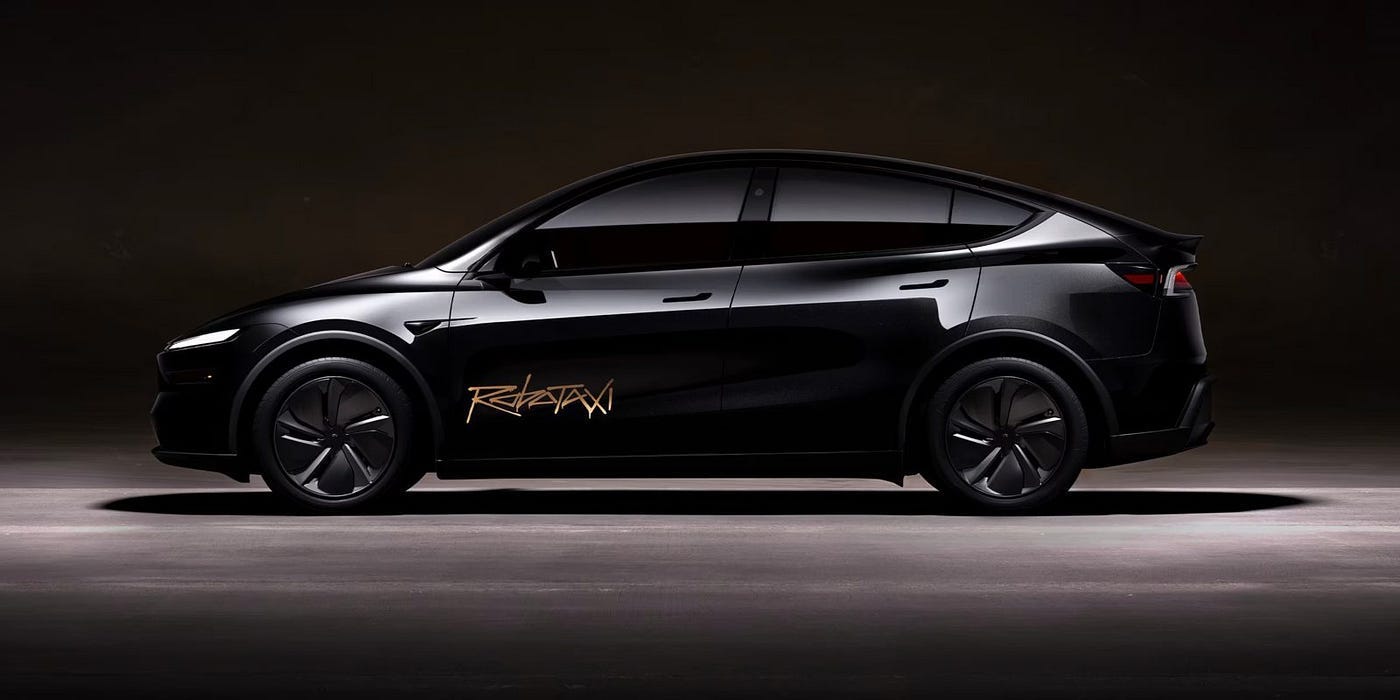
Does anyone actually think the Tesla robotaxi rollout is going well? I’m not sure even Musk fanatics are all that convinced. The news broke a few days ago that Tesla’s Texas robotaxi fleet is just 42 strong, a far cry from the 1,000-a-month after-launch total Musk promised. I’m used to seeing Tesla fans drink the copium and run to Musk’s defence, but it seems their fight has run out. It’s almost like they have finally realised you can trust a damn thing this compulsive liar says! Well, even Tesla insiders are loudly calling BS on Musk’s self-driving taxi.
You see, Reuters interviewed nine former Tesla data labellers and a former self-driving engineer about Tesla’s Full Self-Driving (FSD), the system behind Tesla’s robotaxis and ‘supervised’ self-driving consumer cars. And, let’s just say their reviews weren’t exactly glowing.
Seven of the data specialists outright said they wouldn’t ride in a Tesla being controlled by FSD. They said they had “all seen it fail,” with one even saying that they wouldn’t ride in a Tesla robotaxi “if you f**king paid me.” Which isn’t surprising, considering five of them reported constantly seeing the robotaxis exceed speed limits. The self-driving engineer said that Musk’s proclamations that FSD is ready for “safe unsupervised” rides are flat-out lies, saying “Definitely don’t trust Elon on this.”
When the people whose job it is to get these systems working tell you that it is this crap, you run for the hills.
But, quite frankly, we shouldn’t be shocked.
FSD Tracker crowdsources data from customers who bought FSD for their Tesla, and its results are fascinating. As of writing, they have logged more than 344,000 miles with the V14 version of FSD, the same version used in Tesla’s Robotaxis. They found that in the city, you know, where robotaxis operate, FSD V14 has an average distance to disengagement (when the system has to be disengaged to stop a minor incident) of just 36 miles, and an average distance to critical disengagement (when the system has to be disengaged to stop a major incident) of just 869 miles. A typical taxi drives roughly 200 miles a day. So, these numbers suggest that a truly unsupervised Tesla robotaxi would get into five minor scrapes a day, and one proper accident every week.
FSD tracker currently has the overall critical disengagement rate (which includes highway, side roads, and city driving) at an average of once every 1,996 miles. Which sounds a lot better. But, don’t forget, the average American crashes roughly once every 375,000 miles. So as it stands, FSD tracker suggests the same system Musk claims is ready for unsupervised rides, crashes at a rate 187 times more than human drivers.
But are you ready for the icing on this cake?
FSD tracker is inherently biased towards Tesla. These customers have spent a fortune to get the latest Tesla with the latest version of FSD. As such, they are far less likely to self-report when it goes wrong or underreport the severity of the failures. Moreover, they will likely use FSD only when they feel it is safe to do so, which serves as an inbuilt cherry-picking filter.
So, FSD will likely perform substantially worse than this when used to operate a robotaxi with zero human oversight.
So, why is FSD such an awful system? It’s been in development for a decade by this point; you’d think it would be at least passably good.
Well, thanks to Musk’s vicious combination of idiocracy, cavernously crippling ego, and ignorance, he set the entire system up for failure.
Most self-driving cars use a plethora of different sensors, 3D reference maps, and multiple redundant systems. This might make the vehicle more expensive and limit its operating area to places that have been mapped correctly, but it greatly improves performance. The different sensor types and detailed 3D reference maps provide redundancy, meaning that if the AI gets it wrong, as it almost certainly will, there are redundant systems in place which can check and mitigate these errors.
Cars set up like this, such as Waymo’s, don’t require 100% accurate AIs to drive relatively safely. Which is a damn good idea, because no AI can be 100% accurate, as they are statistical, not cognitive machines.
Ever the contrarian, Musk pushed for a far more ‘naked’ approach. Despite his own engineers’ pleas, he forced FSD to use only cameras (read more here). In fact, the only way FSD ‘understands’ the world around it is with its nine low-quality cameras, and a basic GPS reference map similar to Google or Apple Maps, that is it. To drive even remotely safely, the computer vision AI has to interpret the world around it with near-100 % accuracy, as there are no redundant systems to check for errors or anomalies, and even a minor error or anomaly can cause an incident. Likewise, to avoid constantly crashing, the AI driving the car needs to make decisions with near-100 % accuracy using this very sparse data.
This is why FSD has such a bad disengagement rate. The entire system is set up on the premise that the AI will eventually become functionally 100% accurate once enough data and computing power are shoved into it.
Not only is this total lack of redundancy against all good engineering practices, but a 100% accurate AI physically can’t happen, and anyone with even a passing knowledge of how AI works knows that.
For example, there is the Floridi Conjecture, which I have talked about before. Yale Professor Luciano Floridi put this forward in a paper, detailing how an AI system can either have a narrow scope and high certainty (more accuracy) or a wide scope and low certainty (less accuracy). Crucially, Floridi’s Conjecture states that an AI absolutely can’t have both a great scope and great certainty. FSD has an incredibly wide scope, even wider than other self-driving cars, as it has to cope with chaos using less data, so it can never been 100% accurate, meaning it can never be safe enough for unsupervised operations.
But as Waymo recently found out, when they had to pause their operations across much of the US due to their vehicles driving horrifically dangerously, just because you try to narrow down the scope with redundant systems and greater data fidelity doesn’t mean you have solved the problem. People seem to think I prefer Waymo to Tesla. I don’t. Self-driving cars, as a concept, are utterly moronic to the core. AI is not intelligent; it doesn’t actually ‘understand’ what it is doing, it can’t cope with chaos, and it will statistically get it wrong frequently. We shouldn’t use AI in applications like self-driving, which have such high risk, and require accuracy that it simply can’t deliver. Waymo’s solution is just less worse than Tesla’s as it actually reflects some level of engineering sense.
So, I guess the question is, how long before we actually heed the warnings of the people actually making these inherently flawed and utterly moronic contraptions? There is enough data and testimonials out there to prove that these stupid machines should be nowhere near a public road. So, can lawmakers stop pandering to authoritarian oligarchic Big Tech goons and actually serve and protect the very people they are meant to represent? You know how a democracy is supposed to work.
Thanks for reading! Everything expressed in this article is my opinion, and should not be taken as financial advice or accusations. Don’t forget to check out my YouTubechannel for more from me, or Subscribe. Oh, and don’t forget to hit the share button below to get the word out!
Great thoughts and overview, Will!
One note: I believe can is missing "'t" within "It’s almost like they have finally realised you can trust a damn thing this compulsive liar says!"
FSD is an acronym for Full Self Driving. It was a lie when Musk first sold it. It is still a lie. I don't understand why corporations can get away with lying to their customers but not to their investors.