

If there is one thing Musk is known for, it is his insane obsession with Mars. For decades, he has not just wanted to put boots on Mars but build a self-sufficient city on the oxygen-deficient, fatally cold, horrifically toxic, destructively radioactive and dangerously low-gravity Red Planet. Musk founded SpaceX on this premise, and the entire brain-dead Starship program was explicitly created to enable a Mars colony. Just a year ago, Musk even criticised NASA’s Artemis program, which has shelled out $2.9 billion to fund Starship development, saying that the “Moon is a distraction” and that “we’re going straight to Mars.” This singular point of focus has driven much of the hype and hope surrounding SpaceX. With the company’s IPO on the horizon, you’d think that Musk would be banging this drum harder than ever. But, no. Instead, Musk has seemingly abandoned his Mars ambitions and is hypocritically settling for the Moon. On face value, this decision seems to make no sense at all. But when you look at the reality of SpaceX, everything clicks into place. You see, this isn’t just another case of Musk overpromising and underdelivering but possibly the start of the biggest backtrack of the century. Let me explain.
Musk recently tweeted, “For those unaware, SpaceX has already shifted focus to building a self-growing city on the Moon, as we can potentially achieve that in less than ten years, whereas Mars would take 20+ years.” This marks a colossal shift for SpaceX. Not long ago, Musk planned to use thousands of Starships to establish a colony on Mars, with missions slated to start as early as 2024. I cannot stress how important this Mars target has been to SpaceX. Back in 2013, Musk even said he wanted to end his days living on the Red Planet. Abandoning Mars for the Moon undermines much of SpaceX’s narrative. From a morale, PR, and investor perspective, this really isn’t good.
So, why the climb down?
Well, I highly suspect this is a reaction to the failure of Starship and a reconsideration of SpaceX’s capabilities.
Starship
Firstly, let’s do a quick run-through of why Starship has failed.
It has currently only achieved 20 tons on a suborbital trajectory, which it struggles to manage. That is far less than the 100–150 tons to Low Earth Orbit (LEO) that was promised. What’s more, the fuel required to get to LEO has been estimated to be 20 tons, meaning Starship might not be able to take any payload to orbit. The planned upgrades to Starship, such as minor engine modifications and larger fuel tanks, are highly unlikely to resolve this problem.
The upper stage still can’t be reused, and reflights of both the booster and upper stage require extensive refurbishment(e.g., new engines, heat shields), meaning the cost per launch is likely in the hundreds of millions of dollars, making it egregiously more expensive than promised.
Starship is wildly unreliable, with over half of the current launch attempts ending in failure. For context, SpaceX’s Falcon Heavy has a 100% launch success rate.
On top of all of this, Starship’s operational design is utterly moronic. Starship can’t go directly to the Moon or Mars. Instead, it needs to be fully refuelled repeatedly by other Starships in LEO. There are many reasons this is dangerous and inefficient, from needlessly increasing mission-ending risk factors to extending the timeline of such a mission by years to even the current lack of payload rendering this entire approach unviable. But, by far, the worst issue is boil-off, as this means that even if SpaceX somehow delivers a 100+ ton-to-LEO-capable Starship as promised, Starship can’t realistically reach the Moon or Mars.
I have covered this issue before, but let’s quickly recap. Starship uses cryogenic liquid methane and oxygen as propellant. In space, the fuel is heated by the Sun, causing it to evaporate and dramatically increasing the pressure in the fuel tanks. To prevent the fuel tanks’ catastrophic failure, the evaporated fuel must be vented in a process known as “boiling off”. With some serious insulation, Starship may be able to achieve a boil-off rate of as little as 1% per day, but even that is too much.
Let’s assume SpaceX delivers a Starship capable of delivering the promised 100 tons of payload to LEO and that they can launch a refuelling mission once a month. How long would it take a Starship to refuel in orbit before it can go to the Moon or Mars?
The answer is, it will never be refuelled. After 14 months and the same number of refuelling missions, it reaches equilibrium at just 380 tons of propellant, or 24% fuel capacity. This is because over a one-month period, the orbiting Starship will boil off 26% of its fuel!
However, what if SpaceX launched a refuelling mission once a week? Would that solve this problem?
Not really.
After 110 refuelling missions, which will take more than two years, this Starship hits an impassable equilibrium at 1,428 tons of fuel, or 89% fuel capacity. That might be enough to take a reduced payload to the Moon or Mars. But I have estimated that a realistic launch cost for a fully reusable Starship is $70 million, meaning such a mission would cost $7.7 billion! At this price, it would be far cheaper, easier and quicker to use NASA’s SLS rocket, not to mention significantly less risky.
But again, this is all assuming SpaceX magically solves Starship’s severe payload problem. Right now, there is zero evidence that this is even possible while keeping the rocket fully reusable.
Okay, So What’s Next?
In my opinion, Starship is an unmitigated failure and a dead end. Starship can’t feasibly be used as a launch vehicle, let alone reach the Moon or Mars. The engineers at SpaceX have to be aware of this.
So, how do they solve this mess?
Well, there is a fallback. While the Falcon Heavy doesn’t have the payload capacity to enable a Mars city, it does have the capacity to handle a Lunar base. It is my wild speculation that this is why SpaceX has shifted the goalposts to the Moon, as this is something they can do with currently operational vehicles. Let me explain how.
Falcon Heavy
The Falcon Heavy is the antithesis of Starship. It has a 100% launch success rate. Because of its more traditional upper stage, it can easily integrate with third-party spacecraft, landers and base modules. And because it isn’t dragging half of the rocket across the solar system, it can reach the Moon in a single launch with no refuelling required, which makes missions cheap, reliable and quick. It has a much easier path to certification for human spaceflight than Starship, as it has a safe launch history and is based on the already-certified Falcon 9. All of these factors, combined with its good-enough payload capacity, makes it a surprisingly brilliant candidate for lunar missions.
Okay, but what is Falcon Heavy’s lunar payload? And what would a Falcon Heavy lunar base look like?
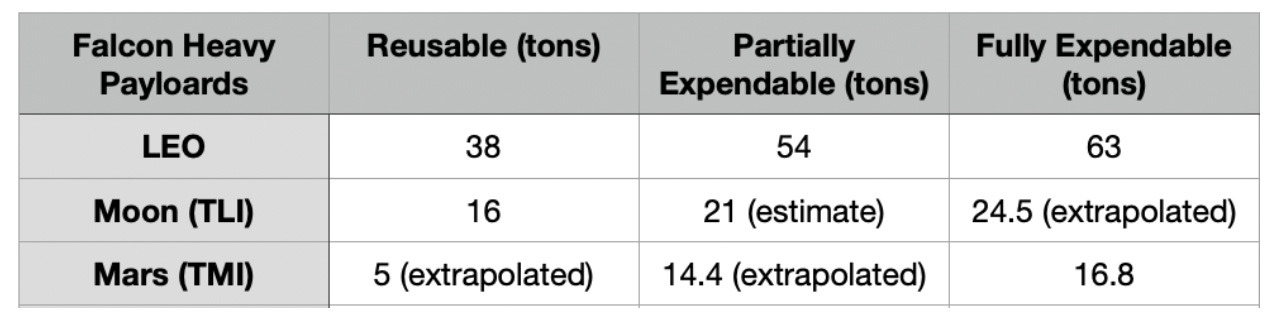
Nailing down Falcon Heavy’s payload capacity is a challenge. It has three different launch configurations — fully expendable, where all three boosters are lost; partially expendable, where two boosters are landed, with the central booster lost; and reusable, where all three boosters are landed. We know Falcon Heavy’s LEO payloads: 38 tons reusable, 53 tons partially expendable, and 63 tons expendable. We also know that when fully expended, Falcon Heavy can deliver 16.8 tons to Mars, and multiple estimates have put its payload to the Moon when partially reusable at roughly 21 tons, and 16 when reusable.
After combining this data and extrapolating using the ratios of the LEO payloads, we get the table below:
Okay, but how much do these different configurations cost to launch? Well, back in 2022, SpaceX listed $97 million for a reusable Falcon Heavy launch. Since then, no reusable flights have occurred, so this is the most up-to-date price we have. Prices for partially reusable launches are on average $150 million, and fully expendable launches typically cost $300 million.
Lunar Base
So how could SpaceX use Falcon Heavy to build a lunar base? How long would it take? How much would it cost?
There are plans for a usable lunar base for eight astronauts, built from six 10.2-ton modules assembled in orbit around the Moon and then gently landed. This hypothetical base can be expanded later with additional modules.
A partially reusable Falcon Heavy can just about carry two of these modules, meaning it would take just three launches to get the base built in orbit around the Moon. Three fully reusable Falcon Heavies can carry the crew and their lander, supplies and scientific equipment, respectively. That equates to a total launch cost of $741 million. The fastest SpaceX has launched Falcon Heavy is once every other month — at that rate, the base, the crew and their supplier could be delivered to the Moon in less than a year.
The cost of developing, testing, and building this exact base is unknown, but NASA has previous estimated the cost of a similar Lunar base to be $10 billion. For now, let’s assume NASA sorts out this cost, not SpaceX.
This shows that Falcon Heavy, a rocket SpaceX has had since 2018, can feasibly be used to deliver an entire lunar base to the Moon, its crew, its supplier and all the instruments they need for less than half the cost of a single NASA SLS launch. That is damn impressive!
What is less impressive is that SpaceX has likely spent more than $10 billion to date on Starship development. So, if they didn’t go down that rabbit hole, SpaceX could have already developed, tested, built and delivered a Falcon Heavy-delivered lunar base!
Why Not Mars?
Okay, so why not use Falcon Heavy for a Mars base?
Well, it takes only a few days to get to the Moon, and we can make the trip any time. However, it takes around 120 days to reach Mars, and that is when it is closest to Earth (which happens roughly every 26 months).
Let’s assume this hypothetical Mars base is built in the same way as this lunar one, with the base built from multiple modules ahead of time. Let’s also assume that a lander is waiting for them in orbit around Mars and that a return rocket has already been delivered to the base. As such, the final rocket will only have to carry the crew and their supplies for the 120-day trip.
However, SpaceX’s Dragon capsule, which is only designed to carry four crew or cargo to the ISS, not both at the same time, has a launch mass of 12.5 tons. Our hypothetical Mars-bound capsule will require far more supplies and equipment, including better radiation shielding, toilets, beds, exercise machines, waste management systems, water recycling systems, etc. Just the food supply for a crew of four for this Mars trip will weigh one ton, so this hypothetical totally stripped-back Mars-bound capsule, with no relaunch from Mars capability and no lander, will likely weigh well north of 15 tons, if not 20. And that is more than Falcon Heavy can launch to Mars.
Quite simply, Falcon Heavy isn’t good enough for a Mars mission, let alone a Mars base.
The Moon, Not Mars
This is why I suspect SpaceX has made this change. With Starship going nowhere, the Red Planet is obviously out of reach. But SpaceX has had a lunar base-capable rocket since 2018! Not only that, but because of how accessible the Moon is and how quick and relatively cheap it is for Falcon Heavy to deliver these modules to the Lunar surface, such a base could be rapidly expanded into a city-like settlement. Now, I am not saying this is an easy thing to do (far from it, in fact), but it is, at least, feasible.
And that is what SpaceX needs. You see, SpaceX’s value isn’t really found in the rockets but in the ability to unshackle capitalism from democratic accountability and governance. After all, who do you think will be the ruler of this city? Musk is openly an anarcho-capitalist and a lover of industrial feudalism, and that is what these off-world settlements promise to enable. There are plenty of investors out there who would love to circumvent pesky laws and democratic movements and are happy to put serious cash on the line to achieve these means, and that is one of the reasons SpaceX has become so valuable.
But if these investors begin to recognise that Starship is an obvious dead-end failure, it totally undermines the Mars narrative. Switching to the Moon, while proving all of Musk’s critics for the past twenty years who said we should settle on the Moon first, not Mars, correct, at the very least, enables this narrative to thrive, as it is possible with SpaceX’s current hardware. And that is damn important with SpaceX’s reported upcoming IPO: a belief that SpaceX has the potential to create a colony separate from our jurisdiction.
This is already the walkback of the century, not just because it isn’t the Mars colony Musk promised, but because it implies that SpaceX knows Starship won’t work. This could very easily be the first domino in a cascade of broken promises and backtracked goals in an attempt to recognise reality while desperately trying to keep Musk’s insane narrative and his cult of personality alive.
Thanks for reading! Everything expressed in this article is my opinion, and should not be taken as financial advice or accusations. Don’t forget to check out my YouTubechannel for more from me, or Subscribe. Oh, and don’t forget to hit the share button below to get the word out!
I don't know anything about anything,
But
It seems like when people with minimal institutional knowledge about an industry begin their quest for "tech disruption" and exploit "market opportunities" they tend to make poor design choices from the beginning. Those poor design choices have massive unexpected consequences.
And before you know it, the captain of industry turns into a caricature of a villain from a Saturday morning animated space opera marketed to 7-13 year olds.
The ketamine NAZI has broken many laws and should be in prison! Any investor that is stupid enough to put monies in any of his scams should deserve to lose all of their monies!!!