
AI Insiders Are Preparing For The Bubble To Burst
And it aligns with OpenAI's predicted demise.

There are so many signs that the AI industry exists in the mother of all bubbles that it can be hard to see the forest for the trees. For example, the total lack of productivity growth, zero GDP growth from AI, OpenAI’s own research on the limitations of today’s models, and the countless studies that show just how useless these machines are. But possibly the most interesting is the recent revelation that AI insiders, who arguably profit the most from this bubble, are preparing for the entire thing to collapse in just a few years. This isn’t as significant a red flag as it sounds. Businesses make such contingencies. But it is a deeply insightful piece of context that reframes the entire AI hype train.
To explain why this revelation is so important, we need to recap a few things.
As I have covered before, the AI industry is currently neck-deep in circular financing. AI companies like OpenAI, AI hardware operators like Amazon or Coreweave, and AI hardware suppliers like Nvidia are funding each other to the tune of hundreds of billions of dollars in a large-scale corporate circle jerk to increase each other’s value and prevent loss-making AI labs from collapsing. For example, Nvidia and Amazon recently gave OpenAI tens of billions of dollars, but in return, OpenAI will use almost all this money to buy their AI chips and use their AI data centres. Unfortunately, OpenAI’s annual losses are only growing, as its models become more and more expensive to train and operate. So it needs a constant flow of these gargantuan cash injections to stave off bankruptcy. In other words, established data centre giants like Nvidia and Amazon are funding colossal, unprofitable AI companies to drive up demand for their hardware, operations, and sales and, in turn, increase their share value.
When viewed through this lens, the AI bubble could be seen as Big Tech using AI to grift the economy and increase its value.
Now, admittedly, AI companies like OpenAI have other sources of financing, such as debt. But they can only rack up so much debt before it completely decimates them. As such, this drive to increase demand for AI data centre sales and operations through circular financing is mainly responsible for the AI bubble.
Why does that matter? Because it has caused the RAMpocalypse.
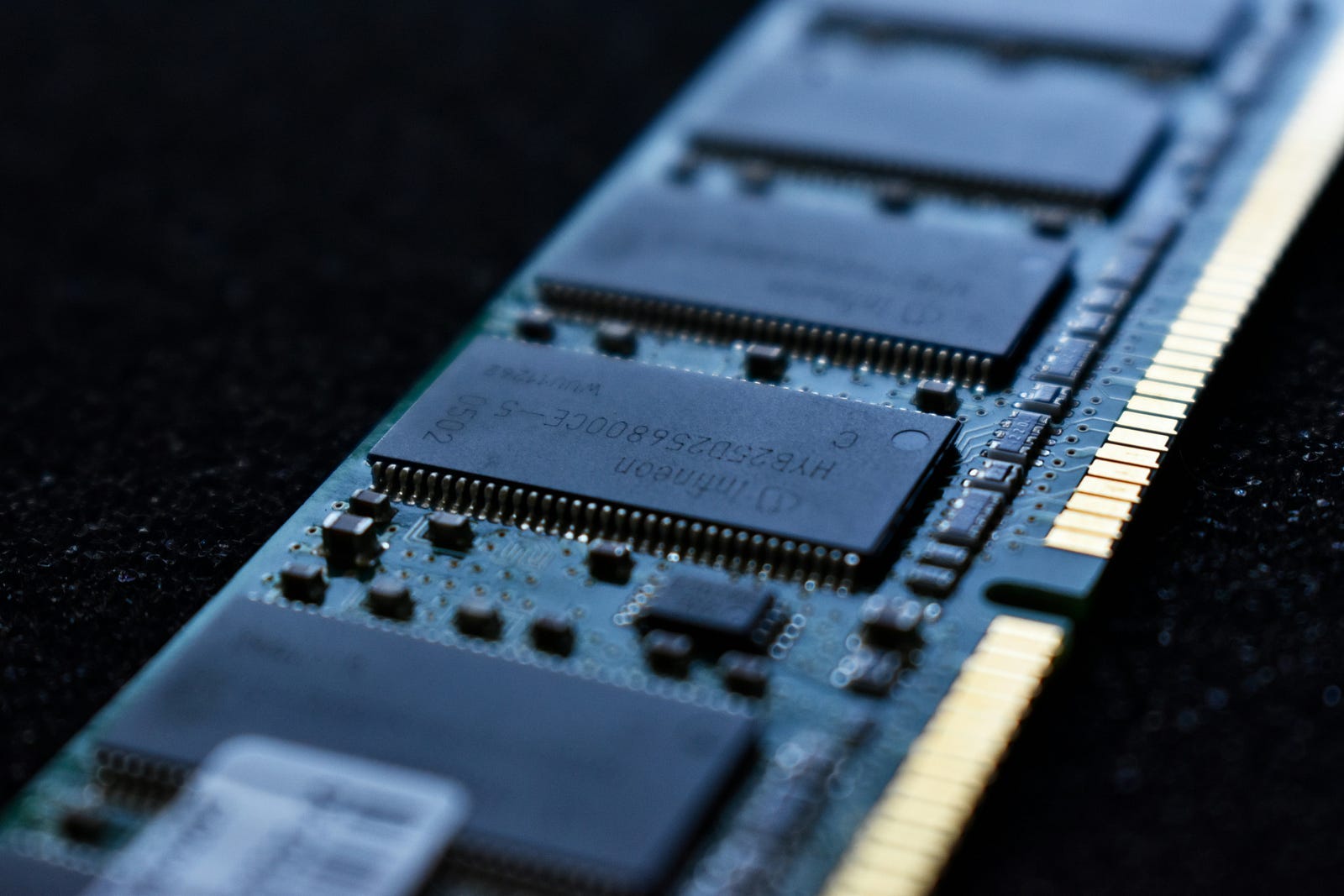
AI infrastructure requires truly enormous amounts of high-speed computer memory. This has caused demand for high-speed memory such as DRAM, VRAM and HBM to skyrocket over the past year and a bit. Sadly, production of these chips is slow to expand, causing demand to significantly outstrip supply and prices to explode. Tech enthusiasts have labelled this the “RAMpocalypse”, as the consumer computer component most affected by these insane price hikes is RAM. Some variants of consumer RAM have increased in price by 500% over just three months!
Those inside the AI circular financing bubble are not the manufacturers of these chips. In fact, there are only three main manufacturers involved: Samsung, SK Hynix, and Micron, and they sell the chips to companies like Nvidia. All three are set to make record profits from these price spikes and arguably might be the ones profiting the most from the AI boom, with them set to pocket around half a trillion dollars. Selling shovels in a gold rush and all.
Now, all three manufacturers are trying to expand production to meet this higher demand. SEMI forecasts that overall 300mm wafer output (used to make these types of memory) is set to increase at a 7% annual growth rate from late 2024 through 2028. But, when you consider that new AI data centres are predicted to use 70% of the memory chips produced in 2026 and that we are expected to deploy exponentially more AI data centre capacity each year until long beyond 2030, that supply increase likely can’t keep up with demand.
Simply put, the AI bubble is directly causing the RAMpocalypse. If the AI bubble continues to grow, the RAMpocalypse will follow in its footsteps. But the opposite is also true. If the AI bubble pops, then the RAMpocalypse will end because memory demand will crash.
And guess who knows that? These memory manufacturers.
As reported by Chosun, Samsung, the largest of the three memory manufacturers, expects the current memory shortage to end by 2028. Understandably, Samsung is cautious about overinvesting in production capacity expansion so as not to be stung by this predicted downturn. In other words, they don’t want to get whiplash from trying to capitalise on the current skyrocketing demand, only for that demand to collapse, leaving them with cavernous losses and a supply-side glut.
This is a surprising revelation to say the least, as back in January, Samsung was reportedly looking to expand its memory production capacity by 50% by the end of this year.
If you add one and one together here, it is very obvious that Samsung has realised there is a very real chance that the AI bubble will burst in the next two to three years, has developed cold feet, and is seriously rethinking its planned expansion. This doesn’t necessarily mean they believe the bubble will burst but that there is a strong enough likelihood of this happening for them to create contingency plans that could limit their near-term growth.
So, what happened in the past few months to spook Samsung so deeply?
We don’t know, but it does align with a broader realisation that the AI bubble is rapidly spiralling towards destruction.
For example, by late January, it was becoming increasingly obvious that OpenAI was growing desperate. Its Sora and Atlas projects had functionally failed, its deeply worrying financial issues had become more publicly known, and Altman announced OpenAI would roll out ads, which he previously called a last resort. This led many analysts and pundits, including myself, to predict that OpenAI would go bankrupt in the next few years. One of the most prominent was The New York Times’ Sebastian Mallaby, who estimated that OpenAI will declare bankruptcy between now and sometime in 2027.
While Anthropic is beginning to overtake OpenAI in terms of users, OpenAI is by far the largest driver of the financial side of the AI bubble. So, if OpenAI goes bust, it very well could pop the entire bubble.
And I think it was revelations like these that made Samsung reassess what they were getting themselves into.
Again, Samsung’s newfound caution isn’t the red flag it might seem at first glance. This isn’t some ground-breaking scoop where I can predict the exact date the tech bros’ empire will crumble. But it is deeply telling that the company that is arguably profiting the most from the AI boom is beginning to view it as a bubble that could blow up in its face soon. Tech bros are on a colossal propaganda campaign to give us all AI FOMO (Fear Of Missing Out). Yet, those who would profit the most from this bubble have a fear of being burnt by hollow promises and an imploding industry. This simple piece of context potentially reframes the whole narrative.
Thanks for reading! Everything expressed in this article is my opinion, and should not be taken as financial advice or accusations. Don’t forget to check out my YouTubechannel for more from me, or Subscribe. Oh, and don’t forget to hit the share button below to get the word out!
Memory manufacturers know boom and bust cycles better than almost anybody. If they're signaling a bust coming on, it's a pretty reliable signal.
Reading your astute analyses gives me such hope! That, when the wreckage of the AI bubble is cleared away, we can return to a human world driven by human intelligence and human activity and human wisdom. And that the millions who are currently under the spell of ChatGPT and its ilk will wake up to the power of their own knowledge and creativity and devote themselves to rebuilding society via their, and everyone's human capacities.