
Was The SpaceX IPO A Success?
It isn't a simple yes-or-no question.

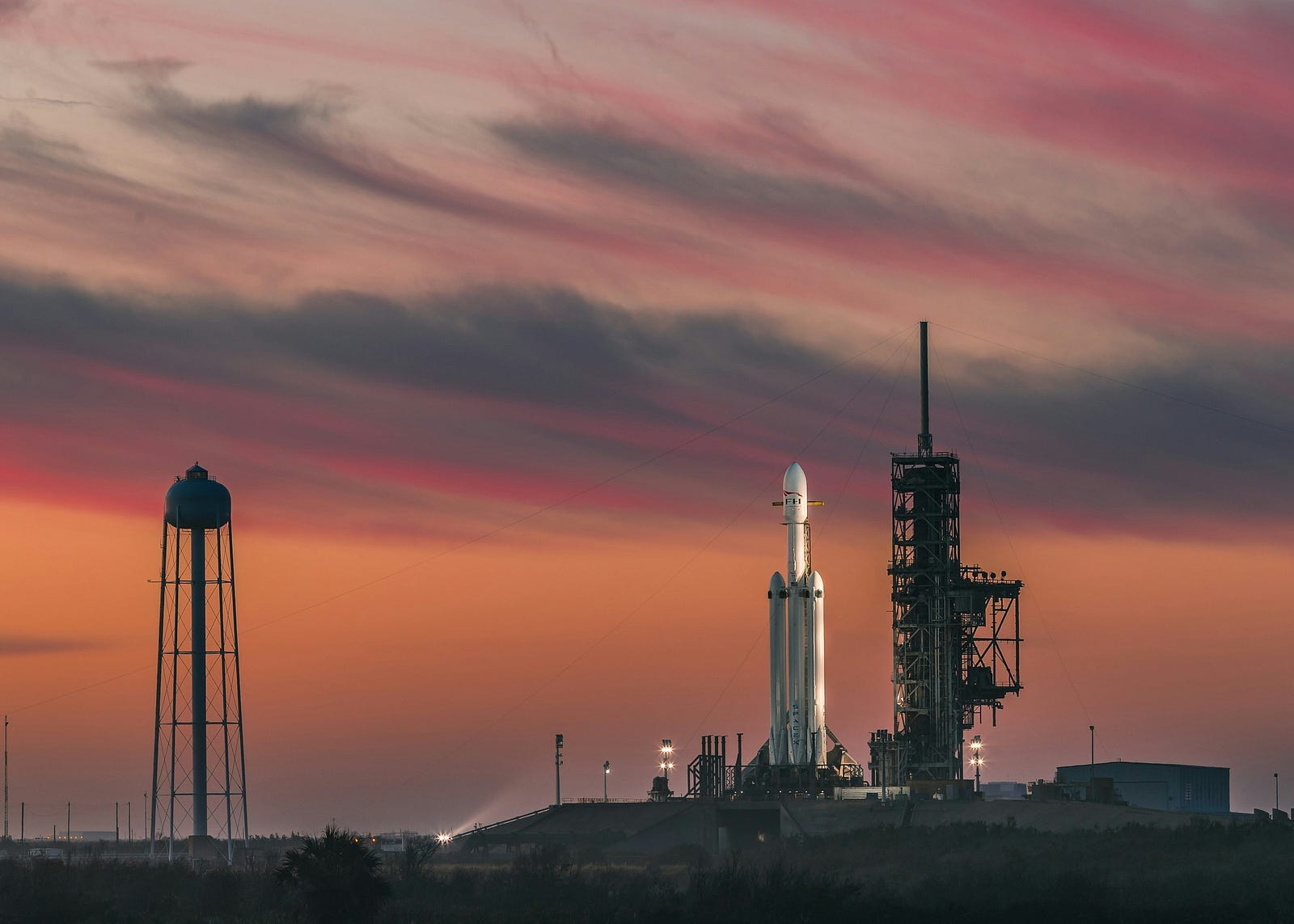
SpaceX’s IPO was always going to be a wild, erratic and chaotic ride. That is why I have waited so long to comment on it. Due to the obviously BS nature of SpaceX’s business plan and the rigged way the IPO was launched, it was anyone’s guess as to what would happen. . You might think that because Elon Musk is now comfortably the most grotesquely greedy man alive — sorry, I mean, the world’s first trillionaire — that this IPO was a success. After all, the pathetic man got the hollow title he desperately craved so that he could feel something. But now, a few weeks down the line, we can see that this IPO is actually quite a mixed bag.
So, let’s start with a positive point. It was a success because SpaceX managed to sell its shares at a $1.77 trillion valuation, raising just over $85 billion, which is $10 billion more than they targeted. That makes this by far the largest IPO in history. The fact that they were able to pull this off is objectively impressive — particularly when you realise that many analysts claimed SpaceX was worth half of this colossal figure.
But this IPO was heavily engineered. SpaceX only floated 5% of its stock, with 70% of that reserved for retail investors, and many brokers heavily reduced the barrier to entry to buy the IPO. That means the supply was greatly restricted and demand skyrocketed because a lot of non-professional investors were suddenly able to buy it. So, while it is impressive that this IPO went well at all, a sizeable chunk of its success is thanks to this manipulation, not necessarily SpaceX itself.
Okay, but what is an IPO actually for? Well, to raise cheap funds for the company to grow rapidly. Indeed, the general notion is that this mountain of cash will be used to finally get Starship working (which it won’t, read more here) and to put a ton of AI data centre satellites in space (which will never be economically viable or scalable, read more here).
Unfortunately, to meet these goals, $85 billion is nowhere near enough. As Cape Fear Advisors points out, SpaceX faces around $235 billion in spending commitments through to 2030. On top of that, SpaceX was going to use its IPO to pay down an extremely expensive $20 billion loan (which SpaceX inherited from xAI and X), meaning that only $65 billion from this IPO would go to these spending commitments over the next three and a half years. That is just 27.6% of what they need! But, in reality, the financial situation is likely even worse. Because Cape Fear Advisors’ analysis is based on SpaceX’s S-1 filing, it likely drastically underestimates the cost of Starship development and doesn’t fully include the cost of deploying orbital AI data centres. In other words, over the next few years, SpaceX will have to raise hundreds of billions of dollars more in cash, or its main value proposition will fail.
In fact, SpaceX has just taken on $25 billion in corporate bond debt and used it to pay off prior debt rather than using its IPO funds to pay it off. This kind of debt is damn expensive, and it is highly unusual for a company to take on so much debt so soon after an IPO (especially the largest IPO in history), since an IPO is a far cheaper source of funds. It also heavily implies that SpaceX will seek to fund its upcoming spending commitments with debt, not share sales.
So, from a cash-raising perspective, this IPO was a total failure! They simply haven’t raised enough funds to grow and should have floated a much larger share of the company (though that would have destroyed their manipulated high valuation).
But let’s be honest: we all know this IPO was never really about raising funds. It was about capturing the peak of the bubble and pushing SpaceX’s value so ludicrously high that Musk would become by far the wealthiest man on the planet. Most investors were also looking to get in early so they could make huge gains fast. Indeed, many investors’ plans were to buy early and flip quickly, kind of like share scalping, to make an enormous profit rapidly..
From that rather hollow point of view, this IPO was a success.
Retail investors who couldn’t get in on the IPO gobbled up shares as soon as they could, pushing SpaceX’s value up another trillion dollars to $2.78 trillion! That made it the fifth-most-valuable company on the planet. This didn’t just make Musk a trillionaire; his net worth ballooned so much that he could lose a trillion dollars and still be the wealthiest man alive.
But, after this meteoric rise, the stock has tanked just as quickly. On Monday, 22 June, SpaceX stock slid 16.4%, marking the biggest single-day drop for a new stock ever. When you consider that the most volatile period for most stocks is the first few weeks after their IPO, that is almost impressive (in a derogatory way). Over a one-week period, SpaceX lost a colossal 28.7% of its value from its peak. SpaceX has lost over $700 billion in market cap from its peak at the time of writing, and Musk’s net worth has dropped by over $350 billion. In fact, Musk is coming close to losing his trillionaire status, and if this sell-off trend continues, he will have lost it by the time this article is published (indeed, he has). This unprecedented slide hasn’t just impacted Musk; the majority of SpaceX investors have now had their gains evisceratedand are potentially on track to make a loss.
So, from an investor’s perspective, based on ‘capture the market’ value’,this IPO isn’t great. This volatility makes short-term gains difficult to capture. The stark downward trend also heavily suggests the business fundamentals, or even SpaceX’s pie-in-the-sky plans, are not enough to justify the stock price. This, in turn, shows that a huge collapse in value is possible. That should be deeply worrying, as while some analysts claim SpaceX is only worth $780 billion, many, including myself, still believe that figure is too high. In a previous article, I pointed out that a more realistic value (using ‘normal’ valuation metrics) is more like $122 to $244 billion. In other words, if SpaceX’s value suddenly transfers from hype to reality, the stock could lose roughly 61% to 90% of its value.
Also, as a quick side note, using market cap to calculate the overall value of a company, or the value of a major shareholder in that company, is famously nonsensical. There are loads of problems with this valuation method, but the simplest example is that if Musk liquidated his SpaceX shares, the market would be flooded, and the overall valuation would plummet. So the actual ‘free market’ valuation of Musk’s ownership in SpaceX is much, much smaller than how it it is presented. Musk is only a trillionaire because this deeply flawed valuation method is widely used.
However, this collapse in market cap is actually a huge problem for Musk.
Okay, so this IPO obviously wasn’t about raising capital to grow, and while it did give Musk his misleading trillionaire badge, that likely wasn’t the actual reason for this IPO. So what was the real reason?
Well, as I covered in a previous article, it is obviously meant to provide exit liquidity for the brain-dead idiots who invested in X and xAI, as well as SpaceX investors who, I am sure, are disappointed by Starship’s painful lack of progress. The IPO included a clause that after just three months, insiders can sell 20% of their shares. If the shares are selling for 30% above the IPO price at that time, that limit is raised to 30%. There is then a rapid rolling schedule, with insiders being able to sell their entire stake just 135 days after the IPO. For some context, insider lockout periods are typically not staged and usually last for at least a year. Moreover, thanks to clauses in their IPO, SpaceX investors waive the right to sue the company, so investors can’t raise a class action lawsuit against SpaceX for orchestrating something like, I don’t know, a rug pull.
You only set up an IPO like this to enable insiders to dump their stakes. I cannot accuse SpaceX of attempting a pump-and-dump, but all I can say is that this is pump-and-dump-shaped.
The trouble is, for these insiders to cash out, SpaceX stock has to remain valuable enough so that the value doesn’t drop to nothing when they offload. But as it stands, that is not a given. The past few weeks of trading have shown us that the SpaceX stock is incredibly volatile, and the past week has proven that there is a huge potential for a rapid drop-off (as we discussed earlier). So, there is a chance that by the time these lock-up periods end, SpaceX’s value could have dropped too low for insiders to exit. Remember that some of these insiders have more shares in SpaceX than shares currently being traded, so even if they sell a tiny portion of their shares, it could mean supply massively outstrips demand, crashing the price. Even if that isn’t the case, this volatility will make it incredibly hard for them to sell and exit, as insiders selling up will likely drive a huge exodus as investors panic.
We have yet to see whether this side of the IPO is a success. We won’t really know for another four to six months. However, if things continue in the same manner, there is a chance these insiders might struggle to exit without taking a loss.
This is why SpaceX’s IPO is not a straightforward success or failure. It might have made Musk a trillionaire on paper, but it didn’t raise enough to fund SpaceX’s growth. Also, even though the stock shot up, it came crashing down just as fast, which wiped out most investors gains. All these signs point to a difficult exit for investors as SpaceX’s value tumbles and volatility sets in. Because of this volatility, all of these downsides could be reversed in the coming weeks — or they could get exponentially worse. This IPO is not a failure, but despite what it may look like, it is not a success either. At least, not yet. What we can call it is messy, chaotic, separated from reality and deeply manipulative. But isn’t that the perfect reflection of the man behind all of this?
Thanks for reading! Everything expressed in this article is my opinion, and should not be taken as financial advice or accusations. Don’t forget to check out my YouTube channel for more from me, or Subscribe. Oh, and don’t forget to hit the share button below to get the word out!
The recent evisceration of the rules governing when a stock can be included in an index will soon mean SpaceX will be part of all the stock indices. The insiders will sell out to the index funds when they are forced to buy.
Ah, the NAZI muskrat is neither an inventor or a “businessman” with integrity! He is a manipulator and criminal for stealing everyone’s social security data with his DOGE. Finally, he is also partially responsible along with Trump and little Marco for causing the deaths of an estimated 500,000 children in Africa by destroying the US Agency for International Development!!!