
The SpaceX xAI Merger Is A Giant Red Flag
No matter how you look at this, it is bad news.

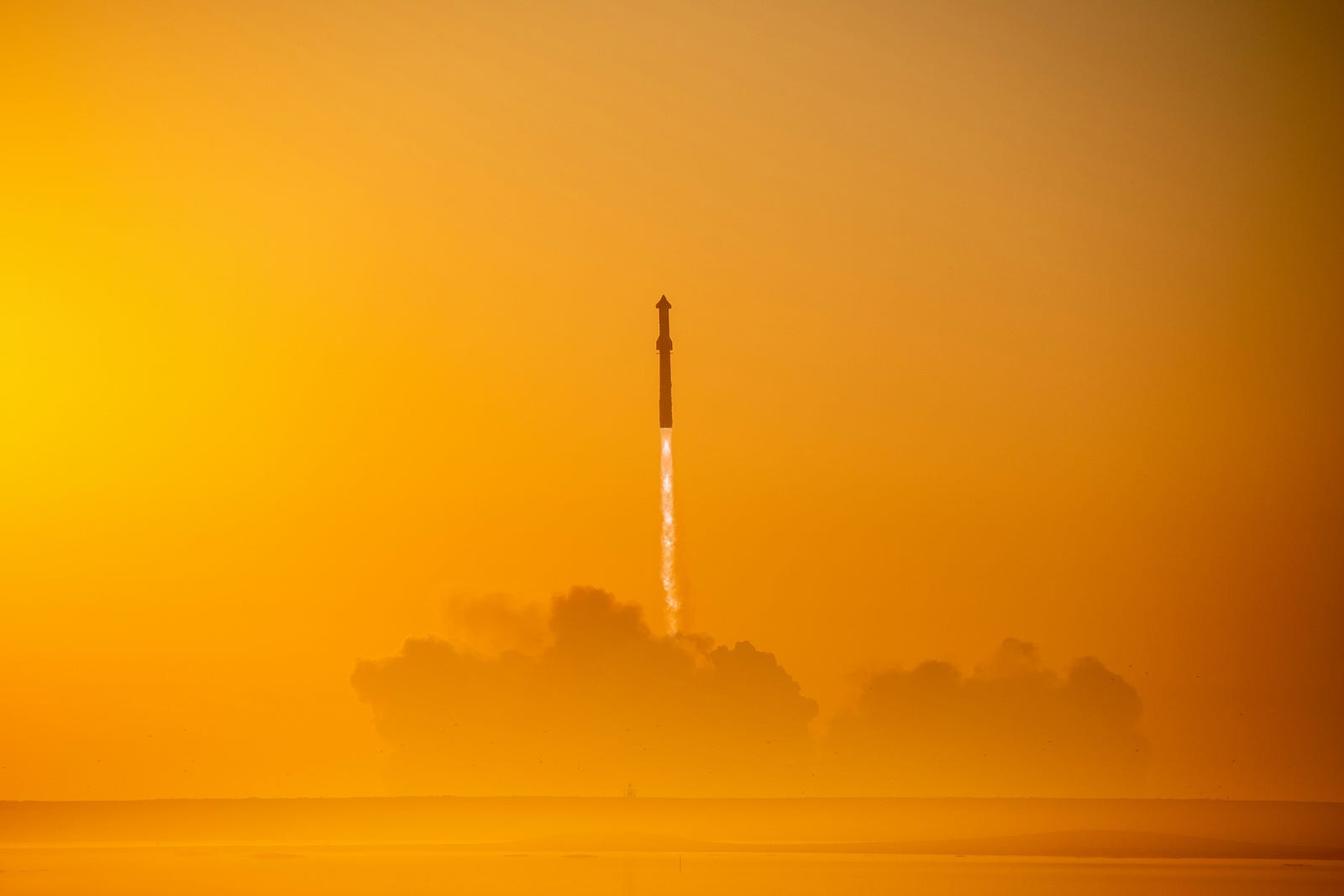
As part of an all-stock merger, SpaceX and xAI have combined into a single giant “vertically integrated innovation engine” — whatever that means. You might think these companies have very little in common, but the justification behind their merger is that SpaceX will build and launch orbital data centres that xAI models will use. Indeed, SpaceX recently applied to launch a million data centre satellites! But this narrative simply doesn’t align with reality. In fact, many consider this a bailout of xAI, given that the company’s losses are mounting and this merger allows xAI to piggyback on SpaceX’s upcoming, highly anticipated IPO. It isn’t like such a move is unprecedented; after all, xAI effectively bailed out X/Twitter in March of last year in a Musk-led merger. But, here is the interesting part: this merger might not be a bailout of xAI but a bailout of SpaceX instead. Furthermore, recent revelations suggest Musk will use this merger to take a worryingly gargantuan leap towards anarcho-capitalism. So, let’s break this down.
xAI
It is true that xAI, like every LLM company out there, is in serious need of cash, which this merger can provide. Bloomberg recently obtained documents showing that xAI’s net losses are growing rapidly, with the company posting losses of $1 billion in Q1 2025 and $1.46 billion in Q3 2025 and a total cash burn of $7.8 billion in 2025.
Moreover, like other LLM companies, xAI’s operational costs are predicted to soar as it plans to exponentially increase its computing power. As we will cover in a bit, this is especially true if xAI opts for orbital data centres, so these losses are likely to dramatically grow in the coming years. For xAI to stay afloat, it needs a steady flow of billions of dollars to dump into this AI black hole.
This is where the merger could come to the rescue.
xAI was valued at $250 million in this merger, which isn’t much higher than its previous valuation. This means that the merger itself didn’t fund xAI. What will fund xAI is the planned public offering of SpaceX later this year. SpaceX is reportedly aiming to raise $25 billion from its IPO, and now that xAI is a part of SpaceX, it can use these funds. So, in theory, this merger could fund xAI for at least a few more years.
Orbital Data Centres
Like all tech bros, Musk loves a good circular funding setup, particularly if it spirals away totally contained within his empire. The xAI and SpaceX merger is a blatant example of this. Let me explain.
Musk has claimed that orbital data centres are the most cost- and energy-efficient way to meet the growing demand for AI computing power. The idea is that these orbital data centres will have free 24/7 solar power, no environmental or real estate costs, no construction delays, and a quick data connection to Earth via Starlink.
Musk wants to capitalise on these supposed benefits and the AI data centre rush. He has stated that SpaceX plans to power orbiting AI data centres with 100 GW of solar capacity per year. SpaceX has seemingly supported this statement by applying to launch one million satellites. Moreover, the reported reason for SpaceX’s IPO is that much of the $25 billion raised will be used to fund this orbital data centre expansion.
So, merging xAI and SpaceX makes sense, right? Rather than SpaceX renting compute power from these data centres to xAI, xAI will effectively own them. It cuts out the middleman and vertically integrates the entire endeavour, reducing costs.
Except that doesn’t match up with reality at all. You see, orbital data centres are way more expensive than terrestrial ones — so much so that Musk’s logic is nothing short of fanciful.
I have covered this topic before (read more here and here). But to meet the power demands of even a single AI data centre rack, you need a colossal solar array. This data centre rack also needs to be cooled, but that is pretty damn hard in space, because there is no atmosphere, and it is completely exposed to the unfiltered sun! Therefore,a huge array of specialised radiators will also be required. Because of this, these orbital data centres are incredibly heavy and bulky, making them very expensive to launch into orbit. And to ensure they receive 24/7 solar power, they also need to be placed in a much higher orbit, such as Geostationary Orbit (GTO), which is significantly more expensive to reach than Low Earth Orbit (LEO), raising the price even further. If placed in LEO instead, they will require gigantic battery packs to see them through the periods when they are in the Earth’s shadow, which again increases their weight and cost.
By my estimation, the launch costs alone of an orbital data centre are 23 times higher than the lifetime energy costs of an equivalent terrestrial data centre. Moreover, the cost of the solar and radiator arrays, the shielding needed to protect the intricate electronics, and the assembly of the satellite will far exceed any lifetime real estate or environmental costs of an equivalent terrestrial data centre. Furthermore, because satellites fail fairly regularly due to launch problems, solar storms, normal computer errors, or orbital failures, orbital data centres will incur high costs even if the loss rate is low.
Quite simply, orbital data centres are orders of magnitude more expensive than terrestrial ones — which, when you think about it for just one second, makes total sense. So, no matter how much money xAI and SpaceX save from this proposed vertical integration; orbital data centres are going to make xAI’s already sky-high costs utterly explode!
I feel I need to give context as to just how badly these costs will surge if Musk has his way.
Putting 100 GW of solar power in orbit each year is an idea that can only be fathomed by those in the deepest depths of brainrot. For some context, the US’s current energy capacity is 460 GW. The mass of 100 GW of space-ready solar arrays is around 286 million kilograms. Launching that mass into GTO with Starship will cost just shy of $1 trillion. But purchasing that many solar arrays will cost about $30 trillion! At the moment, the entire US economy is worth $38 trillion. Now, sure, SpaceX might experience some economies of scale producing this quantity of solar panels, but even if the price drops by 90%, this entire 100 GW push will have a price tag of $4 trillion. And that excludes the cost of the data centres that all this solar is supposed to power!
But don’t worry, it gets worse! These orbital data centres, to which all this solar is attached, only stay in orbit for five years before being deorbited. So, Musk is apparently planning to spend multiple trillions of dollars every year in perpetuity to maintain his orbital data centres.
Where is all that cash coming from?
It isn’t just me who is skeptical. Analysts at MoffettNathanson have estimated that SpaceX will have to shell out $5 trillion annually to build its proposed orbital data centres.
This is why industry insiders understand orbital data centres are a non-starter. Take AWS’s CEO, Matt Garman, who recently said they are “pretty far from reality.”
So, why use an obviously flawed, painfully exaggerated, moronic, dead-end idea to justify this merger and SpaceX’s IPO? Well, there are a few possibilities, and none of them are good.
SpaceX Bailout
Ultimately, it might not be xAI being bailed out here, but SpaceX. Why? Well, because Starship development is so expensive and behind schedule.
We know that by the end of 2023, SpaceX had already spent $5 billion on Starship, and that development costs were going to soar from there. By my own estimates, each fully stacked Starship should cost roughly $500 million to build, and there have been nine such fully stacked since 2023, for an additional $3 billion. Then there are the other expenses, such as scrapped prototypes, engineering costs, infrastructure costs, etc. As such, SpaceX has likely spent over $10 billion on Starship development to date.
But where has all that cash come from?
SpaceX has raised only $12 billion in funding, with the majority of this going towards Falcon 9 and Starlink development, so only a few billion at most of that could have gone to Starship. NASA gave SpaceX $2.9 billion to fund a Moon-lander version of Starship, but there haven’t been any further government pay-outs since then. These sources might account for $5 billion to $7 billion of Starship’s funding.
The rest appears to have come from internal funding. However, SpaceX’s revenue isn’t actually that large, and the vast majority of it comes from Starlink, whose profitability is questionable. Back in 2023, Bloomberg found that Starlink’s accounts were “more of an art than a science.” Musk claimed Starlink had broken even, but Bloomberg found that they were actually losing “hundreds of dollars on each of the millions of ground terminals it ships.” There is little evidence that this has changed, especially since Starlink runs constant sales for these terminals, suggesting it may have lost billions of dollars in terminal sales in 2025. On top of that, the cost of building the 3,000 Starlink satellites SpaceX launched in 2025 is $2.4 billion. The 123 Starlink launches SpaceX undertook in 2025 cost $3.44 billion, assuming the very optimistic estimate that a Falcon 9 launch costs SpaceX just $28 million. So, even after a record year of growth, Starlink likely isn’t making much money, if any at all. Indeed, this problem might actually get worse, as Starlink’s five-year lifespan means that the cost of maintaining the satellite constellation is about to dramatically increase.
Realistically, SpaceX may have internally funded only a few billion dollars for Starship development, and Starlink likely can’t generate enough revenue to continue funding it.
In short, SpaceX may have run out of cash to develop Starship.
This is a catastrophically huge problem, as Starship is barely halfway developed.
So far, the rocket has carried just 20 tonnes of payload, or 13.3% of its promised payload, to orbit on a suborbital trajectory and struggles to do even that. What’s more, the extra fuel required to take Starship up to LEO is roughly 20 tonnes (as calculated by Thunderf00t), which suggests that Starship can currently only reach the lowest possible orbit if it carries zero payload, rendering its entire purpose as a launch vehicle useless. Additionally, SpaceX has yet to demonstrate the ability to refuel Starships in orbit, which is not only critical to its planned operations but also insanely difficult to pull off successfully.
SpaceX is expected to solve all these problems and prove that Starship is safe enough for human spaceflight in time for the 2028 Artemis III mission. At SpaceX’s current rate of development, Starship will miss this target by a long way!
This is what NASA paid SpaceX $2.9 billion for, and if SpaceX delays delivery of a Moon lander or fails to deliver one at all, it could result in major fines, sanctions or repayment plans. So, SpaceX desperately needs a major injection of cash to turbocharge Starship’s glacial development and meet this contract.
It’s also important to note that the vast majority of SpaceX’s current $1 trillion valuation stems from speculation about Starship. If SpaceX takes too long to deliver Starship, or fails to deliver at all, its value will nosedive!
With all of these factors in mind, this merger and planned IPO look more like a bailout for SpaceX. The merger and the orbital data centre narrative provide AI hype for Starship, allowing the current AI investment tsunami to flow into SpaceX’s IPO, which generates the funds needed to keep the party going a little longer.
But there is another, more worrying possible reason xAI and SpaceX have merged.
Cyber Anarcho-Capitalism
About a week ago, French authorities raided X/Twitter’s Paris offices as part of a criminal investigation into Grok for the distribution of “child pornography images”, the infringement of personal rights through the generation of “sexual deepfakes”, and the denial of “crimes against humanity”. The UK, Australia and the EU have launched similar investigations into Grok. Meanwhile, Grok is still producing this kind of content, just behind its paywall.
These investigations could very well have catastrophic consequences, and due to the corporate Russian doll situation, this entire shitshow is now SpaceX’s problem. You see, Musk’s xAI, which developed Grok, merged with X in March of last year, and now this entity has merged with SpaceX.
From a PR and corporate exposure standpoint, this investigation alone makes the merger nonsensical. Why bring SpaceX into this? Why take the risk of significant legal, political and reputational damage? If anything, it makes sense to isolate SpaceX from that.
I racked my brains for days trying to figure out why. Then it hit me, and everything made sense.
Authorities can’t regulate, legislate or raid an orbital data centre, or the hate-mongering pedo bot it hosts. By moving Grok, xAI and X into orbit, Musk can continue his heinous AI trajectory.
This could explain why Musk is okay with the insane price of orbital data centres. After all, bloodthirsty investors will pay a steep premium to get behind the only ungovernable AI, particularly when AI legislation begins to take effect worldwide.
Because this aligns incredibly well with Musk’s political stance, the technological reality, and the current economic climate, I can’t help but feel this is the actual justification for this merger: to unshackle xAI from any meaningful accountability and rake in tens of billions of dollars from painfully immoral investors drooling at the mouth at the prospect. I hope I do not have to explain why that is deeply worrying.
Summary
Whether this is a bailout of SpaceX, Musk’s diabolical march towards cyber anarcho-capitalism, or both, it doesn’t really matter. Both are bad news for the economy, the environment, and you. The fact that the media isn’t openly laughing at the lunacy of these proposed orbital data centres, and that they aren’t questioning why Musk is ploughing ahead anyway, is deeply concerning. This is a giant red flag for the state of our media landscape and critical thinking in general.
Thanks for reading! Everything expressed in this article is my opinion, and should not be taken as financial advice or accusations. Don’t forget to check out my YouTube channel for more from me, or Subscribe. Oh, and don’t forget to hit the share button below to get the word out!
The ketamine addict must really going NUTS because this is insanity business and anyone investing in this “pie-in-the-sky” deserves to go broke!!!
Kisses to the chef