
Tesla Is Dying
Cannibalised by an egomaniac and his cult, Tesla is turning into something strange.

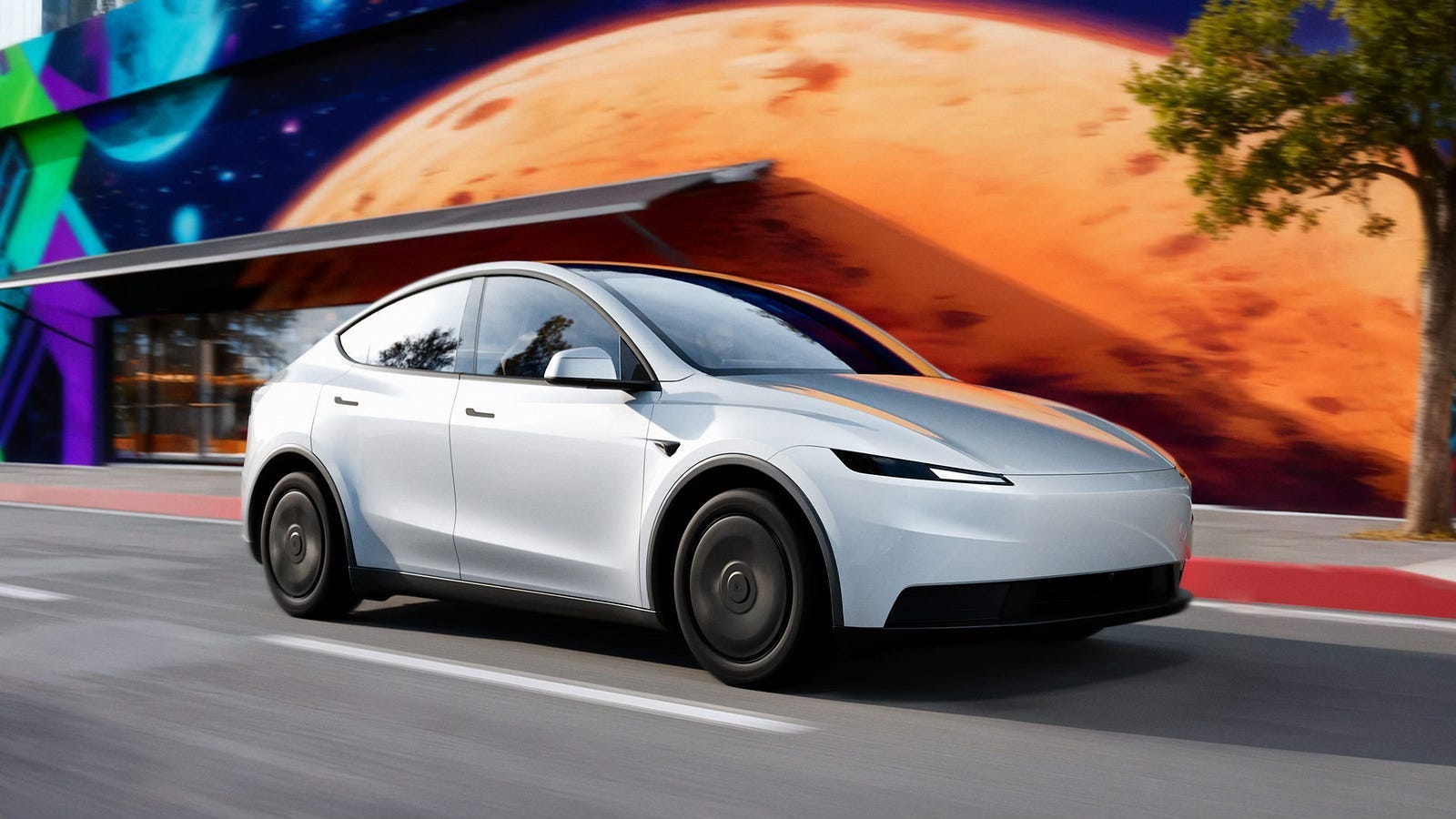
The duality of Tesla is aggravating sometimes, to say the least. Musk is allowed to agree on a record-setting ‘trillion-dollar’ pay package despite historic model flops, crashing profitability, and sales plummeting off a cliff. Still, Tesla stock prices hit insane highs, despite constant evidence that the hype and speculation are as superficial as Musk’s hairline. It makes no sense. So, what on Earth is going on? Well, Tesla is dying, and Musk is the one who drove the knife through its heart. But this death is birthing something else, something stranger. It is a sacrifice to the cult of Musk. Let me explain.
The ‘Standard’ Problem
The budget ‘Standard’ Model 3 and Y, launched back in October, are a perfect example of this.
By cutting out luxury and slashing the price by $5,000, Tesla hoped to invigorate new customers or, at the very least, stem losses as EV tax credits were phased out. But that simply hasn’t happened. According to Cox Automotive and Reuters, fewer than 40,000 Teslas were sold in the US in November 2025, a massive 23% decline from November 2024. Keep in mind that people had already started boycotting Tesla for Musk’s political decisions by November 2024. So, in other words, these new models didn’t help at all. To make matters worse, Musk’s baby, the Cybertruck, sold just 1,200 units in November, marking yet another month of declining sales.
But the issues go deeper here. Some analysts have found that these budget Model 3s and Ys didn’t bring in any new customers but instead replaced sales for the more expensive and more profitable variants. So, they are literally cannibalising Tesla’s profit.
This wouldn’t have happened if Tesla had launched its promised cheaper and smaller ‘Model 2’, as it would not only have been more affordable but it would also exist in a different sector of the market, meaning it wouldn’t compete with the 3 and Y. This would have been a much smarter way to bring in new customers without destroying already-existing profitability.
The proof of this is over the pond in Europe. In October, Tesla’s sales there were down 48.5% compared to October 2024. Again, Tesla’s sales had already begun to slip by October 2024, so this is a gargantuan fall from an already low position. For years, the Model Y was by far the best-selling EV in Europe and the UK. But in October, the Renault 5 was the best-selling EV in the UK and the second-best-selling EV in Europe, lagging just behind the Skoda Enyaq. In fact, the Renault 5 has been incredibly dominant this year, as it was the best-selling EV in Europe for the first half of 2025. Meanwhile, the Model Y has slipped to the tenth-best-selling EV in Europe, and the Model 3 is so substandard it doesn’t even make the top 20.
Why does all of this matter? The Renault 5 offers the same price, performance and specifications that Tesla once promised for the Model 2 (read more here). The 5’s wild success in Europe shows that Tesla was on the right track to maintain its hold on the EV market and rapidly expand its customer base.
So, why isn’t it here? Well, Musk rebelled against his expert executives’ advice to abandon efforts to create self-driving “Robotaxis”, which would be unprofitable, and instead focus on developing cheaper EVs to strengthen Tesla’s market lead. In fact, Musk did the exact opposite and cancelled the Model 2 to divert funds to Tesla’s self-driving Robotaxis (read more here). He had to. Musk had been claiming Tesla would drive itself for over a decade at this point. It was his personal pitch, the reason people listened to him, and the reason Tesla was a highly valuable tech stock and not a run-of-the-mill automotive manufacturer stock. He couldn’t be seen to admit fault.
The success of the 5, the ignoring of expert advice, the cancellation of the Model 2, and Tesla’s pitiful cannibalistic sales show just how poor Musk’s leadership is. Had any other CEO made such a mistake, they would have been ousted without question or resigned in shame.
Musk, his sycophantic investors, and the Tesla board explicitly sacrificed the Model 2, Tesla’s sales, Tesla’s enviable market position, and Tesla’s profitability in order to save Musk’s cult of personality from reality.
The Robotaxi Problem
Speaking of Robotaxis, they also demonstrate this disconnect.
A few days ago, a Tesla Robotaxi was spotted driving on public roads in Austin, Texas, carrying no passengers. If you don’t know, Austin is where Tesla’s Robotaxi roll-out is happening, with a small fleet of 30-ish Model Ys operating as Robotaxis for a few months now. However, they are legally required to have a safety driver in the driver’s or passenger seat, ready to intervene when the FSD (Full Self-Driving) system gets things wrong. So, this sighting of a Robotaxi without a safety driver drove significant speculation. Musk later confirmed that tests involving “no occupants in the car” were underway, suggesting that Tesla is finally testing true self-driving.
This news has driven Tesla stock to a new record high, despite its plummeting sales, as investors flock to back the actualisation of Musk’s promised autonomous future and all the riches it entails.
But — and this is a serious question here — is that actually what is happening?
Tesla only operates a tiny fleet of heavily supervised Robotaxis in Austin. That isn’t Tesla’s choice either. They have been trying to get these supervised services into loads of other cities and expand the number in Austin, yet they can’t get the permits to do so, which heavily suggests these Robotaxis are deemed too unsafe.
And there is evidence to support that statement. FSD Tracker records user-reported data from Tesla’s supervised FSD system. This is the same system used in these Robotaxis; the only difference is that Tesla owners who use FSD still have to be technically driving the car. After more than 60,000 miles logged for the latest version, 14.2, the same version being used in the Robotaxis, they found that the average distance between critical disengagements (in other words, when the driver had to intervene to avoid a crash) is only 1,835 miles, which is actually lower than the previous version. Additionally, the average distance between disengagements (when the system gets it wrong, and the driver has to take control) was just 31 miles. Those numbers are pitiful and suggest FSD is nowhere near ready for full autonomy. Particularly when you realise this is user-reported data, so it will be cherry-picked, as the users will tend to only use FSD when they think it is safe to do so, and considering they shelled out for FSD, they will likely under-report its issues too.
We also know why FSD is so awful, and it mirrors the same issues as before. You see, Musk ignored warnings from his engineers and removed all the sensors, bar the cameras, from Tesla FSD (read more here). This, combined with the fact that Tesla is developing a ‘general self-driving AI’ that is only trained to drive and not trained to operate on specific, constrained roads, has left the system with no safety redundancy and has severely impacted the system’s performance, as it is too broad to be accurate enough, making it far less safe (read more here).
Why did Musk do this? So that the system would be cheap enough to fit into every Tesla customer’s car and theoretically functional enough to be used everywhere. In a way, Musk had to do this too — it was the only way he could deliver autonomy as promised. Musk had to profoundly compromise the system to match his hollow rhetoric.
Compare all of this to Waymo. Their robotaxis are built like the Tesla engineers wanted them to be, with multiple redundant sensor suites, and trained to operate on specific roads. Sure, this means they can’t sell these vehicles as consumer products as Musk promised, but they aren’t meant to be sold; they are meant to be rented. Regardless, designing it this way constrains the AI’s task, making it more accurate, and ensures it has reliable data input, helping it not just operate far more safely but also develop far more quickly than Tesla’s FSD!
Waymo conducted its first driverless test on public roads a decade ago in 2015 and delivered its first paid-for driverless rides to the public five years ago in 2020. By 2024, Waymo’s average distance between critical disengagements was over 17,000 miles, making it significantly safer than FSD is now. This long track record of safe, reliable operations has enabled them to deploy over 2,000 fully autonomous robotaxis in five major US cities so far. In fact, they recently reached 450,000 rides per week, and with huge expansions already underway in Tokyo, London, Detroit, Las Vegas and other cities, they are on track to reach a million rides per week sometime next year. That equates to an annualised revenue of roughly $1 billion! And that is with Waymo operating in less than 15 cities across the globe, meaning that their revenue has the potential to jump dramatically in the very near future.
Waymo is storming ahead! And, given that it took them five years to go from their first driverless ride on public roads to offering those rides to the public, that isn’t a good sign for Tesla’s occupantless Robotaxi only just hitting the streets.
Let’s also not forget the red tape issue here. Waymo has proven itself from a safety perspective and also established a legal framework around its technology and for its operations. This helps it to obtain new permits quickly, which enables fast expansion.
The same isn’t true for Tesla. Sure, Musk argues that once Tesla has FSD sorted out, they can unlock it for every Tesla out there, enabling them to rapidly deploy millions of autonomous cars and Robotaxis instantly, which would bury Waymo. But that requires a totally different and unproven legal framework from the one now standard in the industry, pioneered by Waymo. Tesla’s current questionable Robotaxi operations, as well as Waymo’s flying success, also make establishing such a framework damn near impossible. It is telling that Tesla isn’t attempting to develop this new legal framework at all and is instead following in Waymo’s footsteps. The company doesn’t really have any other option.
In other words, even if FSD eventually works well enough, which is doubtful considering how Musk has openly and purposefully screwed up the design of FSD, the red tape, which is there for a bloody good reason, will likely mean Tesla can’t catch up to Waymo.
Again, had any other CEO promised a revolution in autonomous driving, bet the entire company’s future on it, and then delivered this hot mess while the competition ran away with the market, they would be ousted or resign in shame.
Robotaxis and FSD follow the same pattern as the Model 2. Musk, his sycophantic investors, and the board of directors actively sacrificed the potential of Tesla’s autonomy to keep the cult of Musk alive.
What Is Going On?
So, Musk has demonstrated time and time again just how damaging his leadership is. He prioritises personal image and rhetoric over expert advice and reality, which has delivered enormous damage to Tesla’s core business and commercial potential.
Yet, investors are not selling up, the board hasn’t ousted Musk, and Musk hasn’t walked away in shame. In fact, every time Musk fucks up, and yet another slice of Tesla is sacrificed to protect his rhetoric, his promises, and his image, Tesla’s stock prices go up, the board become even more loyal to him, and Musk’s big head gains another few inches.
Tesla and Musk, in general, were a personality cult meme stock and have been for years.
But a cult needs a sacrifice to solidify itself — something given up in order to separate their self-sustained, self-created reality from the outside world. In the case of a cult of personalities, something needs to be sacrificed to the personality — something to break critical thinking and create totally uncritical adoration and deep loyalty for the figure, as well as a rejection of an external ‘them’. This, in effect, removes the followers’ freedom, making them bow to the leader’s whims. Jim Jones’ followers left family, friends and modern convenience behind. Charles Manson’s followers gave up their autonomy. The Germans sacrificed their rights to Hitler. The followers of Heaven’s Gate’s Marshall Applewhite relinquished their worldly possessions to join him, which, for some, even included surgical castration.
While I am no expert on cults, I believe this is what Musk is doing. His followers came to him as Tesla stock investors or board members with large stakes in the company. Now, he is sacrificing Tesla’s core business to the rhetoric that brought them in. This has kicked away the support for the stock and sacrificed the real value in the investment these followers have made, leaving only Musk’s personality and rhetoric, and these investors’ belief in said personality and rhetoric, to prop up its value. If they break ranks, they all lose their investment. This means they have effectively given up their freedom to the leader, and uncritical adoration and loyalty ensue as coping mechanisms. The sacrifice has been made, the lines between Musk’s unreality and actual reality have been drawn, and control has been handed over to the leader.
With this sacrifice, Tesla has solidified its transformation into a cult. It is no longer a business; it no longer reflects reality; it is now a stock cult that worships the corpse of a business that Musk sacrificed to himself.
But notice the examples I gave for cults of personality: none of them ended well, did they? Time will tell what happens to Tesla and Musk.
Thanks for reading! Don’t forget to check out my YouTube channel for more from me, or Subscribe. Oh, and don’t forget to hit the share button below to get the word out!
Sources: Gizmodo, The Verge, Reuters, Yahoo Finance, Forbes, CNBC, TS2, FSD Tracker, Reuters, Notebook Check, Clean Technica, Will Lockett, Will Lockett, Will Lockett, Will Lockett, Will Lockett, Will Lockett
The difference between Waymos and Tesla Robotaxis in Austin is stark. Waymos are everywhere. I can't take a trip without running into some. I often see more than one at the same time in an intersection. By contrast, Robotaxis are super rare. And when I see one, usually it has the safety driver but no customer.
Musk really is the PT Barnum of our age, telling us we can go to Mars, have humanoid robots serve us, make money from leasing out our personal vehicles as robotaxis.
Other companies only sell us a car, but Musk sells us *the future*.
Actually, on second thought, other companies don’t sell cars either. They sell freedom, independence, etc. But, Musk has taken the marketing bullshit to a whole different level.