
SpaceX’s IPO Is Full Of Giant Red Flags
The ‘technoking’ is showing his true colours once again.

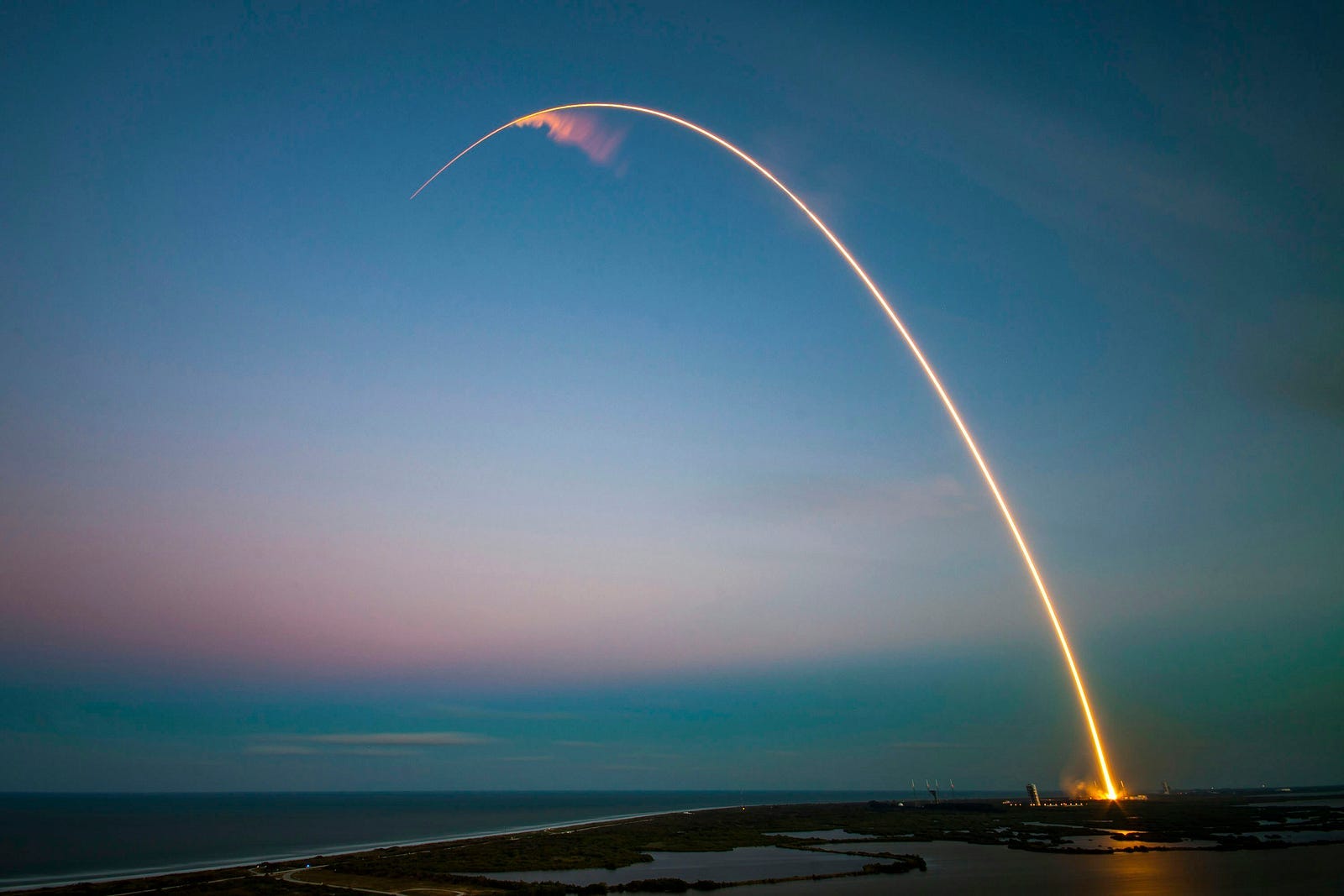
Musk’s exploding rocket company is shooting for an IPO later this year, which is shaping up to be utterly insane. From a two-tier share structure that effectively crowns Musk as a pathetic monarch to bat-s**t crazy pay packets, the usual Musk moronic f**kery is on full display. But why? What is Musk trying to achieve here? All of this lunacy can make it difficult to see the forest for the trees. But remember, that isn’t a bug; it’s a feature. Like a guy getting all up in your face so that you don’t notice him pickpocketing your wallet. So, let’s look past Musk’s bulls**t and see what is actually going on. Strap in—this is a long one.
Red Flags
Let’s start off with the red flags.
The first is the valuation. SpaceX’s IPO is slated to happen within the next few months, and they aim to value the company at $1.75 trillion, with some suggesting it could reach $2 trillion, and raise over $75 billion in capital. That is an insanely high valuation!
Then there is Musk’s cuckoo pay packet. As Reuters reported a week ago, Musk and SpaceX already agreed on a new $1 trillion stock-based pay packet back in January. Like his Tesla deal, Musk is expected to meet certain criteria for this to happen, namely, helping SpaceX reach a $7.5 trillion valuation, creating a lasting human colony on Mars of at least one million people, and deploying 100 TW of orbital data centres. There is no deadline, and once these targets are reached, Musk will be granted 200 million ‘supervoting’ restricted shares in SpaceX, equivalent to $1 trillion at the time of valuation.
Then there is what I can only describe as the god-complex red flag. According to its IPO filing, SpaceX is pursuing a two-tiered share structure. After the IPO, Musk will hold Class B ‘supervoting’ shares, which are worth ten votes each, while almost everyone else will receive normal shares. This effectively means Musk has a majority vote over SpaceX, despite holding a minority share, even after it goes public. In other words, removing Elon as CEO will become impossible, as he would have to personally vote himself out. What’s more, it gives him insane control over the SpaceX board, effectively allowing him to remove whoever he likes. Musk called himself the ‘technoking’ of Tesla a while back, and this is what that title actually represents. It is authoritarian to the nth degree.
We can all innately tell that these terms are bad, right? Unless you have taken the Musk-sphere suppository and mandatory lobotomy, then you can tell that the vibes are most certainly off.
But what is going on here? What do these red flags tell us?
Well, let’s start with what is actually wrong with them.
What Is Wrong?
I don’t think people quite realise just how overvalued this supposed $1.75 trillion IPO is. In 2025, SpaceX posted a net loss of $5 billion, which was largely attributed to their xAI bailout—I mean, purchase—but because that was an all-stock purchase, this doesn’t quite ring true. In reality, spending on Starship and AI was likely very high, and Starlink’s profitability is questionable at best, which presumably dragged SpaceX into the red. However, SpaceX also posted an EBITDA of just $7.5 billion for 2025 (Earnings Before Interest, Taxes, Depreciation, and Amortisation). That means that with a valuation of $1.75 trillion, SpaceX has an EV/EBITDA ratio of roughly 220! For now, you don’t need to know the details of what an EV/EBITDA ratio is, just that it measures how over- or undervalued a company is compared to its revenue and that a ‘healthy’ one is between 8 and 30.
For comparison, Tesla’s EV/EBITDA is stupidly high at around 120. To give you an idea of how overvalued Tesla is, critics like me estimate that its true value is 90% lower than its current value, while even major institutional analysts believe it should be valued 60% lower than it is currently (read more here). Yet SpaceX’s IPO is gunning for an EV/EBITDA nearly double that of Tesla! This pushes this IPO beyond speculative value and into truly unreal territory.
To put it simply, there is nothing to justify this insane price. And what’s worse, the vast majority of IPOs experience an initial ‘pop’ where the company’s value increases the first few days, then steadily loses value over time. In short, investing in IPOs is a great way to lose money. This shooting for an utterly bananas overvaluation will almost certainly greatly exacerbate these losses.
Then there is Musk’s dreaded pay packet. The targets are so moronically outlandish that if you understand the context, you can’t help but wet yourself laughing.
Firstly, SpaceX could achieve a $7.5 trillion valuation purely through inflation if given enough time. $1.75 in 1978 is equivalent to $7.96 today. Using that information to extrapolate, we can estimate that SpaceX would be worth $7.5 trillion by 2074 without actually delivering any growth. Quite simply, without a deadline, this target is utterly meaningless.
Next comes this one-million-person Mars colony. That is quite simply never going to happen. It isn’t even on the table.
SpaceX itself says that establishing a Mars colony will require taking millions of tons of payload to the Red Planet. So, what would that look like with Starship? It can’t go directly to Mars. Instead, a ‘tanker’ Starship in LEO (Low Earth Orbit) will need to be fully refuelled by other Starships, and then this tanker will transfer all its fuel to our Mars-bound Starship, giving it enough propellant to make the journey with its 100-ton payload. As per my previous article, which generously assumes Starship can reach a 100-ton payload to LEO, can launch at a rate of once per week, can actually handle orbital refuelling, and has a low 1% per day boil-off rate in orbit, I found that it would take 110 launches to fully refuel this orbital tanker. Only then could you launch and fully refuel the Mars-bound Starship. With a realistic launch cost of $70 million, that puts the price tag of a single 100-ton payload Starship Mars mission at $7.7 billion. It would also take a whopping two years for this hypothetical mission to even leave LEO (Low Earth Orbit).
Let’s be generous and assume that just setting up a million-person colony on Mars would require two million tons of payload to be shipped from Earth to Mars via Starship. It will take 20,000 100-ton payload missions to deliver that quantity. But remember, each mission requires at least 111 Starship launches, each costing $70 million a pop. Therefore, SpaceX would need to conduct 2.2 million Starship launches, totalling around $155.4 trillion in launch costs alone! That is equivalent to five times the current USD GDP. But let’s say Musk wanted to get the job done in 50 years, making him 104 when he finally achieves this goal. Well, SpaceX would have to launch more than 120 Starships every single day starting now in order for that to happen.
So, even if we are insanely generous with Starship’s potential capabilities, Musk is NEVER going to create this million-person Mars colony. It is beyond absurd to suggest this is even possible, and anyone who implies otherwise has already disqualified themselves from this conversation.
But again, this all assumes Starship will eventually work as promised. All the evidence points to the fact that this simply won’t happen.
Starship has conducted 11 test launches over three years, costing SpaceX tens of billions of dollars. Yet, during that time, it has barely improved. It still hasn’t made it to orbit, and even then, it has only successfully launched with just 16% of its promised payload capacity, forcing Musk to admit it has a fatal payload deficit. In fact, the extra mass of fuel needed to launch it to orbit is likely the same as its current payload capacity (read more here), so its current functional payload might be zero. Just to remind you, Starship is so catastrophically delayed that it was already supposed to have landed on the Moon by now. It is a cripplingly expensive project that is going nowhere.
SpaceX has a barrage of problems to solve to make Starship capable of taking humans to Mars. They need to actually reach orbit; increase Starship’s payload so that its orbital payload is more than six times its current non-orbital payload; land the upper stage; make the upper stage rapidly reusable without requiring extensive repairs between launches; develop reliable and extremely safe orbital cryogenic fuel transfer systems (which is something no one has even attempted because of how potentially explosive it is); reduce orbital fuel boil-off to acceptable levels; develop in-transit life support and radiation shielding; develop a Mars lander; develop Mars-based fuel generation for returning trips; and acquire a human spaceflight certification, despite the fact that there are no, and can never be any, redundant systems for landing, which is critical to certification.
If Starship is a marathon, SpaceX has only run the first few steps, which has taken them three years and tens of billions of dollars. The idea that they can solve all of these problems in the near-term using the $75 billion they plan to raise is f**king moronic on its face.
But hold on, did you catch that? Musk is saying he wants SpaceX to create a million-person Mars colony while also appointing himself the unfireable authoritarian head of SpaceX. Even if Musk hadn’t publicly shown his broken, deranged and damaging political ideals, this decision should be seen as a dangerous dead end. Henry Ford tried to create the same ‘benevolent’ technocratic top-down capitalist utopia in the Amazon with Fordlandia. It failed spectacularly, and if you would like to know more details, I recommend watching Donut Media’s surprisingly well-researched podcast episode on the topic. We know societies set up like this catastrophically fail. This should not be seen as even remotely ethical, let alone a viable investment.
Then there is the 100 TW target for orbital data centres. Like the SpaceX valuation, I don’t think people realise just how comedically overinflated these numbers are.
Musk previously claimed that SpaceX aimed to deploy 100 GW of orbital computing power. In an earlier article, I calculated how long it would take and how expensive it would be for SpaceX to deploy 100 GW worth of their proposed AI Sat Mini into orbit using a 100-ton payload-capable Starship. It would take nine Starship launches every day for 15 years straight to reach 100 GW of operational orbital data centres. The cost of the launches and satellites would total $17.8 trillion. Not to mention that AI chips fail at a staggering rate, so maintaining 100 GW in orbit would cost $886 billion a year.
And here’s the really bad part: 100 GW is equivalent to just 0.1 TW, or 0.01% of Musk’s 100 TW target. So, to deploy 100 TW of orbital data centres in 15 years would take 9,000 Starship launches per day and cost hundreds of times the current global GDP.
I cannot stress enough that this is utterly impossible. Again, it goes so far beyond the realms of reality or even speculation that anyone who parrots this target remotely seriously should probably sit at the children’s table during dinner parties.
Okay, so now that we know what is actually wrong, what is the purpose of all of this?
What Is Going On Here?
Sadly, I do not have a crystal ball. My D&D character, Kenneth The Profane, does, but it doesn’t work all that well either, so I can’t say for certain what Musk is attempting here. Quite honestly, I’m not even sure he knows. Musk has an air of hiding his drug-addled egotistical mania with the veneer of playing 4D chess. He isn’t a genius, and we shouldn’t treat him as such. So, I have a few possible answers as to what Musk is ‘trying’ to do here.
Let’s start with this insane pay packet. Despite what some people claim, this is not designed to motivate Musk. The two main targets are pure fantasy; he will never meet them. As such, this isn’t a carrot for the billionaire. It is blatant propaganda for the IPO.
To reach that $1.75 trillion valuation, investors need to speculate that SpaceX will experience biblical levels of growth in the near future and want to pile in. They need to think that Musk is sitting on a veritable pot of gold. The reality is that this simply isn’t the case. SpaceX’s launches aren’t exactly profitable, nor is Starlink, and its prospects with Starship, orbital data centres and Mars colonies are fanciful dead ends. But signing such a pay packet with Musk lends credibility to the speculation that he can pull off these obviously idiotic ideas. It is enough to entice the gullible into lining up to buy SpaceX, creating the perception of value—and as we will soon see, that is all Musk needs.
But why pursue an IPO now? Why try to sell this blatant manipulation when most people are already deeply suspicious of you?
Well, as Patrick Boyle pointed out, this is Musk cashing out of a business going nowhere.
SpaceX makes very little money from commercial rocket launches (with 90% of its EBITDA coming from Starlink instead) and has tens of billions of dollars in debt; xAI is a money-burning machine; Starship has astronomical R&D costs; and Starlink isn’t actually profitable, given that it has colossal depreciation costs due to each satellite only lasting five years. This is why SpaceX makes billions of dollars in EBITDA, but when you take factors like debt and depreciation into account, it’s not at all a profitable business. As I pointed out, orbital data centres can’t be profitable, and because Starship is a failure, Starlink can’t bring its per-customer costs down.
In other words, SpaceX is set to remain an unprofitable mess. It makes sense for big investors to cash out as soon as the valuation peaks. But that requires buyers.
As a side note, I think this is why Musk has structured this IPO so he can’t be fired. Musk only owns 42% of SpaceX. After this IPO, the finances and prospects of Starlink, Starship development, xAI and SpaceX’s proposed orbital data centres will become significantly more transparent. The chances of investors baulking at the reality of SpaceX’s unprofitable dead-end ventures and voting to oust Musk are a lot higher than you might think, particularly when SpaceX keeps digging a bigger hole, and the myth of Musk is falling apart. Musk needed to retain an overwhelming voting majority and major control over the board to ensure he wasn’t held accountable for the mess he created for SpaceX. So, you could consider this move an example of corporate authoritarianism or an admission of guilt for the grift he has pulled. Or both!
But that doesn’t explain why now.
I think it is a perfect storm of two forces that means SpaceX’s potential valuation is about to peak, making it the ideal time for Musk and his mates to cash out.
Firstly, there is still a modicum of hype and copium around Starship. The media and pundits around the world continue to treat it as if it will one day soon work. But unless SpaceX makes some colossal leaps in the near future and actually delivers on their rapidly approaching NASA contracts, that good faith will vanish as the mounting evidence that this company is a failure will become too significant to ignore. In other words, there is a rapidly closing window where Starship and SpaceX are widely seen favourably, and that favourability is key to drastically inflating its valuation.
There is also something weird going on with the stock market right now. For the first time ever, there is more cash invested passively through ETFs, indices, and pensions than actively invested in buying and selling individual stocks. This basically means that large IPOs, like SpaceX’s, are guaranteed to soak up huge amounts of investment. For example, an S&P500 tracker index fund will sell other stocks to buy SpaceX’s IPO to rebalance its spread to ensure it reflects the market, regardless of how ‘good’ an investment it is.
In other words, SpaceX only needs to drum up a small amount of loud, gullible investors to position its IPO value so high that it forces millions of passive investors to involuntarily buy up huge amounts of SpaceX stock. Musk can effectively force people to buy his hot potato.
As Tom Nicholas points out, this is a bit of a bubble and is, arguably, the reason why events like the Iran war haven’t impacted stocks as much as expected. Passive investments do not react as frequently or as quickly as active investments, which artificially keep stocks high. But equally, when retail investors get hit by the skyrocketing cost of living, they are likely to pull their cash out of these passive investments so they can afford to live. So, this bubble is at risk of, at the very least, deflating in the near future.
Indeed, many believe that SpaceX’s IPO is designed to capitalise on this bubble and grift value from the stock market it doesn’t deserve. But the window of opportunity to do this appears to be closing. This passive investment effect will boost SpaceX’s valuation to a peak, but it also might disappear soon, meaning that if Musk wants to cash out, SpaceX needs to go public as soon as possible.
With an unprofitable business going nowhere, these two perfectly timed forces allow Musk and his other investors to offload shares. It wouldn’t just be finding willing bagholders but using the current market setup to force millions to hold their bags too. In theory, they get to walk away with their gains realised, while others have to stand on the ship they sunk.
Summary
We have known Musk is a grifter for a long time now, so we shouldn’t be all too surprised by this. What I am surprised by is that most mainstream analyses of SpaceX’s IPO fail to assess SpaceX’s moves even remotely critically or attempt to debunk Musk’s blatant lies and manipulations. They just peddle the hype and let Musk get away with it. They are as complicit in this grift as Musk himself. How this all unfolds, I don’t know. Again, I do not have a crystal ball. All I know is that there are enough giant red flags for me to actively seek shelter from Musk’s disaster.
Thanks for reading! Everything expressed in this article is my opinion, and should not be taken as financial advice or accusations. Don’t forget to check out my YouTube channel for more from me, or Subscribe. Oh, and don’t forget to hit the share button below to get the word out!
A close friend of mine started at SpaceX around 2013 ish.
The cultish self-delusion among employees is impossible to overstate. They've collectively agreed that missing their kids' birthdays and working themselves to exhaustion is heroic, because humanity cannot survive without their particular contribution to Elon's rocket company.
What I actually watched unfold in my friend was something simpler and older than that: vanity on a cosmic scale. SpaceX's mission narrative is extraordinarily convenient for people who need to believe the world revolves around them.
We stopped talking around 2018..........
Ah, the Ketamine NAZI with his defunct Starship and other failed ventures intends to stick it to America once again! Sort of like his Orange hero making $60 million on his Trump phone fraud!!!