

“Work hard in silence; let your success be the noise” is a phrase Elon Musk has never heard. Everything he does is spectacle over substance. It is all about the hype and perception of a thing, not whether it will actually work. You can see this with the Hyperloop, FSD, Grok, the Cybertruck, and the Tesla Bot. But there is no greater display of this than Starship. It is a spectacle on a scale never seen before, yet even after so many launches, it has failed in almost every conceivable way. By comparison, Jeff Bezos’s Blue Origin has definitely heard this phrase. They have been astonishingly quiet about their latest rocket, New Glenn. In fact, they have only just conducted their second-ever launch. However, the astounding success of that launch should give SpaceX a few sleepless nights, as it perfectly demonstrates that Blue Origin is preparing to leapfrog SpaceX.
So, let’s look at the details of this incredible launch.
New Glenn’s previous launch was a partial success, placing a prototype satellite into medium-Earth orbit but failing to land its reusable first stage. However, getting a payload into orbit on their first attempt was so damn impressive that NASA greenlighted the launch of their twin-probe ESCAPADE Mars mission on the next New Glenn flight.
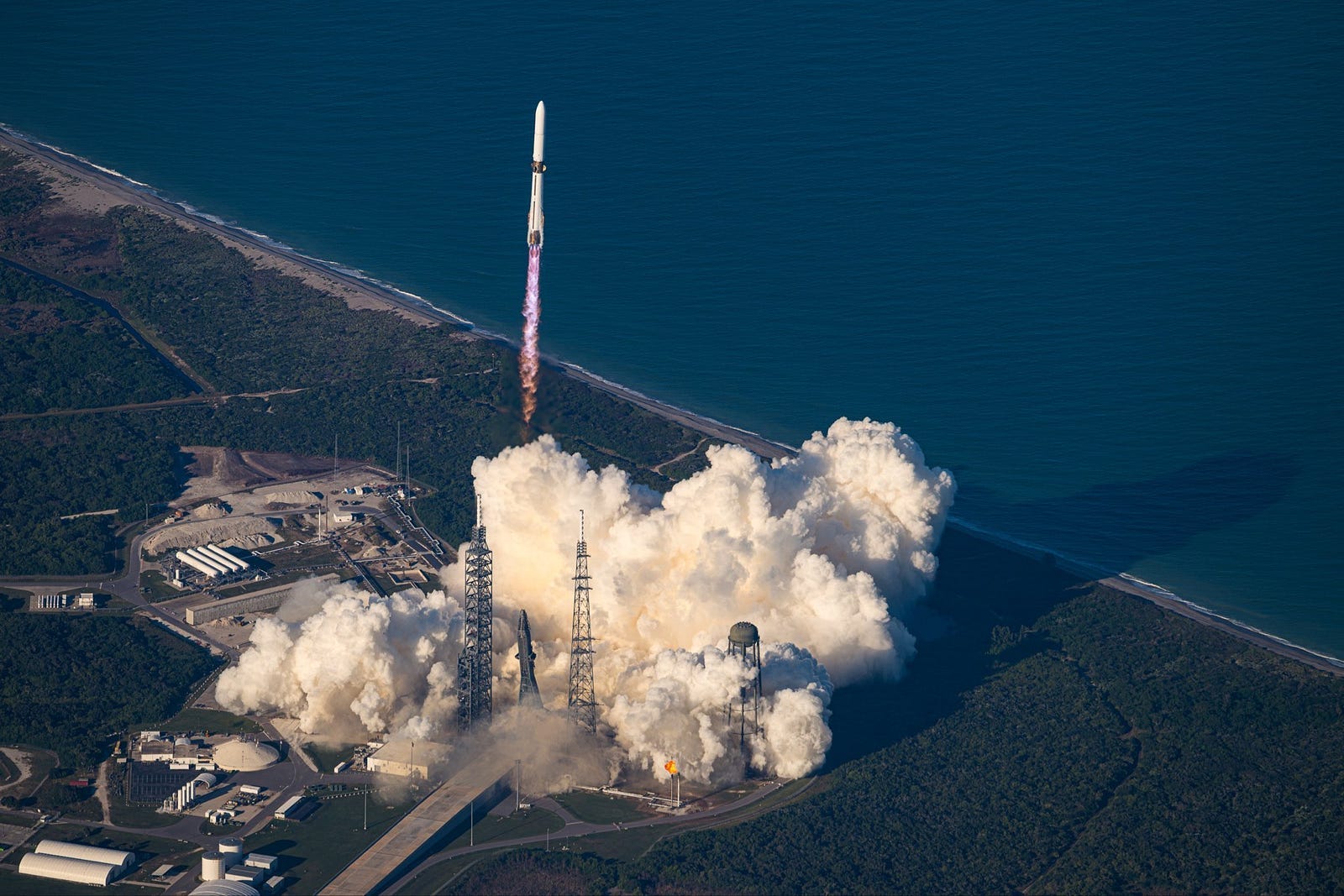
On November 13th, New Glenn successfully launched and delivered the ESCAPADE probes on their journey to Mars without a hitch and perfectly landed the first stage, proving New Glenn is a highly competent and economically viable launch vehicle. Blue Origin’s Ariane Cornell phrased it best during the launch stream when she said, “We are open for business, baby, on New Glenn!”
But why should SpaceX be scared? Their Starship is a very different and far larger rocket, meaning that they aren’t competitors. Right?
Starship Who?
Well, don’t forget that Starship was supposed to have 100+ tons of payload capacity to Low Earth Orbit (LEO) from the get-go, yet even after iterating the design over more than ten launches, it currently sits at less than 35 tons to LEO, which is ten tons less than New Glenn. Musk has recognised that Starship needs a complete redesign, so he is launching unplanned Versions 2 and 3 of Starship soon and has claimed that they will have payloads of 150 tons and 200 tons to LEO, respectively. However, there is absolutely no reason to trust these claims. What’s more, even after 11 test flights, no Starship has ever even reached orbit, let alone placed a payload into orbit.
So, while they might seem like very different rockets for very different uses, that isn’t true. As it stands, New Glen has a much larger payload and is significantly more capable and reliable.
It’s Cheaper Too!
And what if I told you that New Glenn is cheaper than anything SpaceX has to offer?
NASA paid New Glenn $20 million for this launch, though some sources estimate the price at $55 million. That means New Glen costs $444 to $1,222 per kg to LEO (with its 45-ton payload to LEO).
SpaceX’s closest working competitor is the Falcon Heavy. SpaceX tends to hide and underestimate launch costs; for example, they still quote the fully reusable price for a Falcon Heavy launch, even though none have launched with that setup in six years, and none are scheduled to either. But the Falcon Heavy recently launched NASA’s Europa Clipper mission to Jupiter, which is a comparable contract to the ESCAPADE launch, giving us a verified comparison point. NASA handed SpaceX $178 million for this launch. In this partially “expendable” configuration, Falcon Heavy has a payload to LEO of 57 tons, meaning a price tag of $3,122 per kg to LEO.
So, SpaceX’s Falcon Heavy is around three times as expensive as New Glenn!
Okay, so what about Starship?
Well, it’s hard to calculate the launch cost of a vehicle that doesn’t work… Musk’s estimates are the ramblings of a lunatic. My own estimates range from $70 million for a fully reusable flight, if they can ever achieve it, to $177 million for a flight in which the upper stage is expendable, as I expect it will be for the foreseeable future. Especially when that 35-ton LEO payload is based on launches where the upper stage has been lost. So optimistically, Starship will cost $2,000 per kg to LEO, and more realistically, it will cost $5,057 per kg to LEO. This means that New Glenn may already cost just 20% of what Starship will eventually cost per kg to orbit. Can you see why I don’t take this moronic launch vehicle seriously?
It’s Better For Actual Space Exploration
So Starship isn’t ready to explore the Moon or Mars yet. But Falcon Heavy could in the meantime, right? After all, its enormous payload to LEO would make you believe it is capable of doing so.
But the truth is past LEO, Falcon Heavy is a little useless. It can only take eight tonnes to Geostationary Transfer Orbit (GTO) if all its boosters and first stage are reused, 16 tonnes if the first stage is expended and the boosters recovered (like all of its recent and planned launches), and 26.7 tons if fully expendable. No fully expendable launches have ever been attempted, and none are planned, likely because launch costs would balloon dramatically. This applies to Trans Lunar Injection (TLI) payloads too, as a fully reusable Falcon Heavy can only take around four tons to the Moon, if reusable, and significantly less than 16 tons if partially expendable.
This makes Falcon Heavy a terrible vehicle for getting significant payloads into higher orbits or onto other celestial bodies. The fully expendable option is so expensive that no one is taking it. The partially reusable option is still painfully expensive at more than $11,125 per kg to the Moon and destroys valuable boosters in the process. That means repeated higher orbit, lunar or Mars missions like this will deplete the fleet of first stages, requiring them to use new ones, rather than those at the end of their life, which will increase launch costs exponentially. In other words, Falcon Heavy is useless for large-scale ongoing space exploration past LEO.
But, because it is made of lighter materials and uses a lighter, more efficient fuel (LNG compared to RP-1), New Glenn can actually carry more to outer orbits than Falcon Heavy. It can take over 13 tons to GTO and seven tons to TLI when fully reusable. New Glenn is also on course to be human-rated, unlike Falcon Heavy, so it can transport humans to places like the Moon. With New Glenn’s launch costs sitting between $20 million and $55 million, that means it should only cost $2,857 to $7,857 per kg to the Moon. That is a lot less than Falcon Heavy. But, again, this is the fully reusable price, meaning that regular lunar launches won’t jack up prices as end-of-life boosters are used up.
As for Starship, it can’t make it past LEO. It needs to be cryogenically refuelled by other Starships in LEO to even think about getting to GTO, let alone the Moon. This is a feat that is so complex that NASA has purposely avoided it for decades, and SpaceX has yet to test if it is even feasible, let alone reliable. With its current payload of 35 tons, that would mean at least 34 refuelling missions, assuming no boil-off happens (which it absolutely will). And SpaceX can’t even nail refuelling down on terra firma, given that a Starship exploded on the launch pad during fuelling for its wet-dress rehearsal. Considering how many times SpaceX has fuelled a Starship, that gives it a 2.2% chance of exploding during refuelling on Earth, and the chances will be significantly higher in orbit. But, even if we optimistically assume orbital refuelling has the same 2.2% chance of a catastrophic mission-ending explosion, there is only a 37% chance that during these 34 refuelling missions, this orbital Starship won’t be blown to smithereens.
So, even with Starship’s proposed 100-ton payload to the Moon, thanks to requiring 35 launches to complete it, such a mission would cost $2.45 billion if we take the very optimistic $70 million per launch. That works out to $24,500 per kg to the Moon. Oh, and even after splashing all that cash, this mission has a much higher chance of exploding in LEO than ever reaching the Moon.
Lunar Missions
So, if you want to rapidly build space infrastructure past LEO and get humans exploring the Moon at scale, New Glenn is by far the best rocket around. It is very nearly ready for such a mission, has proven a reliable launch vehicle, has a reliable one-shot path to the lunar surface and is a good chunk of change cheaper than its competition. But the gulf between New Glenn and Starship for lunar missions is so much wider than you might think.
You see, NASA contracted SpaceX to use the entire Starship upper stage as a human-rated lunar lander for the Artemis III mission. This was supposed to have already happened, but due to the horrific development of Starship, it has been pushed back multiple times to mid-2027.
Either way, this almost certainly won’t happen. For one, Starship development is so slow that they will not have demonstrated their orbital refuelling or proven that their landing ability is safe enough for humans by that time. Even if they did, the practicality of such a mission is impossible. The crew don’t launch onboard Starship; they launch onboard the SLS and rendezvous with Starship in lunar orbit. Even if SpaceX were able to double the rate of Starship launches, launch this lunar-ready Starship into LEO immediately and start using every available launch to refuel it, it would be ready to get to the Moon by late 2028, which is over a year too late. What’s more, what if the final refuelling causes an explosion, or the rocket engines fail to work after more than three years in space? The Artemis III crew will have already set off. They will reach the Moon with no way of getting back down.
Let’s also not forget that SpaceX has already spent the nearly $3 billion NASA gave SpaceX to develop this lander and use it for this mission. So, that $2.45 billion total launch cost will have to come directly out of SpaceX’s pocket. And, again, even after spending all of this money, the chances of this mission exploding hundreds of thousands of miles away from the Moon are far greater than its chances of reaching the Moon. I suppose it is convenient for Musk that he only gambles other people’s money on this crap.
Fortunately, NASA recently opened the Artemis III lunar landing contract, and Blue Origin will almost certainly take it from SpaceX. After all, NASA contracted Blue Origin to develop a New Glenn-based lunar lander for the 2030 Artemis V mission, and Blue Origin seems set to beat that deadline.
New Glenn’s next launch will be a demonstration of the lunar lander they have been developing for years. Blue Moon MK1 will be a three-ton uncrewed lunar probe; it will test and demonstrate Blue Origin’s ability to land on the lunar surface and will carry NASA experiments. Because of its low mass, a single New Glenn can take the payload straight to the Moon, and Blue Origin plans to do precisely that early next year. Considering the immense success of its recent launch, this mission will more than likely happen on time.
Their Blue Moon MK2 is a little larger, with a mass of 16 tons, but it can carry two astronauts to the lunar surface for a whopping 30 days. This makes it too heavy for a single New Glenn. Instead, Blue Moon MK2 is launched into orbit by one New Glenn, and a tug vessel developed by Lockheed Martin will be launched at roughly the same time on a different New Glenn. The tug craft will conjoin with Blue Moon MK2 in orbit and tug it to lunar orbit, where Blue Moon MK2 will separate from the tug, rendezvous with Artemis astronauts, and act as a shuttle between them and the lunar surface. Blue Origin is planning an uncrewed lunar landing demonstrator mission of Blue Origin’s Blue Moon MK2 for 2029 so that it will be ready for the Artemis III mission by 2030.
Let’s assume that to ensure Blue Moon MK2 and the tug vehicle are ready by then, they expedite development with hard cash, and together they cost a billion dollars per launch. Well, that would put the entire New Glenn-based crewed lunar mission cost at $1.1 billion to carry just over 16 tons on the Moon (negating the SLS crew launch cost). That is less than half the cost of a Starship-based lander. Furthermore, with only two launches from a rocket that has never failed to make it to orbit, rather than 35 from a rocket that constantly fails, and no risky in-orbit refuelling, this is also a significantly more reliable and safe route to the Moon.
Now yes, because of its lower payload, Blue Origin’s lander option costs $68,750 per kg to the lunar surface, which is nearly three times the cost per kg of a Starship lunar lander. But don’t forget, NASA doesn’t need a giant payload on the lunar surface, and Blue Moon MK2 is more than roomy enough for their needs. So, in practice, Blue Moon will be cheaper.
SpaceX has toyed with creating a ‘simplified’ Starship, or even a Falcon Heavy-based alternative for NASA that would use more traditional lander technology, like Blue Origin has, to ensure they can keep the contract. But, they are already years behind Blue Origin in that department and only have a handful of years to catch up. Even worse, every cent of development money is going towards fixing Starship, and as we have covered, Falcon Heavy isn’t that useful past lower orbits..
In short, SpaceX doesn’t have the time, money, resources, partnerships, or even the expertise to offer an alternative to its failed Starship Lunar lander before Blue Origin gives NASA an option that is better than what SpaceX initially promised to deliver.
As such, Blue Origin now has a big opportunity to leapfrog SpaceX entirely.
Summary
“Work hard in silence; let your success be the noise.” This is Blue Origin’s noise. The overwhelming success of the ESCAPADE mission has proven just how capable New Glenn is and how well its development is progressing. And, when you look at the state of play, with SpaceX failing to make meaningful progress, their nonsensical and highly risky plan for a lunar lander, and NASA getting fed up with their nonsense and opening up launch contracts, it’s hard not to conclude that Blue Origin is about to dethrone a king. Now, while I lament the fact that once again a private billionaire is monopolising what should be a public effort, this is nonetheless a huge step in the right direction for humanity in space and a colossal slap in the face to Musk and his idiotic ego. If, or more likely when, NASA turns to Blue Origin to mitigate SpaceX’s failure, what do you think that will do to SpaceX’s future prospects? Will investors want to back them? Will NASA trust them? Or will the industry switch allegiance to Bezos? Those are the questions that should keep Musk up at night.
Thanks for reading! Don’t forget to check out my YouTube channel for more from me, or Subscribe. Oh, and don’t forget to hit the share button below to get the word out!
Sources: Space.com, Space.com, Space.com, NASA, Space.com, SpaceNews, NASA, NASA, NASA, SpaceNews, Nasdaq, SpaceX, Blue Origin, NSS, SpaceNews, IE, TSP, Will Lockett, Will Lockett, Will Lockett
With a little Wikipedia help, I’ve learned New Glenn is named after John Glenn and that it landed on the barge Jacklyn, named after Jeff Bezos’ mother, which brings Freud into 21st century space exploration.
Blue origin had a very long development period for new Glenn but it looks solid and they are working rapidly to get capacity expanding. I think they will start eating market share away from spacex