
SpaceX Keeps Proving My Little Starship Theory Right
Why on Earth do they keep exploding?

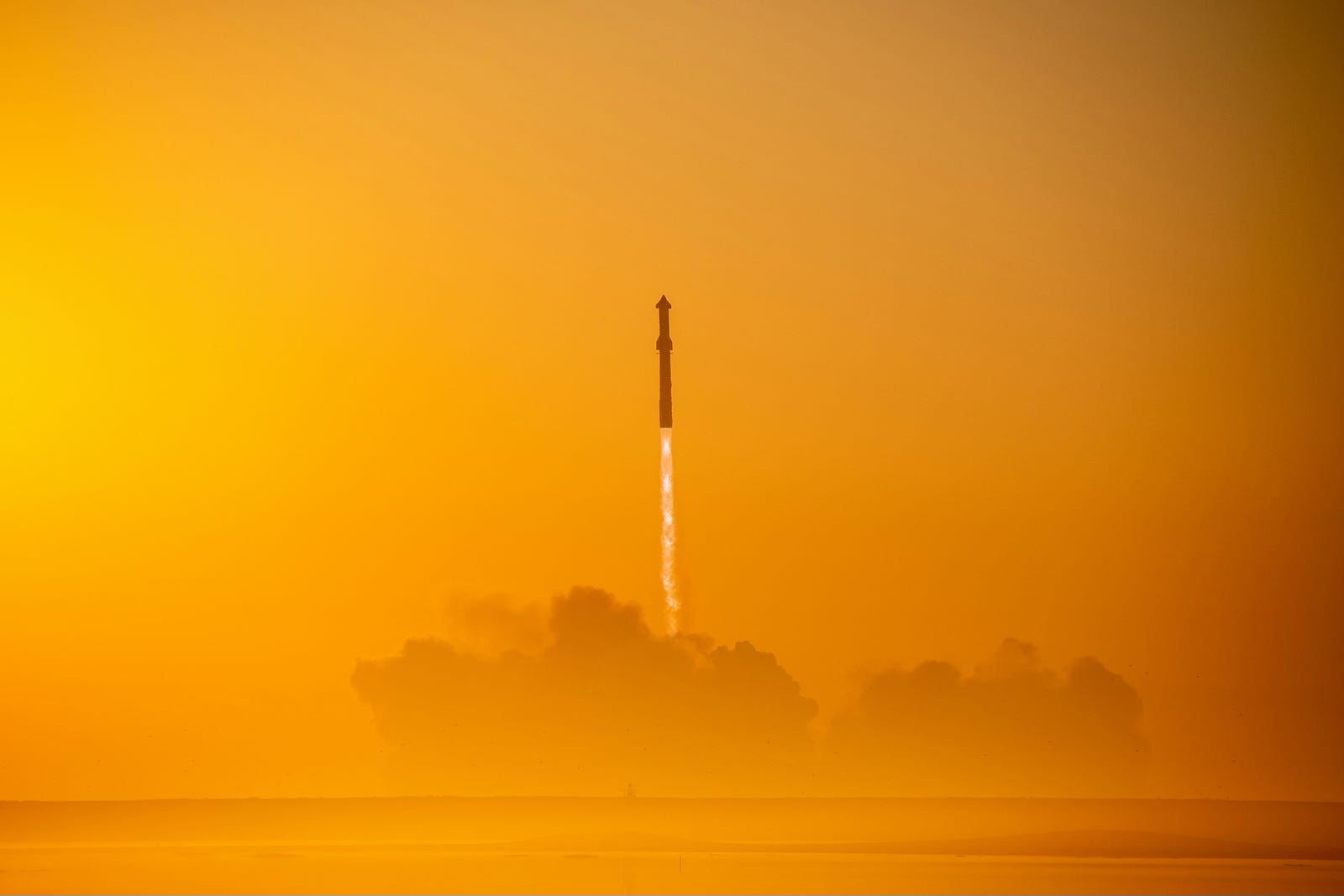
Over the weekend, another Starship exploded on the test pad, making it the second to do so in a year. Except, this time, it wasn’t the upper stage; it was the Super Heavy Booster. And to make matters worse, this was the latest V3 variant that was designed to remedy all of Starship’s truly woeful payload issues. Thankfully, though, the Booster was only undergoing pressure testing and had no fuel onboard, so this explosion was more akin to a balloon popping than a giant bomb. This meant far less damage to SpaceX’s infrastructure, but potentially just as large a setback for Starship development. The fact that these explosions are happening at all is deeply embarrassing for SpaceX, but this goes beyond embarrassment. This incident is even more evidence to support my little theory as to why Starship is, and will continue to be, a failure, and it all boils down to SpaceX forgoing very basic engineering.
Okay, so what is this theory? Well, it goes something like this:
Starship has a significant payload issue. The latest version’s payload to LEO is still around 80% short of what was promised, rendering the entire rocket useless. To resolve this, SpaceX is stripping out as much mass as possible and pushing the engines far harder. However, this is making the rocket too fragile, to the point that its stress tolerance is below standard operational levels, leading to constant catastrophic failures.
Okay, so why does Starship have a payload issue?
Quite simply, Musk ignorantly overstated how much thrust their rockets could generate (to comical levels) and grossly underestimated how much a rocket this giant would need to weigh.
V1 & V2
Starship was supposed to have one version capable of taking over 100 tonnes to LEO straight out of the gate. Unfortunately, that was not the case, as after six test flights, Starship had failed to reach orbit with zero tonnes of payload on board. Even in substantially less stressful conditions than it was designed for, most launches had multiple engine failures.
A total redesign was needed, so SpaceX suddenly announced new versions of Starship.
Test Flights 6 to 11 were of the V2 variant, the first of these new versions. It had slightly more thrust and was marginally bigger to carry more propellant. Despite this, its dry mass (weight without propellant) was lower than V1. It functioned slightly better in the payload department, having carried a 16-tonne payload on a transatmospheric flight at suborbital speeds. That is still an underperformance of over 80%, which means that a Falcon 9 is technically a more capable rocket. However, this pathetic improvement in payload came at a considerable cost, because V2 Starships began to catastrophically explode at an alarming rate.
Flights 7, 8, and 9 all catastrophically exploded mid-flight, destroying the upper stage. Massive fuel leaks caused the explosions on Flights 7 and 9, and Flight 8 was taken out by a “flash event” in one of the engines (where the fuel ignited too early, destroying the engine). Flights 10 and 11 didn’t explode, though their mission scope was significantly reduced, with small payloads and suborbital flights. However, the Starship upper stage that was meant to be used for Flight 11 exploded on the test rig while undergoing a wet rehearsal. One of the brand-new composite high-pressure tanks ruptured at a pressure below its supposed design limit, and the ensuing fireball destroyed the entire upper stage.
In other words, only one of the five test flights of V2 was not associated with a ruinous explosion.
So, why? Why did the V2 explode so much?
Simple; its safety factor is obviously far too low. A safety factor is simply how much stronger a system is than it needs to be for its specified maximum load. Most aeronautical and astronautic safety factors are around 1.5. So, a composite pressure tank on a rocket should be rated to take 1.5 times the load it is expected to take. Likewise, the engines and fuel systems should be rated to take 1.5 times the intended structural load and harmonic vibrations. But it seems SpaceX is breaking this basic industry-wide rule.
SpaceX’s main goal with V2 was increasing the payload, which they accomplished by reducing the rocket’s dry mass by lightening the structure and fuel systems, as well as boosting thrust by pushing the rocket engines harder. So, there is more force but a weaker structure to withstand it. In other words, V2 could only carry a larger payload by sacrificing its safety factor, but that meant the likelihood of critical failures was sent sky-high. At least, that is what seems to be the case.
V3
Nowadays, the V2 has been retired, and the V3 is set to launch in early 2026. Musk claims that the V3 will be capable of taking 100 tonnes to LEO, just as the V1 was supposed to. That is triple the claimed payload capacity of the V2! How?
Well, they are making the rocket even lighter, pushing the engines harder, and carrying more fuel.
The V3 has been fitted with SpaceX’s new Raptor 3 engines, which are both more powerful and lighter than the Raptor 2 engines of the V2. They have managed this by removing the heat shield and instead using more ablative cooling (which is when cryogenic fuel is used to cool the engine before it is burned). This makes the Raptor 3 105 kg lighter than the Raptor 2, saving over four tonnes of weight per rocket.
But a more powerful rocket engine is useless without more propellant, so the V3 Booster has 12% more propellant than the V2, and the V3 upper stage has 6% more. To accommodate this, the V3 is noticeably longer than the V2, yet its dry mass is reported to be 20% to 30% lower than the V2’s, or 100 tonnes less.
Do I think this is enough to triple Starship’s payload? No.
The added fuel penalty offers five times the weight savings (given that it has 500 tonnes more fuel and 100 tonnes less structural mass than the V2). Yet, the overall thrust has increased by only 9%. This should increase the payload, yes, but only marginally, not by 300%, as Musk claims.
However, did you notice? V2 already had a far too low safety factor and was constantly failing. But this V3 is somehow larger, lighter and more powerful, while also removing critical features like heat shields? It has to have an even lower safety factor, and so it will almost certainly critically fail more often than the infamously explosive V2.
I thought I wouldn’t have evidence to support this claim until V3 launched. I was wrong.
The Starship that blew itself to smithereens on the test pad before Test Flight 11 heavily implies that the composite pressure vessels SpaceX are using are much too light and weak. But this Super Heavy failure over the weekend might be the first piece of evidence that V3’s safety factor is even lower. After all, its pressure tanks failed in even less stressful conditions. That suggests a fatally low safety factor.
So, even if V3 can get its payload up to 100 tonnes, which I highly doubt, it appears to be accomplishing this by making itself so light and fragile to the point of uselessness. After all, who is going to strap their million-dollar satellite into a rocket with a tendency to explode?
There is other situational evidence to support this, too. Musk famously removed the system redundancy for Tesla’s Full Self Driving (FSD), forcing it to rely entirely on unreliable camera-based AI computer vision, which made FSD a lot less safe in the process. Musk is happy to build in high levels of fatal risk into the systems he oversees, whether that is a space launch system or a car that tries to drive itself. To be crystal clear, this is the complete opposite of what every engineer is taught, yet Musk does it constantly.
Summary
So, to summarise, when I found out that the V3 Super Heavy Booster experienced this explosive mishap while on the test bed, I was not at all shocked. For one, SpaceX now has a reputation for these failures. That is in stark contrast to the rest of the industry, given that New Glenn and SLS have never had such issues. But it is obvious that the Starship concept was based on a false premise, and SpaceX is desperately and fruitlessly trying to make up for that by going against engineering know-how and dragging its safety factor down. They are shooting themselves in the foot rather than admitting defeat. So, I think we might be in for some very large fireworks next year.
Thanks for reading! Don’t forget to check out my YouTube channel for more from me, or Subscribe. Oh, and don’t forget to hit the share button below to get the word out!
Sources: The Register, America Space, Tech Crunch, Futurism, NSF, Ars Technica, Futurism, Will Lockett, Will Lockett, Will Lockett, Will Lockett, Will Lockett, Will Lockett
Every time a Spacex rocket explodes, an angel gets their wings.
Seriously though, I appreciate the technical analysis. It does seem like you are on the right track.
So, if everything you are saying is true, and Tesla is an overvalued, over-hyped company, what is the best financial play? And why are you not keeping this knowledge to yourself and playing a contrarian financial angle?
Should your subscribers short the stock?
Just wondering...