
Musk's Pathetic Robot Is Looking More And More Like Bad Vapourware
The Wizard of Oz is wearing the Emperor's New Clothes.

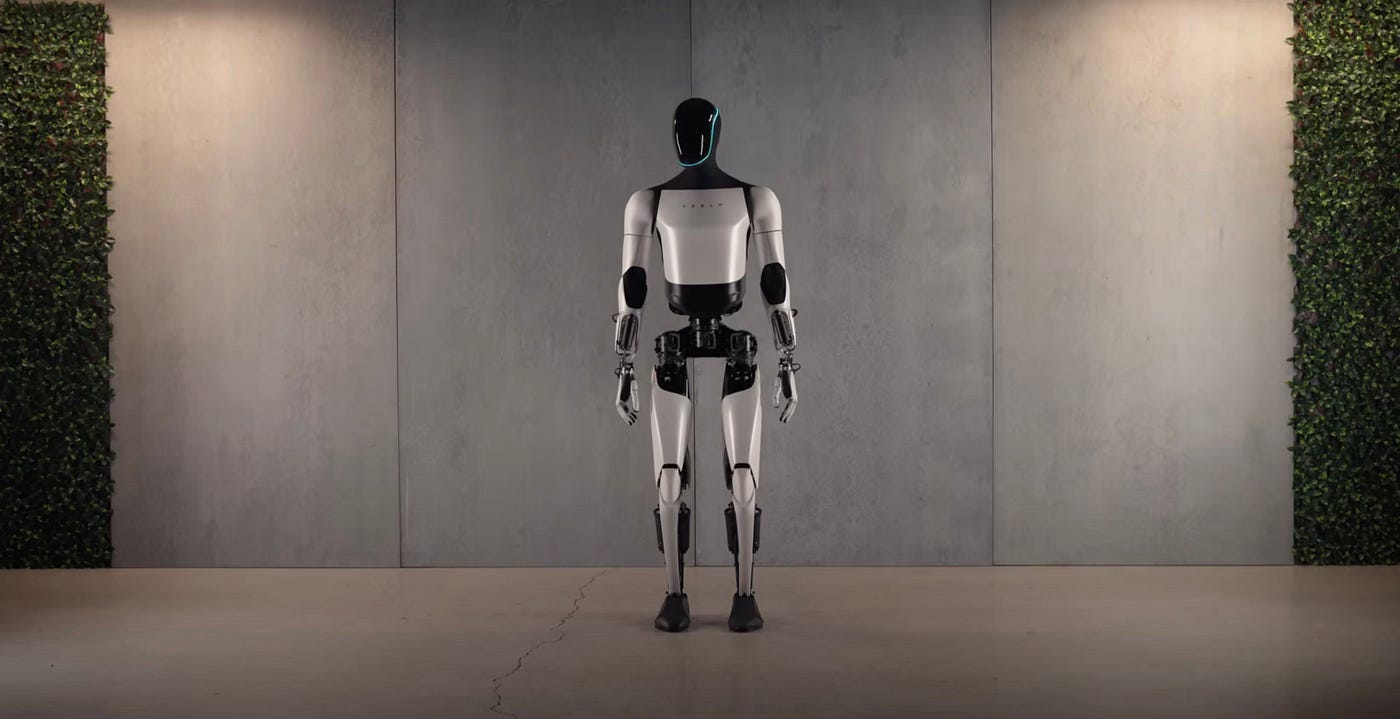
If one thing has characterised Elon Musk’s career, it has been illusion. From faking a supercomputer to hooking in his first investors to simulating self-driving car demos, the hype that drives Musk’s wealth and power does not come from material results but from the illusion of progress. However, Musk is not a very skilled magician, and the illusion breaks every now and then. Occasionally, we get a glimpse into how phony this empire of speculation is — just look at the non-existent new Roadster, the easily shatterable windows of the Cybertruck, and even the hilarious failure of the Hyperloop. Last weekend, the illusion was broken yet again when, at Tesla’s Miami ‘Autonomy Visualised’ event, one of Tesla’s robots took a very suspicious fall, which made it look less like a cutting-edge robot and more like a decade-old Disney animatronic. The implications of this are nothing short of devastating for Tesla.
Before we get into this hilarious incident, we first need to understand what Musk claims this robot will do.
In short, Musk wants this robot to completely transform the economy. He, in all seriousness, expects to sell a million of them a year by 2030, with a billion sold per year following shortly thereafter. Musk has claimed these robots can replace most forms of labour and will have 5x the productivity of a human per year, and that this will create a “sustainable abundance”. He estimates that soon these robots will account for 80% of Tesla’s overall value and that they could generate $10 trillion in long-term revenue.
He has also called Optimus Tesla’s “most important product ever”, but he said the same thing about the Cybertruck, so go figure. Let’s also be clear here: infinite abundant growth within a finite system is the definition of cancer. Just a little food for thought.
So, do you want to see just how incredible these robots are after four years of development? Well, take a look at the video below, taken at the recent Miami event:
https://x.com/cixliv/status/1997878834956525898?s=20
(Substack sometimes embeds the tweet, if not then there should be a link above)
Notice how it looks like the robot knocks everything over, takes off a nonexistent VR headset, and then goes so rigid it falls backwards? Yeah, this looks exactly like the bot was being remotely puppeteered, the operator forgot the shutdown sequence, and began to remove the VR headset before control had been totally severed, causing it to grab at a nonexistent headset and lose its balance. Indeed, I can’t think of a single other reason this robot could have acted like this.
So, it’s less like a real-life autonomous C-3PO and more of a Muppet with an underpaid intern’s arm up its arse. This kind of non-autonomous VR control also isn’t new, with Da Vinci Systems pioneering its use in medical robots in the ’90s and Honda’s ASIMO putting it in a humanoid form factor in the early 2000s.
This marks the third time this illusion of autonomy has been broken this way. First, there was the demo video of the bot folding clothes, with the VR puppeteer in the frame. Second, there were the bots at the We Are Robot event that talked to attendees in a way only an underpaid and uninterested intern would. Both times, Tesla had to come out and acknowledge that these robots were operated remotely. This third incident just confirms that Tesla still can’t deliver an autonomous robot capable of undertaking basic tasks like handing out drinks reliably enough for a demo — something other robot companies cracked years ago.
This means that, after four years of development, we have yet to see this robot do anything more than shuffle around under its own control. For every other demo, it has just been a puppet. This means its development is totally stagnant. While such a robot is cool for the likes of theme parks, a remote-controlled humanoid robot is not going to revolutionise the economy, let alone sell a million units a year by 2030.
We know why development has stalled, and we also know it is unlikely to leap forward any time soon.
Tesla still struggles to produce a self-driving car, which is a much simpler task to automate than a humanoid robot, thanks to having a more constrained environment, fewer variables, more obvious objectives, and fewer controls. So, why should we expect them to make an even vaguely functional humanoid robot?
Then there is the way Tesla is using these puppeteers to train the AI behind the robot, which many experts have pointed out simply won’t work (read more here), as well as the simple fact that the humanoid form factor is actually highly inefficient for robotics (read more here and here). In fact, the guy who Musk hired to lead the Tesla Bot’s development has said this form factor limitation means it can never be anything more than a tech demonstrator novelty.
In short, the Tesla robot development has likely hit a dead end. After all, it was never based on engineering or IT reality but on fanciful thinking designed to drive an illusion that will make Musk more powerful.
Still, a lot of people are damn glad this robot is a hot mess. After all, flooding the job market with billions of robots will severely negatively impact their lives.
But another crucial piece of context here is how Musk addressed these fears. He said at the latest shareholder event that “People often talk about eliminating poverty, giving everyone amazing medical care,” and went on to claim that “There’s actually only one way to do that, and that’s with the Optimus robot.” He even said that “I came to the conclusion that the only way that the only way to get us out of the debt crisis and to prevent America from going bankrupt is AI and robotics.”
Now, back in the real world, we don’t actually need this weedy fake Terminator to do any of that. Socialist countries, particularly democratic socialist countries, have historically provided, and still provide, some of the best healthcare on the planet to their citizens for free. Meanwhile, the US has some of the worst healthcare in the developed world, which its citizens pay for at the point of use or through insurance. In fact, insurance premiums in the US exceed the per-person tax burden of socialist countries’ nationalised health care. Socialist countries have also eradicated far more poverty than capitalist countries have, by investing in and enabling their populations to work and thrive. What’s more, countries with the highest leveraged national debt are overwhelmingly extreme capitalist countries, like the US and UK, while countries with strong socialist governments, like the Scandinavians, rank much further down the list, as they fund their programs through appropriately taxing the wealthy and through collective national ownership of essential resources. To give you an idea, China, the largest socialist country on the planet, has a larger economy than the US when purchasing power is taken into account, yet it has less than half the US’s national debt, despite insanely rapid economic growth and strong social programs.
Also, unlike unleashing a nation’s worth of robots onto the world, there is enormous support for these kinds of policies in the US and across the Western world. More than 60% of Americans want universal health care, 73% want water nationalised, and 71% of Brits want energy nationalised, just to mention a few statistics.
With these facts, Musk’s comments, and the Tesla robot’s obviously vapourware nature as context, the Tesla robot no longer seems like a dashed attempt at futurism. Instead, it looks like a crappy, bare-faced attempt to obfuscate the growing international desire to tax the mega-wealthy, such as Musk, who collectively own critical resources and industries, and create robust democratic social states by dangling something shiny and sci-fi in our faces to distract us.
Remember, this robot, like so much of Musk’s work, is all about the illusion of progress and what it can do for Musk, from influencing politics to driving speculation, rather than what it can actually achieve. Don’t forget that he admitted that he knew Hyperloop would fail and that he just used it to destroy US high-speed rail to ensure tax incentives went to EVs (read more here). It’s the same script, just a different prop.
But what does this mean for Tesla?
Under Musk, they have pretty much entirely abandoned developing any new EVs or EV technology. Sales are still plummeting worldwide as even legacy competitors are thoroughly outpacing them on every metric. On top of that, Tesla’s Robotaxi rollout is pathetic, as the vehicles appear to be so dangerous that they can’t obtain a permit to provide any service without yet another underpaid driver ready to take over at a moment’s notice.
Tesla is only worth ten times more than it should be because investors believed it would deliver considerable, disruptive growth. Yet the opposite is happening: projects are failing across the board. The doors have closed, and this stupid robot is the only one left open, but only because it hasn’t hit the market yet.
However, the fact that Tesla Bot is such patently dead-end vapourware that it is doomed to fail is a sign that this is where Tesla will be going too. We just have to sit back and wait for reality to hit.
Thanks for reading! Don’t forget to check out my YouTube channel for more from me, or Subscribe. Oh, and don’t forget to hit the share button below to get the word out!
Sources: Gizmodo, Electrek, Kataku, BlueSky, Fortune, BI, Fortune, BI, X.com, WPR, Gallup, US Water Alliance, PubMed, Monthly Review, New Atlas, Fortune, Fortune, Will Lockett, Will Lockett, Will Lockett, Will Lockett
Humanoid robots are a dumb idea, but the appeal is pure Musk. Because the robot looks human-ish, people are will to attribute intelligence, that they would not believe of a robot dog
https://johnquigginblog.substack.com/p/elons-last-grift
This leaves unanswered the question, Which underpaid flunky is remotely piloting Musk?