
Musk's Most Moronic Idea To Date
Data centres, but in space!

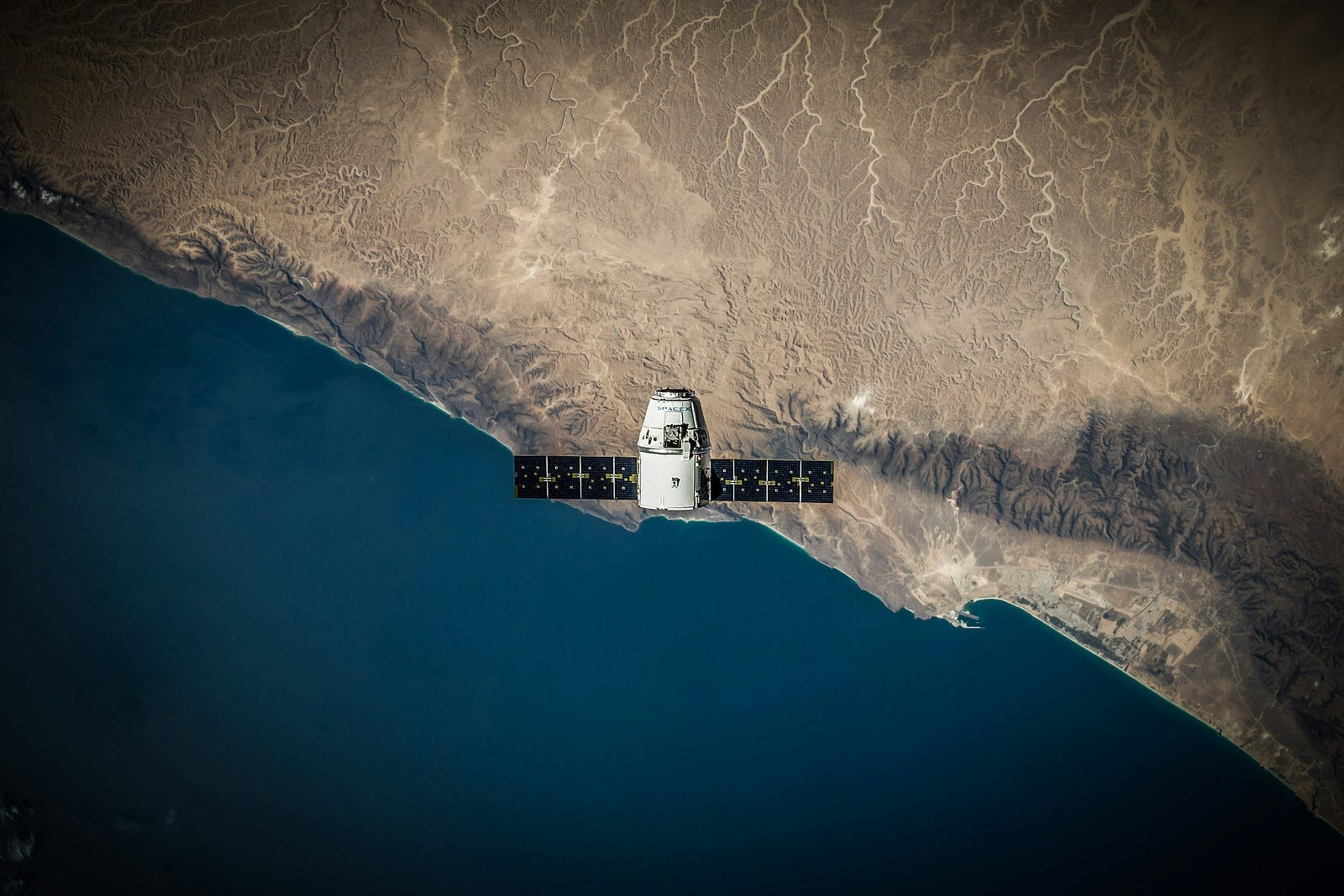
Musk isn’t known for having the most rational ideas. From the Hyperloop to Optimus and even Starship, the majority of his grand plans turn to utter shite the minute they face reality. But, egged on by his billionaire frenemies, Musk has only gone and outdone himself this time. As the AI bubble threatens to pop, the billionaires who backed it are desperately trying to keep the hype train chugging along. For example, Amazon’s Bezos and Google’s Schmidt have publicly declared interest in putting AI data centres in orbit. This is clearly just a PR stunt, an attempt to associate cutting-edge tech with AI, as such a plan makes no sense at all. However, Musk didn’t get that memo. He has now confirmed that the upcoming Starlink V3 satellite will enable a fast enough in-orbit internet connection to make orbiting data centres viable and has confirmed that SpaceX plans to build space-based data centres. So, let’s break down why this plan is utterly moronic.
There is a theoretical benefit to putting data centres in space: energy. Running data centres requires a serious amount of energy, and supplying that energy on Earth is expensive and horrifically bad for the environment (as well as people’s wallets). However, in orbit, particularly geostationary orbit, there is an uninterrupted supply of mighty solar power. So, an orbital data centre can power itself 24/7 for free with a simple solar array.
How much money would that save?
Well, let’s take the latest Nvidia GB200 NVL72 rack. This single 1.36 metric tonne, $3 million unit features 72 GPU chips and is the modular building block of the latest AI data centres. Musk has said he plans to build orbital data centres modularly, so it makes sense to use this rack as a basis for our hypothetical. It draws a nominal 132 kW and is expected to run nonstop for its entire five-year lifespan, with energy costs hovering around $0.1 per kWh, which means this single rack has a lifetime energy cost of $578,160, or 20% of the purchase price of the rack. So, by strapping a solar array to it and lobbing it into orbit, it could, in theory, significantly reduce the lifetime cost of a data centre. And, considering how all data centres are currently losing money hand over fist, that is a huge deal.
But there are some serious modifications, costs, and risks to putting this infrastructure in orbit.
The most significant additional cost is the launch costs. To figure that out, we need to know the mass of the modifications we need to make.
Take cooling. In space, there is only weak radiative cooling, as there is no atmosphere for conductive cooling, which is what all electronics use to cool themselves — it is far more effective. So, unless we want this orbital data centre to melt from its own immense heat, we need to slap on giant space radiators. Using a NASA example of this kind of shield and scaling it to our needs, we find that each rack will require a 33.70-square-metre radiator with a mass of 172 kg. This alone increases the mass of our orbital data centre by 12.6%, which will increase launch costs.
But we also need to find a way to power this data centre. So, how much solar array is required? Well, let’s assume this will be in geostationary orbit, as this will place the data centre in nearly 24/7 sunlight, meaning it will require fewer solar panels and no heavy batteries in comparison to lower orbits. Well, NASA finds that space solar arrays typically produce 66 watts of power for every kg of mass. Therefore, our satellite will require two metric tonnes of solar array. That is 1.4 times the mass of the data centre itself!
Okay, but in geostationary orbit, this satellite will be exposed to the raw radiation of the sun. These high-energy particles can interact with electronics, wiping out data, corrupting files, or straight-up frying them. This isn’t ideal at the best of times, but it is even worse for a data centre that has no business being in space in the first place. As such, we need to cover this rack in top-notch radiation shielding. NASA has found that radiation shielding for geostationary orbit has a mass of around 3 g/cm², meaning we will need 262 kg of the stuff to cover our 60 cm x 106.8 cm x 223.6 cm rack. So radiation shielding is another 20% increase in mass.
There are other systems required, such as a laser-based communications system to transfer data via Starlink, thrusters to maintain orbital position, backup systems, and the like. But let’s be generous and assume this mass is negligible. That would put the mass of our modular orbital data centre at 3,794 kg (given that it would be 1,360 kg for the rack, 2,000 kg for the solar array, 262 kg for radiation shielding, and 172 kg for cooling). How much would it cost to take this one module of the data centre to geostationary orbit?
Well, Starship definitely can’t take it there and likely won’t be able to for a very long time (read more here). So instead, let’s assume SpaceX will use its current cheapest launch vehicle, the Falcon Heavy, and fully maximise its payload capacity with seven of our hypothetical modular orbital data centre satellites. Well, the heavy costs are $3,632 per kg to geostationary orbit, meaning the launch cost per 3,794 kg module would be $13,779,808!
Just a reminder that the only reason this was put into space in the first place was to reduce energy costs. Yet on Earth, a single rack consumes only $578,160 worth of energy over its entire lifetime. Putting the same rack with the systems it needs to operate into orbit will cost $13,565.46. So rather than negating energy costs, it has effectively increased them by 23 times! And, throughout these calculations, we have assumed that the solar panels, radiation shielding, cooling, communications systems, thrusters, backup systems, and satellite construction will cost nothing, making this a wild underestimate.
Now, launching to Low Earth Orbit (LEO) is much cheaper, so you could argue it would be better to put our hypothetical data centre there. But again, this would require a much larger solar array and gigantic batteries to retain power when it is in the Earth’s shadow, dramatically increasing the weight. However, even if we assume the same 3,794 kg mass, the Falcon Heavy cost per kg to LEO is $1,400, putting the launch cost per rack/module at $5,227,600, or nine times higher than the lifetime energy of the same rack/module cost if it were on terra firma.
In other words, the main premise of orbital data centres — that they will save on energy costs — is totally bogus!
Not to mention that putting such sensitive and vast digital infrastructure in space has some seriously horrific drawbacks.
Firstly, it makes maintenance impossible. If something goes wrong, you can’t just send a tech in to fix it; that problem is there to stay. This is a major problem for orbital data centres, as these chips are being pushed to their rugged edge, meaning they fail at alarming rates. Meta has found that the annualised failure rate of their AI chips is around 9%. Or, in other words, six of the 72 GPUs in our hypothetical rack will fail each year. This will not only seriously hinder performance over time but also make it impossible to reliably use the data centre, as chip failures can disrupt whatever program/process the data centre is running.
Then there is the issue of radiation. Even with all that shielding, some high-energy particles will make it through due to the brutality of solar radiation. These will interact with the delicate circuitry, flipping 0s to 1s, corrupting files, and messing with calculations. To this day, satellites still regularly experience serious radiation-induced glitches. This is not a problem for many of these satellites, as they are given backup computers to double-check and ignore anomalies, and much of the complex processing is offloaded to safer terrestrial computers. However, you can’t give an orbital data centre a backup data centre to check its calculations weren’t impacted, as it would cost too much. Without this process of double-checking, we can’t tell whether the files are corrupted or correct these errors, which could waste millions of dollars in incorrect AI training.
Then there is the scale issue. A modern hyperscale AI data centre has tens of thousands of GPUs. So, to make this orbital data centre large enough to be useful, we need to launch around 300 of our hypothetical modules/racks for 21,600 chips. Because the Falcon Heavy only launches twice per year, SpaceX likely can’t scale up its launch rate enough to achieve this quickly enough, so it will need to turn to the more expensive per kg to orbit Falcon 9, which launched 134 times last year. A Falcon 9 can take 8,300 kg to geostationary orbit, or just two of our hypothetical modules/racks. In other words, it would take more than two years of SpaceX using its entire annual launch capacity to build a single useful orbital data centre. This means that by the time the orbital data centre has been completed, chip technology will have moved on, and it will be nearly obsolete. On top of that, all these launches would cost far north of $5 billion, easily quadrupling the cost compared to a terrestrial data centre.
Basically, orbital data centres make zero sense. Financially, they are the equivalent of nuking yourself in the foot. But, even if that wasn’t the case, the practicalities of building an orbital data centre are so cumbersome, and the downsides so immense, that any remotely sane person would choose to build them down here. Or, you know, not build them at all, as the AI industry exists in a giant bubble (read more here), and every single data centre is losing ungodly amounts of money anyway (read more here). The fact that these billionaires are even entertaining this idea shows how out of touch they are and how they absolutely shouldn’t be trusted with our economy — or in general. It is moronic on a scale humanity has never seen before.
Thanks for reading! Don’t forget to check out my YouTube channel for more from me, or Subscribe. Oh, and don’t forget to hit the share button below to get the word out!
Sources: Notebook Check, NS, The Guardian, Nvidia, Semi Analysis, NSS, DCD, DCD, Universe Magazine, Dishy Central, NSS, NASA, Tom’s Hardware, MDPI, HPE, SpaceX, SpaceX
Just when you think Elon can't possibly come up with a dumber idea than the last 3 he had and bam, he hits you upside the head.
What I don't get is why people keep giving him money. I'm just scrolling your article list below the comment section, and if it's so obvious to you and it's doesn't take a PhD to explain it to a normal audience, why can't these billionaire investors figure it out? When does the gravy train finally stop?
I laughed out loud when I realized you were going to do the numbers for Musk’s cockamamie idea. Doing the math is a really cool exercise though.