

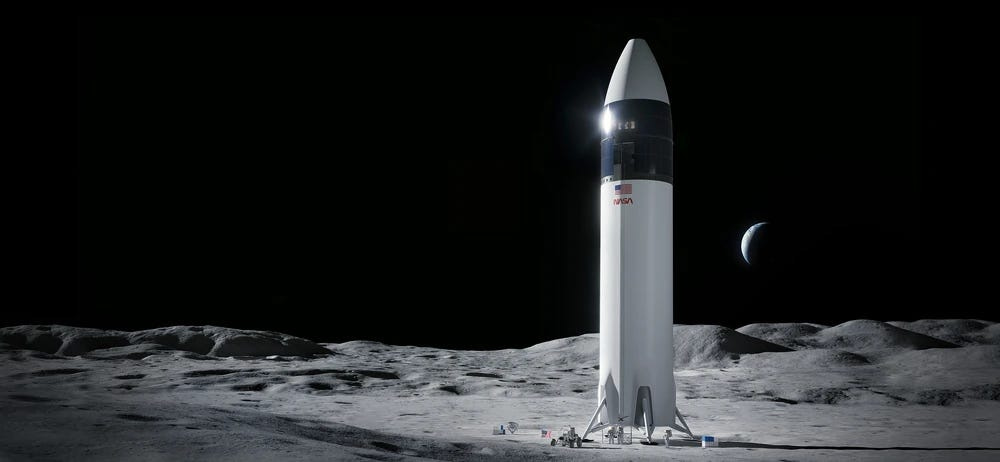
If you thought Musk’s decision to choose the Moon over Mars was a brain-dead cop-out, wait until you see what he has planned for this lunar city — that is, if it can even be built. The New York Times recently reported that SpaceX informed its employees it will aim to build an AI satellite factory on the lunar surface, including an electromagnetic catapult to launch the satellites into space. This is, quite frankly, the worst idea Musk’s cognitively challenged brain has farted out. Even if we are insanely optimistic and generous, this method simply doesn’t work, and it makes Musk look like a fanciful moron. So, what is Musk really doing here?
On the most superficial level, this kind of makes sense.
Moon-based space infrastructure production isn’t a new idea. The Moon is an ideal candidate for In-Situ Resource Utilisation (ISRU). Its regolith (rocks) is rich in oxygen, silicon, aluminium, iron, calcium, magnesium, and titanium, meaning it contains plenty of materials that can be refined relatively easily into useful raw materials. These can be used to build habitats, power systems and other infrastructure on the lunar surface. In theory, this technique is cheaper and more scalable than building these systems on Earth and launching them to the Moon. But the Moon’s gravity is also only 1/6th that of Earth’s, making it far easier to launch objects into space from the Moon than from Earth. As such, everyone from sci-fi authors to NASA engineers has realised that it might be easier to build and launch space infrastructure — such as giant satellite constellations or spacecraft — from the Moon rather than Earth. Indeed, this is one of the main justifications for NASA’s Artemis mission, given that establishing a more permanent presence on the Moon can majorly reduce the Earth launch mass requirements for a Mars mission by using the Moon as a stepping stone.
So, yeah, a Moon city that creates and launches AI data centre satellites sounds like a good idea. But only on the surface. As soon as you scratch even a little, this entire narrative falls apart faster than Musk’s relationships with the mothers of his small army of children.
Why Satellites?
First of all, why launch these satellites from the lunar surface instead of just building and installing data centres on the lunar surface?
On the lunar surface, these data centres could be buried, reducing their exposure to the Sun and lowering cooling demands, while also reducing potentially damaging radiation and enabling easy maintenance by a basic rover. If they are launched into orbit, they are fully exposed to the unfiltered, insanely hot Sun and are out of reach for maintenance.
A study by Meta found that AI data centre chips have a 9% annual failure rate, so being unable to replace or repair them could cause significant losses! Not to mention that failure rates will likely be higher in orbital data centres. The increased exposure to radiation can literally fry electronics. Meanwhile, cooling these systems in the vacuum of space is incredibly difficult, which creates an increased risk of thermal build-up.
If you are going to be building an AI data centre on the Moon, it makes no sense to launch it into space on board satellites.
But, as Musk has done, let’s ignore these facts. Is it even feasible to build and launch satellites from the Moon? Would that be cheaper than building and launching them from Earth? Is this method better than terrestrial AI data centres?
To answer that question, we need to understand SpaceX’s Starship’s capabilities and costs, the setup and mass of an AI data centre satellite, and the various potential options for lunar manufacturing.
Starship
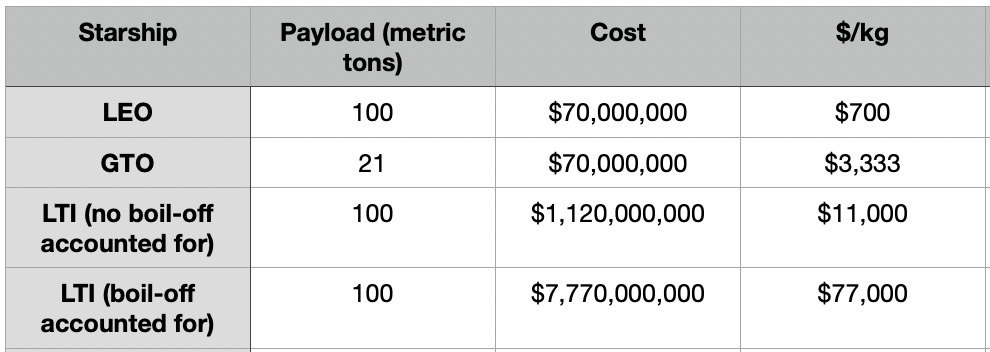
Let’s start with Starship. It is, in my opinion, utterly useless. After 12 test launches, it has only managed to carry 20 tons on a suborbital flight, meaning its current payload to LEO (Low Earth Orbit) is effectively zero.
But let’s be insanely generous and assume that Musk manages to meet Starship’s payload goal of 100 tons to LEO and 21 tons to GTO (Geostationary Orbit). Let’s also be insanely generous and assume a realistic cost per launch of $70 million (as I previously estimated).
Starship still can’t go straight to TLI (trans-lunar injection, or payload to the Moon). It needs to be fully refuelled in LEO by other Starships to deliver a 100-ton payload to the lunar surface. This creates two problems.
Firstly, the in-orbit transfer of Starship’s cryogenic fuel has never been tested, and it is extremely dangerous, with a high chance of a mission-ending catastrophic explosion during refuelling. But for now, let’s remain generous and assume this isn’t a problem. This would mean it would take Starship 17 launches to deliver 100 tons to TLI at a total cost of $1.12 billion.
And even that is a significant underestimate, thanks to the second problem with orbital refuelling: fuel boil-off. In orbit, cryogenic fuel heats and boils, increasing the pressure in its fuel tank. To prevent fuel tanks from failing, evaporated fuel needs to be vented, and we call this process ‘boiling off’. Starship will likely experience a boil-off rate of roughly 1% per day. If we assume a weekly refuelling rate (which is very fast), it would take 110 refuelling missions to bring a Starship in LEO to 89% capacity, at which point it would reach an impassable equilibrium (given that the boil-off rate is the same as refuelling rate). Again, let’s be super generous and assume 89% fuel capacity is enough to take 100 tons to TLI and return Starship to Earth, which is necessary to meet the $70 million launch cost. These launches would take just over two years to complete, and they would cumulatively cost $7.77 billion ($70 million x 111).
All of this allows us to make some basic, wildly optimistic assumptions about Starship’s capability and costs, which I have laid out in a table below.
AI Satellites
So, what is the mass of an AI satellite?
Because they don’t exist yet, we can’t be sure. But what we can do is take a well-established AI-capable data centre rack and calculate the mass of the components needed to operate in space, such as solar panels, radiators, and radiation shielding. This combination can give us a rough estimate of the mass-to-compute-power ratio to expect from AI satellites and provide us with a reasonable terrestrial comparison.
As I have done before, let’s take the Nvidia GB200 NVL72 rack. It weighs 1,360 kg and draws 132 kW of power. When used in normal data centres, it has a total installed cost of $5.9 million and will consume $578,160 worth of power over its roughly five-year lifespan. Musk’s main argument for AI satellites is that they will be solar-powered, meaning that the launch costs of our GB200 NVL72-based satellite must be below $578,160 to be a better option than operating from Earth.
Speaking of solar, the current go-to tech for space solar arrays is gallium arsenide. These are sturdy enough to survive in space and have a high energy density of 300 W/kg. As such, you would need a 440 kg solar array to deliver the 132 kW this rack draws. However, for that to work, the satellite would need to be in a higher orbit, which is more expensive to reach, such as a GTO orbit, which has constant direct sunlight. Lower, cheaper-to-access orbits, like LEO, experience roughly 45 minutes of darkness and direct access to the Sun each orbit. Satellites orbiting the Moon spend a similar amount of time in sunlight and in darkness. Therefore, AI satellites designed for LEO or lunar orbit require a large battery and a larger solar array to keep the power on. In our case, the solar array would need to be double the size, or 880 kg. We would likely require one hour’s worth of battery capacity to make up for degradation and losses, so a 132 kWh battery pack. Lithium-ion is still the go-to for orbital batteries, with an energy density of 280 W/kg, meaning this pack would weigh at least 471 kg.
But this rack also needs to be cooled and shielded. Because there is no atmosphere in space, the more efficient conductive cooling can’t happen, so satellites must rely on the far less effective radiative cooling. Naturally, the rack would require very large specialised radiators to prevent it from burning up. I previously estimated that our GB200 NVL72-based satellite will require 172 kg of these radiators. Likewise, the extreme radiation from the Sun can damage electronics if not properly shielded, and I previously estimated that such a shield for this rack would have a mass of 262 kg.
There are other components needed, such as a chassis, laser communications, thrusters, and actuators, but let’s be super generous and assume their mass is negligible.
With all of this, we can calculate the total and component mass of AI satellites for where they could potentially operate, which are listed in the table below:
From Earth
Okay, we need one last piece of information. We need to know if launching AI satellites from the Moon is actually cheaper than launching them from Earth. So we need to know the cost of launching them from Earth, which we can calculate based on everything we have just discussed.
Let’s start with the simpler AI satellite for GTO. We know that it will have a mass of 2,234 kg, and we have estimated that Starship costs $3,333 per kg to GTO, so it will cost roughly $7.45 million to launch. The LEO satellite is not much better. It has a mass of 3,145 kg, and we have estimated that Starship costs $700 per kg to LEO, meaning it will cost $2.2 million to launch.
Just to remind you that Musk’s entire justification for these orbital data centre satellites is to save on energy costs. Yet, the single rack we based our entire AI satellite around uses only $578,160 of energy over its entire lifetime. Our wildly optimistic cost of launching the same rack into LEO is four times higher than that, and 15 times for GTO. Then there are all the costs of the solar arrays, radiators and shielding, not to mention the chip failures that will occur due to the lack of maintenance.
In short, these satellite AI data centres are unbelievably more expensive than their terrestrial counterparts. So, we need to see some truly enormous cost savings from building them on the Moon for the endeavour to make sense at all.
Okay, now we can really dig into just how utterly moronic Musk’s Moon satellite factory is.
Solar Array Glass Fabrication
Manufacturing anything on the Moon is an insanely challenging prospect. As a result, most realistic proposals for lunar ISRU aren’t producing the complex electronics these satellites use; instead, they focus on far simpler, cruder approaches, such as using raw lunar dust to 3D print shelters. But even such simple manufacturing can theoretically be used to manufacture parts of these satellites on the Moon, specifically the glass used in the solar panels. Glass makes up the vast majority of a solar array’s mass. This is especially true for lightweight solar technologies such as halide perovskite. Furthermore, the lunar regolith is mostly silicon oxide and is relatively easy to turn into glass. So, in theory, sourcing a satellite’s solar array glass from the Moon, rather than Earth, could dramatically reduce launch mass and costs.
This study analysed this very topic. The idea is that the satellite launches from Earth with no solar array, just the perovskite crystals required to make one, and travels to the Moon. Once there, a lunar factory takes these perovskite crystals and combines them with glass it has made from lunar regolith to create and install the solar array, and then the satellite is flung into Earth orbit from the Moon. They discovered that not only could this method work, but it would also reduce the mass of the solar array by 99%.
So, if Musk used this more realistic method of Moon manufacturing, would his lunar AI satellite plan be viable?
Well, no. Not at all!
The LEO/lunar-orbit-capable satellite, with the larger solar array, would save 871.2 kg (27% of its mass) using this method and weigh 2,273.8 kg. But that mass has to be taken to the Moon. If we ignore Starship’s boil-off, it would cost $25 million for it to deliver that mass to the Moon. If we take that boil-off into account, it would cost $175 million.
The satellite optimised for GTO, with a smaller solar array and no battery, would save 435.6 kg (19.5% of its mass) using this method and weigh 1,798.4 kg. Again, this mass must be transported to the Moon from Earth. Launching that to the Moon would cost Starship $19.8 million without taking boil-off into consideration, and if you did, it would cost $138.5 million.
These are both CONSIDERABLY more expensive than launching the same satellite from Earth. So, the only thing this method has done is exacerbate the issues that orbital data centres experience.
But what if Musk produces the entire AI satellite on the Moon, using only materials from the Moon? Would it make sense then?
Take a wild guess!
Full Lunar Fabrication
Manufacturing a cutting-edge AI satellite from raw materials on the Moon is functionally impossible. Why? Quite simply, the factories capable of making the chips they need are too large, and the smaller ones are not capable enough.
AI requires modern 5nm or smaller microchips, and the scale of the fabrication plants that produce these is insane! The upcoming Arizona TSMC will cover 1,100 acres and likely weigh millions of tons. But even the individual components in these production lines are colossal. A single EUV photolithography machine, which is critical in making modern chips, weighs around 180 tons. This vast size means it is simply unfeasible for Starship to deliver even individual components of such a facility to the Moon, let alone the entire plant.
Now, these plants are optimised to produce way more chips than Musk will need. But this technology can’t really be scaled down.
That hasn’t stopped people from trying, though. Take Cubefab’s modular microchip facility, which is small enough to be feasibly delivered to the Moon. Unfortunately, the smallest chips they can produce are 50 nm, which simply isn’t good enough for AI data centres. The same is true for every ‘minifab’ out there.
This is why feasibility studies into lunar microchip manufacturing are frustrating. Because, yes, there is a lot of silicon on the Moon, and you can theoretically extract and purify this into silicon carbide, an alternative material for semiconductors and microchips, which might be better for AI than our current silicon technologies. It is also feasible to manufacture basic electronic components in situ from lunar regolith, such as wires, capacitors, resistors, and PCBs. But these studies (such as this one, this one, and this one) are forced to rely heavily on speculative workarounds, such as “bio-inspired semiconductors”, to make lunar microchip fabrication feasible. And even then, the chips are not powerful enough for modern AI.
So no, Mr Musk, you probably can’t manufacture an AI satellite in situ on the Moon.
But What If?
Okay, but what if Musk does go that extra mile and build one of these giant AI-capable microchip fabs on the Moon? Let’s be irrationally generous and assume SpaceX engineers manage to reduce the total mass of the miners, refineries, electronic fabrication, satellite construction and launcher to one million tons. How many AI satellites would this facility have to produce to break even against terrestrial AI data centres?
Well, our Nvidia GB200 NBVL72 has a total lifetime cost of roughly $6.4 million ($5.9 million plus $578,160 in lifetime energy costs) when used on Earth. The hypothetical lunar plant has to match, or be cheaper than, this per-unit cost.
Let’s continue to be unreasonably generous and assume that the cost to develop and build this facility is negligible, and so are the operational costs, meaning this thing can autonomously chuck out satellites indefinitely. In that case, the launch costs will be the main expense. If we assume Starship has no boil-off problem, launching this million-ton mass to the Moon would cost $11 trillion! A more realistic cost, including boil-off, would be $77 trillion, which is more than double the current US GDP.
That means this facility would have to churn out 12 million of these Nvidia GB200 NBVL72-based satellites to break even with terrestrial data centres! That equates to 26.4 million tons of satellites, or 1,670 times the current human-made mass in Earth orbit. It also equates to 1587 GW of computing power, nearly 40 times the current capacity of generative AI.
That is a truly huge amount to even break even, not just because we have made so many cost concessions for this lunar plant, but also because at that cost, terrestrial AI data centres aren’t making any profit!
Even if Musk did manage to pull off the impossible here, it would take decades to set up this facility, decades more to build and launch all these satellites, and then after all that time, this entire venture still wouldn’t make a single dime of profit.
So, assuming that Starship will work, that it will reach the scale to make this possible, that lunar facilities like this are even possible, and that the huge costs will be totally negligible, this entire proposal is still beyond brain-dead.
So, Why?
To anyone who has even a passing awareness of engineering, this just makes it painfully clear that Musk has totally lost the plot. However, Musk knows this makes him look as stupid as a fruit fly, even if I believe his grasp on reality has completely broken. Therefore, I don’t think this idiotic plan is a bug but a feature.
Have you ever noticed that scam emails often have poor spelling and grammar? That isn’t a mistake; it is done on purpose to help the grift. It filters out people with critical thinking skills, allowing them to hone in on a more susceptible victim. It is my opinion — and I can’t stress enough that it is my speculative opinion — that Musk is attempting something similar here. With SpaceX’s IPO on the horizon, Musk needs to boost interest in the company to secure a giant payday. But SpaceX’s future prospects aren’t all that great, what with Starship being a total failure and Starlink’s profitability still being highly questionable. So Musk can’t have investors with any critical thinking skills, as it could tank the value of the company. Pushing this grand and blatantly impossible plan solves both these issues. It generates hype and attention while also weeding out any potentially critical investors, which ensures that SpaceX has a small army of susceptible, desperate dopes willing to hand over their life savings without asking any questions.
When you stop and think about it for just a second, it’s quite obvious this is what Musk is doing. After all, we have all seen that he is a terrible engineer, a lousy coder, a shitty political figure and an utterly awful business leader. But the one thing Musk excels at is grifting, and this looks like one giant grift to me.
Thanks for reading! Everything expressed in this article is my opinion, and should not be taken as financial advice or accusations. Don’t forget to check out my YouTubechannel for more from me, or Subscribe. Oh, and don’t forget to hit the share button below to get the word out!
As Mr. Lockett has so often pointed out, the stock valuations of Musk's ventures have no basis in reality. No matter how many times his promises go unfilled and his predictions fail, his investors never seem to lose their faith that there'll be pie in the sky in the great by and by. I always found this hard to understand—until it reminded me of the Month Python "Dr. Mystico" sketch in which huge blocks of flats are instantly built by hypnosis and can remain standing as long as the residents believe in them. Here's a video: https://youtu.be/1ujRE2IkEIo?si=bxuVJJs9eMVhV4hh
Chips are silicon, energy, information and some very
Special materials like boron or arsenic. The first three are super cheap. The cost of sending the specialty materials and the workers is nutty expensive. Debugging a chip line takes a while and the line has a useful life of 5 years and a premium life of 18 months. Losing a year to debugging processes for low gravity is going to make this ridiculous.