
Microslop Just Said The Quiet Part Out Loud
Don't call it a bubble, and don't blame us.

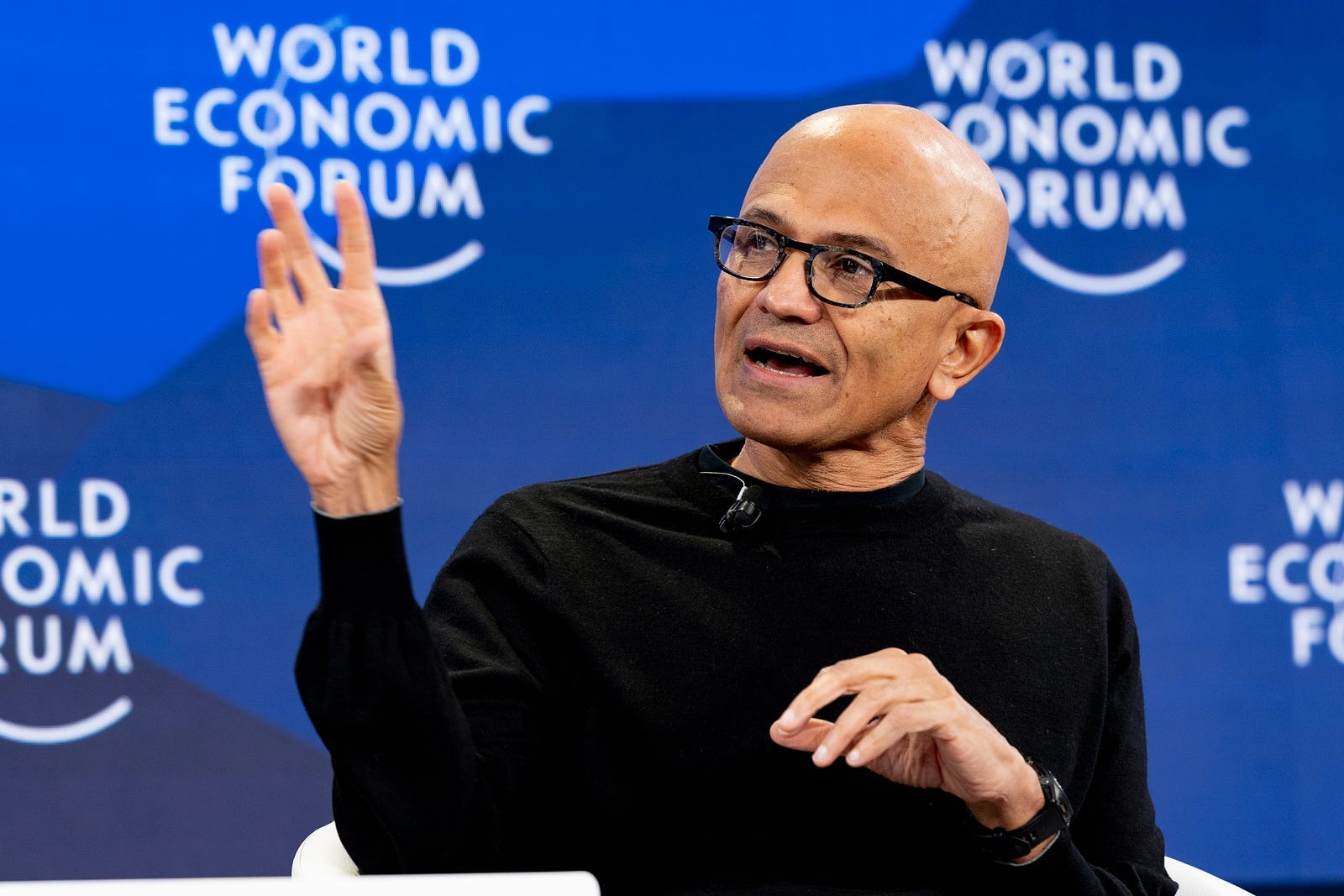
It’s that time of year again when all the richest wankers you know take their private jets to Switzerland to try to justify their insane wealth, strongarm global leaders into forgetting their voters’ demands, and implement economic policies that enable them, the new-age billionaire oligarchs, to pillage even more wealth and power from the rest of us. I am, of course, referring to the neoliberal hellhole that is the World Economic Forum. This conference is a buzzword-filled farce at the best of times, but with a deranged, demented, orange, alleged pedophile buffoon ripping up international law, and the looming multi-trillion-dollar AI bubble threatening to destroy the economy, I knew this one would be a doozy. If anything, I thought it would be fun to watch the architects of our modern societal decay squirm under the spotlight — and boy was I right! In conversation with the undisputed king of creating and profiting from devastating economic bubbles, Larry Fink, Microslop CEO Satya Nadella didn’t just functionally admit the AI bubble exists but also tried to shift the blame onto you, the consumer. I genuinely nearly wet myself laughing watching this interview; it is that pathetic, and I feel obliged to share it with you.
So, what did the man who single-handedly kick-started the AI bubble by piling a small nation’s GDP worth of capital into Sam Altman’s giant plagiarism machine have to say to the architect of the 2008 financial crisis about the state of AI? Well, he said that “for this not to be a bubble by definition, it requires that the benefits of this are much more evenly spread,” and that the “tell-tale sign of if it’s a bubble” is if only tech companies are benefiting from AI, as that means there is a significant oversupply. Nadella then went on to heavily imply this isn’t the case but still offered a solution to this apparent non-problem. He claimed that “The mindset we as [business] leaders should have is we need to think about changing the work — the workflow — with the technology.” To translate from corporate-speak, businesses across a broad range of industries, including those in less wealthy economies, need to completely restructure themselves around AI in order to generate sufficient demand. In other words, if the AI bubble pops, it is the consumer’s fault, not Big Tech’s.
Nadella said the quiet part aloud here and essentially admitted he knows the AI bubble exists. Why? Because Microsoft understands that AI has a huge supply-side problem.
The Information recently reported that Microsoft has slashed its sales targets for Copilot after struggling to find buyers, with some targets cut by up to 50%! Microsoft did push back on The Information’s reporting, claiming they conflated sales and growth quotas, but that is a bit like saying, “It isn’t horse shit on my face — it’s bull shit.” This is especially true when Microsoft’s own financials prove they aren’t making much money from AI at all. Fortunately, Microsoft isn’t a stranger to flogging products consumers have no interest in, which means they know exactly what to do in this situation: force users to integrate it and package it alongside other essential products to drive unwanted customers through the door. They have done this with Cortana, OneDrive, Teams, and more, and now they are doing it with their Copilot AI. Essential updates force Copilot on Windows 11 users, and Copilot is now bundled with every Microsoft Office subscription, which has been idiotically rebranded as 365 Copilot.
Quite simply, if there was any demand whatsoever for Copilot, they would sell it as a standalone subscription. Instead, they are shoving it down our throats. Microsoft’s actions make it painfully obvious that they know there is a chronicdemand issue. So, Nadella was effectively saying, ‘Yeah, there is a bubble, and it is f**kin’ huge!’
Now, forgive me, but as CEO, isn’t it Nadella’s responsibility to ensure there is demand before dumping billions of dollars into a product? This is why I, and many others, despise WEF. It platforms the powerful, allowing them to twist the narrative and avoid accountability. For suggesting that the total lack of demand for AI is anything other than his fault, Nadella should have been laughed off stage. It is a pathetic, thinly veiled scapegoat.
Okay, but will his solution actually work? After all, factories and entire industries had to completely restructure themselves during previous revolutions — shouldn’t we expect modern industries to do the same for the AI revolution?
Well, no. All the statistics and credible examples prove that businesses simply do not benefit from AI, no matter how they use it.
There is the now-famous MIT report, which found that 95% of AI pilots failed to deliver meaningful results. This has been backed up by a BCG report, which found that only 5% of companies that deployed AI saw value from AI, and one by Forrester Research, which found that 15% of their corporate survey correspondents reported an increase in profit margins from AI over the past year. Generally, AI is far more likely to be a drain on a company than a help.
Why? Because AI sucks! For example, one study tested ‘agentic’ AIs, including Copilot, and discovered that they flat out failed to complete even simple tasks 70% of the time, rendering them somewhere between useless and an active hindrance. Some studies have found that even newer AI models are ‘hallucinating’ at rates ranging from 33% to 79% on simple query tasks. Not to mention researchers have repeatedly found that workers using AI have to spend more time finding and fixing this constant flow of errors than the amount of time the AI actually saves them (Melbourne & METR).
Some may argue that the upcoming huge investment in AI will make it much more accurate — maybe even bordering on useful! But that isn’t true. Thanks to the efficient compute frontier and the Floridi Conjecture, AI is about as accurate as it will ever be, and chucking trillions of dollars at it isn’t going to change that fact (read more here).
AI doesn’t improve productivity, quality, or efficiency for the individual building blocks of business (i.e., a single worker). So, it doesn’t matter how a business structures itself around AI or adjusts its “workflow” with AI; it isn’t going to change anything. You can stack up turds in any order you like — at the end of the day, you are still going to have a giant pile of turds! Or, to put it in language Nadella would understand, if it doesn’t work on the micro scale of a worker, how can we expect it to work on the macro scale of a business or the mega scale of an industry?
So, what Nadella is actually saying is that entire industries need to shoot themselves in the foot so that his multi-billion dollar idiotic gamble will pay off.
Which I doubt will happen, because the entire economy is U-turning on AI.
One study found that in 2025, 42% of corporate AI programs were cancelled, which is a significant increase from the 17% cancelled in 2024. A recent analysis found that AI adoption rates in large companies fell from 14% at the beginning of 2025 to 12% by the end of 2025. Together, these factors mean that the total number of companies using AI should be falling, which is exactly what is happening. The Economist recently reported that back in March 2025, 74.1% of companies with 100 to 249 employees said they did not use AI, but that figure increased to 81.4% by November 2025. For large companies of over 250 employees, that figure was at 68.6% in November 2025, up from 62.4% in February 2025. Forrester Research analysed responses and predicted that in 2026, companies will delay about 25% of their planned AI spending by a year, suggesting that this usage rate is set to fall even further. In other words, the whole economy has been burned by AI and is slowly moving away from it.
So, not only would Nadella’s solution not work, but the economy itself is already going in the complete opposite direction.
Oh, and also, this all demonstrates that the only measurable benefit of AI is the stock price of the tech companies within the AI bubble. If you remember, Nadella stated that if only tech companies are benefiting from AI, then it constitutes a bubble. So Nadella actually admitted the bubble existed twice in this one interview!
Nadella and all the other tech bros know this charade is coming to an end very soon. The AI industry needs to generate an additional $2 trillion in annual revenue by 2030 just to break even on its current committed investments. That simply isn’t going to happen, and they know it. They recognise that this is a bubble that is going to pop and that they will be rightly blamed when it does. So, watching Nadella Freudian-slip his way to admitting the giant bubble exists and then openly laying the blame on others is so pitiful, slimy, spineless and despicable that I couldn’t help but point and laugh. In my opinion, these morons deserve all the mockery headed their way.
Thanks for reading! Everything expressed in this article is my opinion, and should not be taken as financial advice or accusations. Don’t forget to check out my YouTubechannel for more from me, or Subscribe. Oh, and don’t forget to hit the share button below to get the word out!
Sources: FT, PC Gamer, Fortune, Futurism, Bain, Will Lockett, Will Lockett, Will Lockett, Will Lockett, Will Lockett
And I just read that the AI titans are going to form Super PACs to donate millions to their elected supporters. And our electeds are so open to lobbyists...