
Blue Origin Might Make Starship Obsolete
No, really, they might!

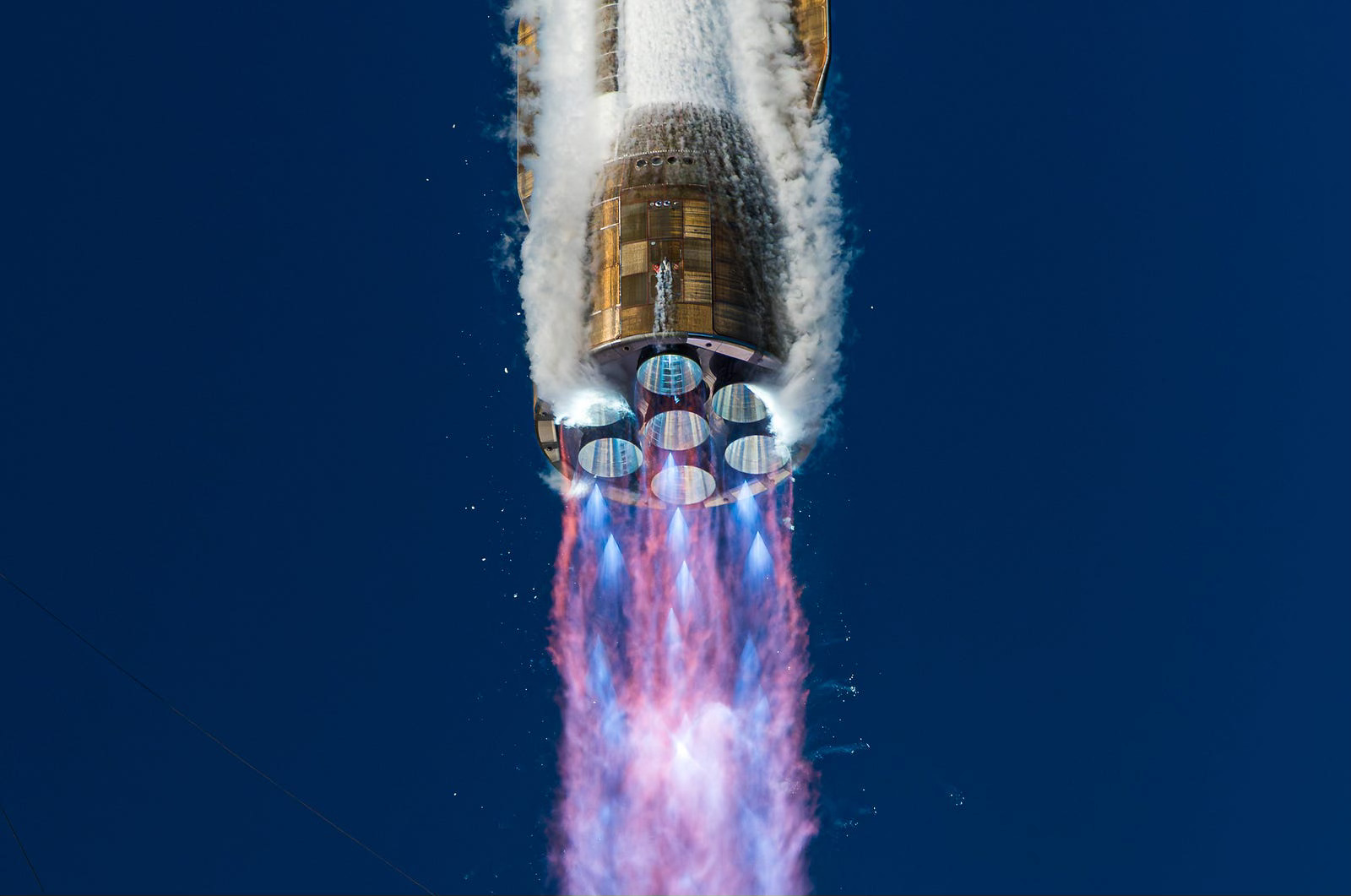
After the roaring success of Blue Origin’s second New Glenn flight, which not only reached orbit and recovered its booster but also launched two probes to Mars (take note, SpaceX, this is how you design a rocket!), they are taking things up a notch with the New Glenn 9x4. This is a recently announced “super heavy” variant of the New Glenn, and its silly name comes from its engine configuration, as its booster has nine rocket engines, and its upper stage has four. This is a sizeable upgrade over the standard New Glenn, whose booster has seven engines, and its upper stage has two. However, this upgrade is a much bigger deal than you might think, as it is set to make SpaceX’s infamous Starship completely obsolete. Let me explain.
New Glenn
I have already covered the standard New Glenn rocket (read more here), and it is damn impressive. Like a Falcon 9, it is partially reusable, with the booster landing back on Earth. It can take 45 tons to Low Earth Orbit (LEO), 13 tons to Geosynchronous Transfer Orbit (GTO), which is five tons more than SpaceX’s Falcon Heavy, and seven tons to Tran Lunar Injection (TLI, equivalent to payload to the lunar surface). While launch costs for New Glenn are not publicly known, they have been estimated at between $55 million and $68 million, which is about $30 million cheaper than a Falcon Heavy launch (with all three boosters recovered).
But New Glenn can dramatically increase its payload to the Moon using a tug vessel Lockheed Martin is developing. The idea is that one New Glenn launches the payload, while the other launches the tug vessel; they then dock in orbit and use the tug vessel’s power to head towards the Moon. Such docking and tug technology already exists and is well proven. Using this setup, Blue Origin plans to land its 16-ton Blue Moon MK2 on the lunar surface by 2029.
If we assume the tug vessel costs around $20 million (which is a similar cost to other proposed tug missions), that means the standard New Glenn costs around $130 million (given that it requires two launches and a tug vessel) to get 16 tons to the lunar surface, or $8,125 per kg to the lunar surface. That is pretty damn cheap!
The 9x4 is almost exactly the same thing, just on steroids. It can take a massive 70 tons to LEO, the same as a Falcon Heavy, and 14 tons to GTO, which is 75% more than a Falcon Heavy. Using this tug vessel setup, it can carry a whopping 20 tons to the lunar surface! As for launch costs, we don’t exactly know yet, but considering the estimated costs of the standard New Glenn, it will likely be around $100 million.
That means a 9x4 can take 20 tons to the lunar surface for around $220 million (given that it would be $100 million per flight, plus $20 million for the tug vessel), for a cost of $11,000 per kg to the lunar surface. That is more than the standard variant, but the added payload can enable much more complex missions.
Compared to Starship
Okay, so how much does Starship cost per kg to the lunar surface?
A lot more than you might think.
Let’s use Starship’s proven figures, as Musk’s projections and SpaceX’s plans for Starship development are wildly unrealistic, to say the least (read more here).
Well, the outgoing V2 Starship only ever took 16 tons on suborbital flights, but SpaceX claims it can take 35 tons to LEO. Let’s give them the benefit of the doubt and believe that claim.
To reach the lunar surface, Starship needs to be fully refuelled in LEO by other Starships. However, the V2 upper stage requires a gargantuan 1,500 tons of propellant, and its pathetic payload means refilling these tanks will take 42 refuelling missions! At Starship’s current launch rate of five per year, that would take nearly nine years!
How much would all of that cost? Well, again, Musk’s launch cost predictions are pure fantasy. My very optimistic back-of-the-envelope prediction is $70 million per launch for a fully reusable Starship (based on analysis from this article, combined with more realistic repair and lifespan costs). Now, I personally don’t believe Starship can even reach this operational level, but again, let’s be very generous and assume they can.
This means that for Starship to land 35 tons on the lunar surface, it will cost $3 billion and take nearly nine years to get there! That is the equivalent of a price of $85,700 per kg to the lunar surface, or 7.7 times more expensive per kg than the 9x4 New Glenn, and over ten times the cost per kg of the standard New Glenn!
Okay, but what about the upcoming Starship V3? It is supposed to be far better, and therefore it will be cheaper. Well, personally, I don’t think it will work, let alone reach Musk’s proclaimed 100-ton payload to LEO goal (read more here). But, once again, let’s be generous.
Musk claims the V3 has a fully reusable payload to LEO of 100 tons, and we know the upper stage has a propellant capacity of 1,600 tons, meaning it will need 16 refuelling missions. At the current launch rate, that will take an unacceptable 3.2 years to complete. At our estimated $70 million per launch, these 17 launches (including the mission and refuelling) will cost $1.19 billion to get 100 tons to the lunar surface, or $11,900 per kg to the lunar surface.
So, it is a far less convenient and far more risky launch system than the New Glenn, and it is also more expensive than both versions of the New Glenn. And that is if SpaceX can deliver on Musk’s predictions, which are so optimistic that they are practically mythic.
Risk Factor & Practicality
But when it comes to complex outer-orbit or inter-celestial missions, price isn’t everything. Mission safety, reliability and scope are all huge considerations. And both versions of the New Glenn destroy Starship when considering these factors!
For one, while in orbit awaiting refuelling, the cryogenic fuel inside Starship will boil off as it is heated by the Sun. We don’t know the rate at which this will happen, but it is likely to be considerable. As such, the number of refuelling missions is likely higher than I have estimated. Not only that, but this also means that delays in refuelling, which are likely due to a plethora of reasons, could severely delay the mission. That hugely reduces Starship’s reliability. If the boil-off problem is severe, the Starship might never be able to refuel in orbit, as the rate of propellant loss could be larger than the rate at which it is being refuelled. Needless to say, if this is the case, it will render the mission a failure.
Because New Glenn and New Glenn 9x4 don’t rely on orbit refuelling and instead use proven docking and tug technology, they are significantly more reliable systems. Moreover, Blue Origin is set to have two launch pads capable of launching New Glenn, meaning they can launch a lunar payload and tug vessel concurrently and cancel both launches if one is scrubbed. In other words, even though they rely on multiple launches, there is a negligible chance that this will reduce the system’s reliability.
Then there is the explosion risk. Starships have exploded while being refuelled on Earth, and cryogenic refuelling in orbit is exponentially more complex and dangerous. As such, the risk of a Starship mission exploding in orbit during refuelling concerns many experts. I estimated that the current likelihood of a Starship exploding while being refuelled on Earth is around 5%. If we optimistically assume the same for orbital refuelling, then the V2 Starship has an 88.5% chance that one of the 42 refuelling missions will cause a mission-ending explosion, destroying the lunar-bound Starship. The hypothetical V3 has an improved 54% chance of such a failure due to its reduced number of refuelling missions; however, that still means that it has a greater chance of exploding in LEO than actually getting to its destination.
Again, because New Glenn and New Glenn 9x4 have no refuelling or dangerous manoeuvres, they have no such risks. This makes their mission risk and safety so much better than Starship’s that it is almost funny. That extra risk is not worth the 15 extra tons of payload to the lunar surface that Starship can optimistically deliver over New Glenn 9x4.
But if you want to talk about payload, arguably, New Glenn is significantly better than Starship.
A Starship V2 can theoretically take 35 tons to the lunar surface from 43 launches. New Glenn 9x4 can take 420 tons to the lunar surface from 42 launches (20 tons over 21 missions).
If we believe Musk’s nonsense, then a Starship V3 can theoretically take 100 tons to the lunar surface over launches. A New Glenn 9x4 can take 160 tons over 16 launches (20 tons over eight missions).
In other words, the New Glenn 9x4 can take 12 times more payload to the lunar surface per launch than Starship can realistically deliver. Even if we believe Musk’s bullshit, it can still take 60% more payload to the lunar surface per launch than Starship!
So, if you want to transport the most payload to a different celestial body, whether it’s the Moon or Mars, as quickly as possible, New Glenn is a far superior vehicle to Starship.
No matter how you spin it, New Glenn and its new big brother, the New Glenn 9x4, are quicker, more efficient, less dangerous and less expensive than Starship in terms of space exploration. Not only that, but they will likely be ready many years before Starship. New Glenn is set to deliver its first lunar lander in just four years. Meanwhile, SpaceX hasn’t even started testing full reusability or in-orbit refuelling, and even if it launched a lunar mission today, it would likely reach the Moon after New Glenn. We don’t have an official launch date for the 9x4 yet, but considering Blue Origin’s pace and how close it is to the standard New Glenn, we will probably see it launch this side of 2030. When you look at Starship’s painfully slow development, it will likely not even enter commercial service by then.
Now, am I happy that one out-of-touch billionaire has been outdone by another here? No. Space exploration should be a collective effort, not a new military-industrial complex. That being said, I am glad that the divorce crisis billionaire is undermining the Nazi-saluting billionaire. It is still evil, but a lesser one.
Thanks for reading! Don’t forget to check out my YouTube channel for more from me, or Subscribe. Oh, and don’t forget to hit the share button below to get the word out!
Sources: Space.com, Blue Origin, Will Lockett, Will Lockett, Will Lockett, Will Lockett, Will Lockett, Will Lockett
Always glad to see Musk debunked, but sending humans to the moon,or Mars, or into space at all, is an idea whose time has passed. The 1969 moon landing which was the culmination of the Apollo program coincided almost perfectly with the launch of the first space telescopes.
https://en.wikipedia.org/wiki/Orbiting_Astronomical_Observatory
Now, thanks to Hubble, Webb etc, we can detect planets thousands of light years away, and light from the beginnings of the universe. Putting some people on the moon and keeping them alive for a few years won't tell us anything or lead anywhere. It's a challenge, like rowing around the world single-handed, but that's about all.
I always wonder what companies like Tesla and Space X could have done had Elon not taken over?
I mean, Blue Origin seems to have a higher quality of engineers or at least their engineers aren't being overseen by a micromanager who promises things he can't deliver.